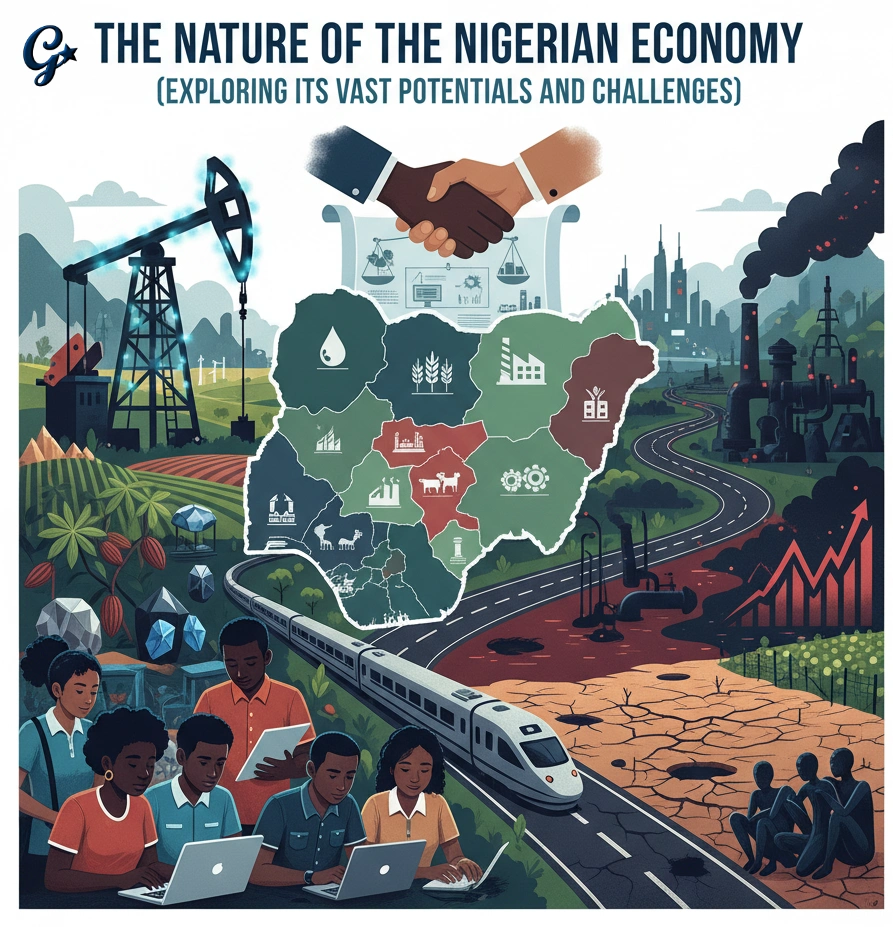
The Nigerian economy is one of the largest in Africa, richly endowed with both human and natural resources. It operates as a mixed economy, meaning that both the government and private individuals play important roles in the production and distribution of goods and services.
The country’s economy is largely dependent on the oil and gas sector, which accounts for a significant portion of government revenue and foreign exchange earnings. However, agriculture remains a major employer of labor, providing livelihoods for millions of Nigerians, especially in rural areas.
Despite its vast resources, the economy continues to face challenges such as unemployment, inflation, and poor infrastructure.
Nigeria’s economic structure is divided into three main sectors: primary, secondary, and tertiary. The primary sector includes agriculture, mining, and fishing, which supply raw materials for industries.
The secondary sector focuses on manufacturing and construction, transforming raw materials into finished products.
The tertiary sector deals with services such as banking, education, health care, and transportation. While the service sector is growing rapidly, the manufacturing sector remains underdeveloped due to problems such as power shortages, lack of capital, and inadequate technology.
This imbalance limits industrial growth and economic diversification.
Another key feature of the Nigerian economy is its regional imbalance. Economic activities are not evenly distributed across the six geo-political zones. For example, oil production is concentrated in the South-South region, while agriculture dominates in the northern regions.
The South-West is known for its commercial and industrial activities, while the South-East focuses on trade and manufacturing. This uneven distribution of resources has led to economic inequalities and varying levels of development among different regions. Addressing these disparities is crucial for achieving balanced national growth.
The Nigerian economy has experienced various phases of growth and decline since independence in 1960. The oil boom of the 1970s brought massive revenue, but overdependence on oil led to neglect of other productive sectors like agriculture and manufacturing.
Over time, external shocks such as falling oil prices and global recessions have exposed the weaknesses of the economy. In recent years, the government has introduced policies such as economic diversification, promotion of non-oil exports, and investment in digital technology to strengthen other sectors.
These efforts aim to reduce reliance on oil and create a more stable and inclusive economy.
Table of Contents
Economic Potentials of the Nigerian Economy
Economic potential means the ability or capacity of a country to grow and develop its economy. Nigeria’s Economic Potentials Include:
- Natural Resources: Nigeria has vast natural resources that give it strong economic potential. The country is richly endowed with crude oil, natural gas, coal, tin, limestone, gold, and several other minerals. Crude oil, which is found mainly in the Niger Delta region, remains Nigeria’s main source of foreign exchange and government revenue. Apart from oil, solid minerals are found across various states but are still largely untapped. If these resources are properly managed and developed, Nigeria could significantly increase its industrial base and export earnings.
- Agricultural Land: Another major potential of the Nigerian economy lies in its agricultural resources. The country has fertile land and a favorable climate suitable for growing many crops such as yam, cassava, rice, maize, cocoa, palm produce, and groundnut. Agriculture has the capacity to provide employment for millions of people and ensure food security. With modern farming methods and proper investment in irrigation, mechanization, and storage facilities, Nigeria can become self-sufficient in food production and even export to other countries. Reviving the agricultural sector will also reduce dependence on imported food items.
- Human Resources: Nigeria’s human resources form another area of great potential. With a population of over 200 million people, Nigeria has one of the largest labor forces in Africa. The population is mostly young and energetic, which can be an advantage if properly educated and trained. A skilled and productive workforce can drive innovation, entrepreneurship, and industrial growth. However, this potential can only be realized through quality education, vocational training, and job creation policies that engage the youth meaningfully.
- Industrial Opportunities: In addition to human resources, Nigeria has great potential in industrial and manufacturing development. The country has a large domestic market that can support local industries producing consumer goods, building materials, and machinery. Nigeria’s access to raw materials and its position as a regional trade center make it attractive for industrial investment. Encouraging local production, improving power supply, and providing incentives for investors can transform Nigeria into a major industrial hub in Africa. Developing small and medium enterprises (SMEs) can also enhance productivity and create employment.
- Tourism Potential: In addition to human resources, Nigeria has great potential in industrial and manufacturing development. The country has a large domestic market that can support local industries producing consumer goods, building materials, and machinery. Nigeria’s access to raw materials and its position as a regional trade center make it attractive for industrial investment. Encouraging local production, improving power supply, and providing incentives for investors can transform Nigeria into a major industrial hub in Africa. Developing small and medium enterprises (SMEs) can also enhance productivity and create employment.
- Strategic Location: Nigeria’s strategic geographic location provides economic opportunities. Situated in West Africa, Nigeria shares borders with several countries, making it a gateway for regional trade. Its coastal ports offer easy access to international markets, while its membership in regional bodies like ECOWAS creates opportunities for free trade and cooperation. By improving transportation networks and promoting export-oriented industries, Nigeria can become a leading trade and logistics center in Africa. This strategic position can help the country attract foreign investment and strengthen its global economic relevance.
Economic Activities of the Six Geo-political Zones of Nigeria
Nigeria is divided into six geo-political zones, each with unique economic activities based on natural endowments and climate.
- North-West Zone: The North-West zone is made up of states such as Kano, Kaduna, Katsina, Zamfara, Kebbi, Sokoto, and Jigawa. The main economic activity in this zone is agriculture, as the region has vast fertile land suitable for growing crops like groundnut, millet, sorghum, maize, and cotton. Many people are also involved in livestock rearing, including cattle, sheep, and goats. Trading is another major activity, especially in cities like Kano and Kaduna, which are known for their large markets and commercial centers. The zone also has industries such as textile production, leather processing, and food processing. Artisan work like blacksmithing, tanning, and tailoring are common sources of income. Overall, the North-West is an agricultural and commercial hub in northern Nigeria.
- North-East Zone: The North-East zone includes states like Borno, Bauchi, Gombe, Yobe, Taraba, and Adamawa. The people of this zone are mainly engaged in farming and cattle rearing, taking advantage of the wide open grasslands and savannah vegetation. Major crops grown include millet, maize, beans, and groundnut. Fishing is also a major occupation in areas around Lake Chad and the River Benue. The zone is rich in solid minerals such as gypsum, limestone, and kaolin, which provide opportunities for mining activities. Local crafts and trading are common in rural and urban areas. Despite its economic potential, insecurity and poor infrastructure have limited full economic development in the region.
- North-Central Zone: The North-Central zone, often called the Middle Belt, includes states like Benue, Kogi, Kwara, Niger, Plateau, Nasarawa, and the Federal Capital Territory (Abuja). It is often referred to as the “food basket of the nation” because of its high agricultural output. Farmers produce crops like yam, cassava, rice, maize, and guinea corn. The zone also has rich deposits of minerals such as tin, limestone, and iron ore, leading to mining and quarrying activities. Cattle rearing and fishing are also practiced, especially along river areas. Some parts of the zone are developing industries for food processing, cement production, and beverage manufacturing. In addition, the presence of Abuja makes the zone a center for administration, construction, and service-based jobs.
- South-West Zone: The South-West zone consists of Lagos, Ogun, Oyo, Osun, Ondo, and Ekiti States. It is one of the most economically advanced regions in Nigeria. The people engage in farming, producing crops such as cocoa, rubber, oil palm, and cassava. Lagos serves as the commercial and industrial center of Nigeria, hosting seaports, manufacturing industries, banks, and service companies. The zone has a well-developed transport network, which supports trade and business. Education and tourism also contribute to the economy, with many higher institutions and historical sites like Olumo Rock and the Osun-Osogbo Sacred Grove. Overall, the South-West combines agriculture, industry, and services to drive regional development.
- South-East Zone: The South-East zone includes Abia, Anambra, Ebonyi, Enugu, and Imo States. The main economic activities here are trading, small-scale manufacturing, and agriculture. Farmers grow crops such as yam, cassava, maize, and palm produce. The zone is known for its entrepreneurial spirit, with many people involved in commerce, especially in cities like Onitsha, Aba, and Nnewi. Oil exploration and mining also take place in parts of Abia and Imo States, while Enugu has deposits of coal and limestone. The region has several cottage industries, producing goods like garments, auto parts, shoes, and building materials. The South-East’s strong business culture makes it one of Nigeria’s most economically vibrant zones.
- South-South Zone: The South-South zone, also called the Niger Delta region, is made up of Rivers, Delta, Bayelsa, Akwa Ibom, Cross River, and Edo States. The major economic activity here is oil and gas exploration, as the zone contains most of Nigeria’s petroleum resources. This makes it the main source of national revenue and foreign exchange. In addition to oil, the people engage in fishing, farming, and trading. Crops such as cassava, yam, and plantain are cultivated in the fertile riverine areas. The zone also has timber, rubber, and palm oil industries, and ports that support shipping and export trade. Tourism, through attractions like Obudu Cattle Ranch and beaches, adds to its growing economy. Despite its wealth, environmental pollution from oil spills remains a challenge.
Summary
- The Nigerian economy is a mixed economy that depends largely on oil but still relies on agriculture and services.
- Nigeria has abundant natural, human, and agricultural resources that can drive economic growth.
- Each of the six geo-political zones in Nigeria engages in distinct economic activities suited to its environment.