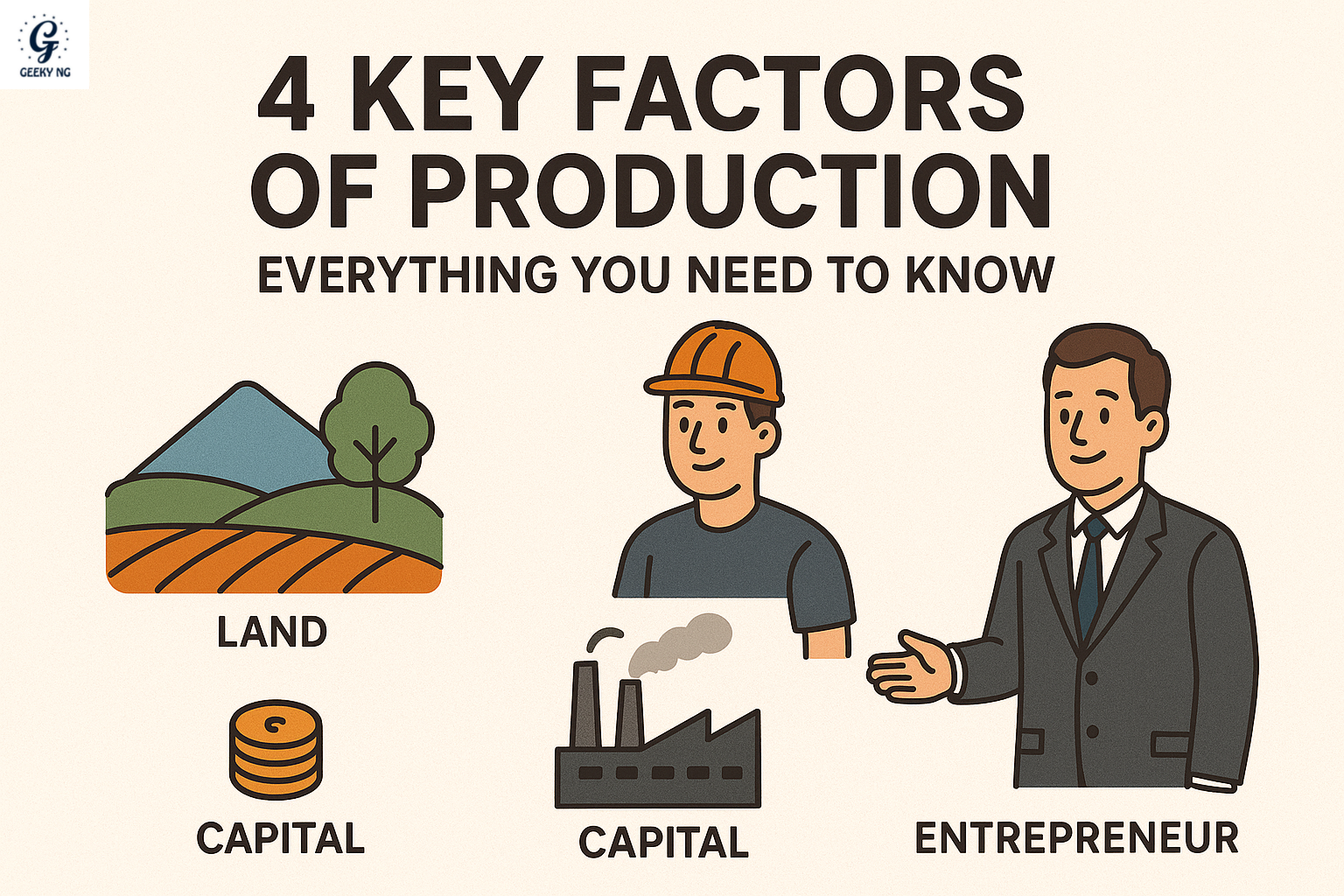
As the business and entrepreneurial industry evolves, the factors of production, though largely static share interesting dynamics.
In today’s world, applied knowledge is important for business owners especially for those with interest in agriculture and infrastructural development.
A good knowledge and understanding of the essential elements that make production possible will go a long way. Without these elements, the various forms of production may not take place.
Table of Contents
Factors of Production
Here are four main factors of production:
Land
Land refers to all natural resources that are used in the process of production. It includes not only the physical surface of the earth but also everything found in and on it that are not man-made. This includes the soil, forests, rivers, minerals, sunlight and natural gases.
Land is a basic and essential factor of production. It provides the space and raw materials needed for agricultural, industrial and construction activities.
Characteristics of Land
- Land is a Gift of Nature: Land isn’t man-made, thus rightly called a free gift of nature, making it unique among the factors of production.
- Land is Fixed in Supply: The total quantity of land available to a country is limited and cannot be increased by human effort.
- Land is Immobile: While its ownership or usage rights can be transferred, the physical land itself remains fixed in one place.
Why Land is Important
- Source of Food and Raw Materials: Land provides the food we eat every day. Crops like rice, yam, maize, and vegetables all grow on land. Apart from food, land also supplies raw materials such as cotton for textiles, timber for furniture, and minerals like crude oil and gold that are used in various industries.
- Basis for Agriculture and Industries: Almost every agricultural activity depends on land. Farmers need land to plant crops and rear animals. Likewise, many industries rely on land either directly for raw materials or as a physical space to build their factories and warehouses.
- Supports Housing and Infrastructure: Land provides the space on which houses, schools, hospitals, roads, and other buildings are constructed. Every form of human settlement or infrastructure development takes place on land.
Labour
Labour refers to all human efforts, both physical and mental, that are used in the production of goods and services. It includes the work done by people in various roles, from farmers and factory workers to teachers, engineers, and doctors.
Unlike land or capital, labour is provided by human beings who think, feel, and need motivation.
Types of Labour
Labour can be classified into three main types: skilled, semi-skilled, and unskilled labour.
- Skilled labour refers to workers who have special training, education, or expertise that allows them to perform complex tasks. These workers often have formal education or have undergone vocational training.
Examples include doctors, engineers, teachers, and accountants.
- Semi-skilled labour includes workers who have some training and experience but do not have the full qualifications of skilled workers. They usually operate machines or equipment and follow set procedures.
Examples of semi-skilled workers are drivers, welders, machine operators, and factory workers.
- Unskilled labour involves workers who do not need formal training or special skills to do their job. These workers often perform simple, manual tasks such as cleaning, digging, or carrying loads.
Examples include cleaners, labourers at construction sites, and messengers.
Characteristics of Labour
- Labour is Human: Without human involvement, other factors of production like capital or land cannot be used effectively.
- Labour is Mobile: This ability to move makes labour flexible and able to respond to changes in job opportunities or working conditions.
- Labour Cannot Be Stored: Labour is different from goods or capital because it cannot be stored for future use. Time once lost is gone, so labour must be used when available, or the opportunity is wasted.
Importance of Labour
- Drives Production: Whether it is a farmer planting crops or a teacher giving lessons, it is the work done by humans that turns raw materials into useful goods and services.
- Operates Machines and Tools: Despite the automation in Factories and industries today, people are still required to run these machines.
- Provides Services: Apart from producing goods, labour is also essential for providing services such as teaching, healthcare, transportation, and security.
- Contributes to National Development: The more goods and services are produced, and the government earns more income through taxes. This helps the country build schools, hospitals, and roads, which improves the standard of living for everyone.
Capital
Capital refers to all man-made resources that are used in the production of goods and services. Unlike land, which is a natural resource, capital is created by humans to aid the production process.
It includes items such as machinery, tools, equipment, buildings, and money that help in producing other goods.
It is essential in enhancing efficiency, saving time, and boosting output in both small and large-scale production.
Types of Capital
Fixed Capital: Fixed capital refers to long-lasting man-made resources used in the production of goods and services. These are assets that do not change hands quickly and are not used up in one production cycle.
Examples of fixed capital include machinery, tools, buildings, and vehicles used in factories or offices.
Working Capital: Working capital consists of the resources that are used up during the daily running of a business. These include raw materials, money for day-to-day expenses, and other items that are quickly consumed or changed in the production process.
For example, a bakery needs flour, sugar, and cash to pay workers and buy ingredients—these are all part of working capital.
Social Capital: Social capital includes public facilities and infrastructure provided by the government or society that help support production activities. These are not owned by a single business but benefit many people and companies.
Examples of social capital include roads, bridges, power supply, schools, and hospitals.
Characteristics of Capital
- Capital is Man-Made: Capital is not provided by nature like land; it is created by human effort.
- Capital Can Be Accumulated: This ability to accumulate capital helps businesses grow and increase their production capacity.
- Capital Requires Maintenance: To remain useful and productive, capital goods must be maintained regularly.
- Capital Can Depreciate: Over time, capital goods lose their value due to wear and tear, usage, or becoming outdated. This reduction in value is called depreciation.
Importance of Capital
- Increases Efficiency and Enhances Production: Capital helps to increase the efficiency of production. When workers use machines, tools, and equipment, they can produce more goods in less time.
- Reduces Human Effort: Machines and equipment provided by capital often reduce the need for physical labour.
- Supports Other Factors of Production: Capital plays a supporting role to land, labour, and entrepreneurship.
The Entrepreneur
An entrepreneur is a person who brings together all the other factors of production—land, labour, and capital—to start and manage a business.
The entrepreneur takes the initiative to organize resources, make important decisions, and bear the risks involved in the production process.
They are often innovative, identifying business opportunities and creating goods or services to meet consumers’ needs.
Importance of an Entrepreneur
Brings Ideas into Reality: The entrepreneur plays a vital role in transforming business ideas into actual products or services.
Creates Employment: Entrepreneurs help reduce unemployment by establishing new businesses and creating job opportunities for others. As their businesses grow, they hire people to handle various roles such as production, marketing, administration, and customer service. This leads to income generation and improved living standards within the community.
Coordinates Production: An entrepreneur acts as the coordinator of all other factors of production—land, labour, and capital. Without the entrepreneur, the resources would remain idle and unproductive.
Takes Business Risks: Entrepreneurs take financial and operational risks in starting and running a business. These risks may involve investing capital, facing uncertain market conditions, or dealing with competition.
By taking these risks, entrepreneurs help drive economic activity and encourage innovation, even though there is no guarantee of success.
Summary
- Land refers to all natural resources, and it is essential as the foundation for farming, mining, and construction.
- Labour is the human effort (skilled, semi-skilled, and unskilled), both mental and physical, used in the production process.
- Capital includes man-made tools and equipment used to produce goods and services.
- The entrepreneur organizes other factors, makes decisions, and takes business risks.
Read more: Unleashing Success: The Personal Qualities Of An Entrepreneur