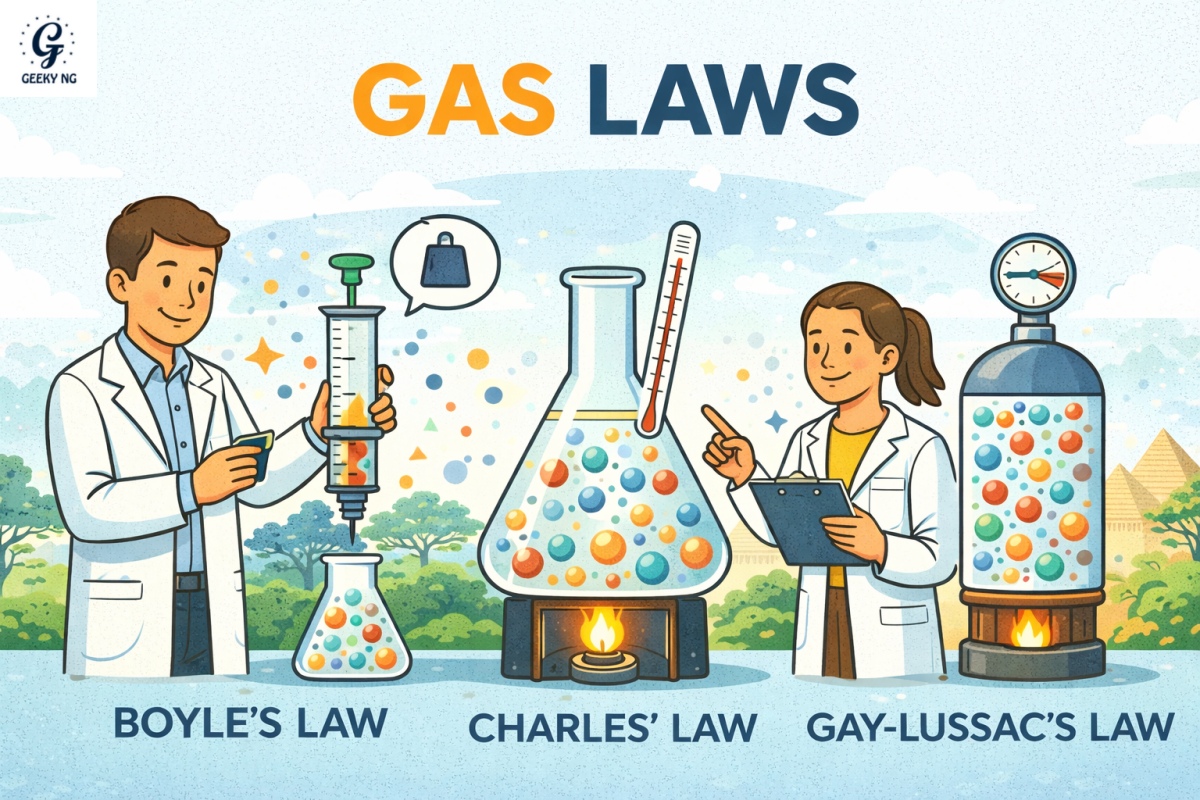
Gas laws are theories propounded by certain scientists and its development dates back to the 1600s.
In this post, you’ll get to see these laws and its formulae but first, let’s look at the history of gas laws.
Table of Contents
History of Gas Laws
The journey of understanding gases started as far back as the 1600s when scientists noticed that gases behave quite differently from solids and liquids. In 1662, Robert Boyle discovered that when the pressure on a gas increases, its volume decreases — an inverse relationship.
Years later in 1787, Jacques Charles explored how temperature affects gas volume. Then came Joseph Louis Gay-Lussac, who studied how gas pressure changes with temperature.
These three discoveries laid the foundation for the major gas laws we still apply in Chemistry today. Over time, other scientists built on their work, combining the individual laws into the Combined Gas Law, and eventually the Ideal Gas Law, which gives a broader picture.
However, before we dive into each law, it’s important to know the key factors that affect gas behaviour:
Factors Affecting Gas Behaviour
- Pressure (P): The force gas particles exert on the walls of their container (measured in atm, mmHg, or Pa).
- Volume (V): The amount of space a gas occupies, usually measured in litres or cm³
- Temperature (T): How hot or cold the gas is, always in Kelvin when calculating.
Gas Laws
1. Boyle’s Law – Pressure and Volume
Boyle’s Law states that at constant temperature, the volume of a gas is inversely proportional to its pressure.
Formula:
P₁V₁ = P₂V₂
In simple terms, if you compress a gas (increase pressure), it occupies less space. Reduce the pressure, and gas expands.
Real-life example: When inflating a tire, the air is compressed, increasing the pressure and reducing the free space inside.
2. Charles’ Law – Volume and Temperature
Charles’ Law explains that at constant pressure, the volume of a gas increases as its temperature increases.
Formula:
V₁ / T₁ = V₂ / T₂
As gases get warmer, their particles move faster and spread out more, which increases volume.
Remember: Always convert Celsius to Kelvin by adding 273.
Example: Hot air balloons rise because heating the air inside causes it to expand — that’s Charles’ Law at work.
3. Gay-Lussac’s Law – Pressure and Temperature
This law states that at constant volume, the pressure of a gas increases with temperature.
Formula:
P₁ / T₁ = P₂ / T₂
When a gas is heated in a sealed container, its particles move faster and hit the container walls more forcefully, causing a rise in pressure.
Example: Spray cans can burst if left in the sun. This is because the heat raises the pressure inside.
4. Combined Gas Law
When pressure, volume, and temperature all vary, we use the Combined Gas Law.
Formula:
(P₁V₁) / T₁ = (P₂V₂) / T₂
This law brings together Boyle’s, Charles’, and Gay-Lussac’s laws into one equation for situations where multiple changes happen at once.
5. Ideal Gas Law
The Ideal Gas Law takes things a step further by also including the number of gas particles, or moles.
Formula:
PV = nRT
Where:
- P = pressure (atm)
- V = volume (litres)
- n = number of moles
- R = gas constant (0.0821 L·atm/mol·K)
- T = temperature (Kelvin)
This equation helps us calculate any unknown variable when the rest are known.
Practical Examples for Each Law
1. Boyle’s Law – Pressure vs Volume
A gas with a volume of 500 cm³ at 1.2 atm is compressed to 2.0 atm. What’s the new volume?
P₁V₁ = P₂V₂
1.2 × 500 = 2.0 × V₂
600 = 2V₂
V₂ = 300 cm³
2. Charles’ Law – Volume vs Temperature
Gas occupies 4.0 L at 27°C. What will it be at 127°C?
Convert to Kelvin:
T₁ = 300 K, T₂ = 400 K
4.0 / 300 = V₂ / 400
V₂ = (4.0 × 400) / 300 = 5.33 L
3. Gay-Lussac’s Law – Pressure vs Temperature
Gas pressure is 1.5 atm at 20°C. What’s the pressure at 80°C?
T₁ = 293 K, T₂ = 353 K
1.5 / 293 = P₂ / 353
P₂ = (1.5 × 353) / 293 = 1.81 atm
4. Combined Gas Law
Gas: 3.0 L at 1.0 atm, 27°C → New condition: 2.0 atm, 77°C
T₁ = 300 K, T₂ = 350 K
(1.0 × 3.0) / 300 = (2.0 × V₂) / 350
V₂ = 1.75 L
5. Ideal Gas Law – Step-by-Step
Find the volume for 3.5 mol of gas at 2.0 atm and 27°C.
T = 300 K
V = (3.5 × 0.0821 × 300) / 2.0 = 43.10 L
Quick Summary of the Laws
| Law | What Changes | What Stays Constant |
| Boyle’s Law | P ↑ → V ↓ | Temperature |
| Charles’ Law | T ↑ → V ↑ | Pressure |
| Gay-Lussac’s Law | T ↑ → P ↑ | Volume |
| Combined Gas Law | All variables change | None |
| Ideal Gas Law | Uses P, V, n, R, T | Universal equation |
Common Mistakes to Avoid in Calculating Gas Laws
- Using Celsius instead of Kelvin
- Mixing volume units like litres and cm³
- Forgetting which variable must remain constant in each law
Practice Questions
- A gas has a volume of 400 cm³ at 2 atm. What volume will it have at 1 atm (constant temperature)?
- A balloon has a volume of 1.2 L at 27°C. What is its new volume at 77°C?
- If 2 moles of gas occupy 10 L at 300 K, find the pressure using PV = nRT.
Conclusion
Gas laws help us understand how gases behave in everyday life from inflating tires to the way a balloon rises. Whether you’re dealing with a simple experiment or industrial processes, these laws give us the formulas to explain and predict gas behaviour with accuracy.
Read more: Girl Meets Biochemistry: Interview With Haleemah Hamzah (Part 1)