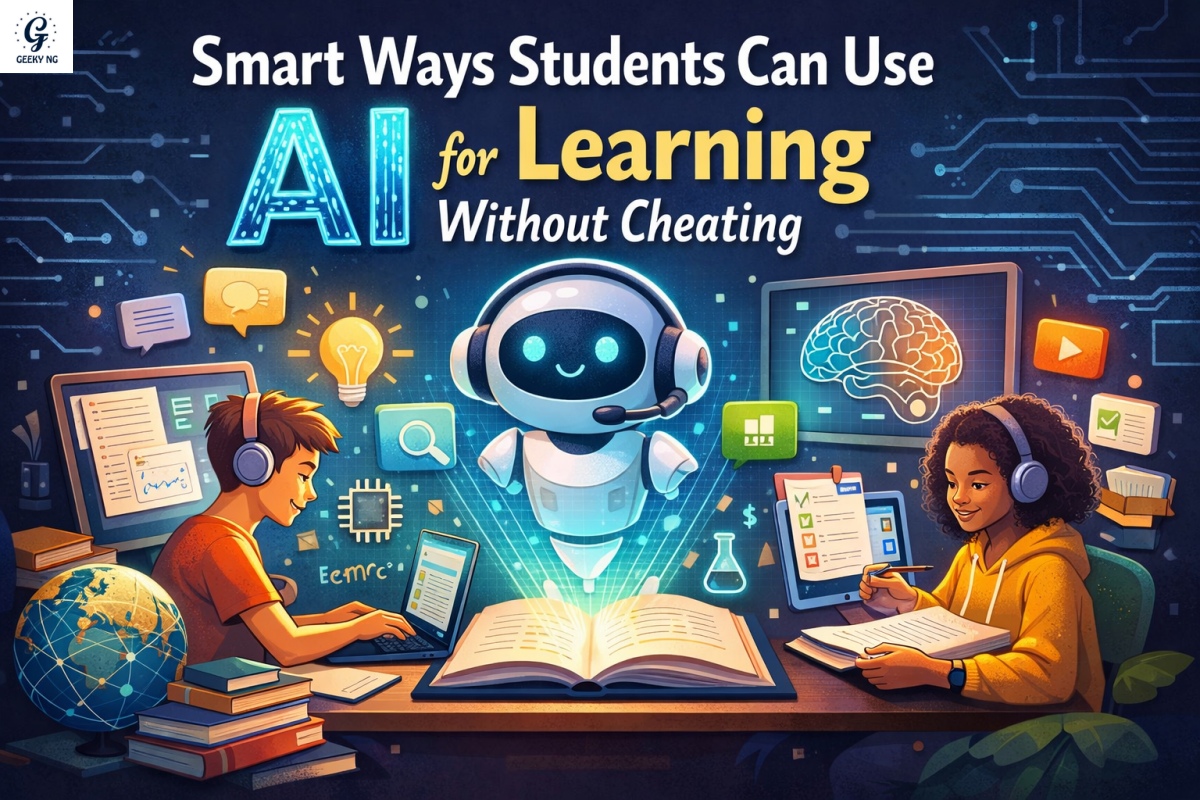
Artificial intelligence (AI) has become a powerful tool for students in classrooms, lecture halls, and private study rooms across Nigeria and the world.
Students are discovering how AI can help them brainstorm ideas, prepare study notes, and revise for exams more effectively.
But as the opportunities grow, a big question remains: how can students use AI without crossing the line into cheating?
This is not just about avoiding punishment from lecturers or disciplinary boards; it is about building integrity, developing genuine knowledge, and preparing for a future where creativity and originality are highly valued.
The truth is that AI, like any other technology, can be a tool for growth or a shortcut that harms learning. The choice depends entirely on how wisely it is used.
This guide will explore how students can benefit from AI in education without falling into academic dishonesty.
We will discuss practical strategies and real-life examples that show the balance between smart usage and ethical learning. By the end, you will see why AI is not a threat but a partner in building your future.
Table of Contents
What AI in Education Really Means
AI in education simply refers to using tools like ChatGPT, Google Gemini, Grammarly, Redmenta, and others to support learning.
In Nigeria, many students already use AI to summarize long lecture notes, practice multiple-choice questions, or generate ideas for assignments. Globally, universities are actively researching how AI can transform teaching and improve student outcomes.
However, the fear that students will misuse these tools to copy and paste assignments, submit AI-written essays, or avoid critical thinking is very real. That is why understanding the correct way to use AI is essential.
Using AI for Brainstorming and Ideas
One of the safest and most rewarding uses of AI is for brainstorming. Imagine you’re a student preparing a term paper on climate change in Nigeria.
Instead of copying an entire essay, you can use AI to generate outlines, possible titles, or even research directions. This way, AI becomes a partner in your thought process, not a replacement for it.
In the past (before the early 90’s and 2000’s), brainstorming meant sitting in study groups, flipping through dictionaries, or borrowing textbooks from Libraries or Seniors in school.
Today, students can achieve in minutes what used to take hours. The key difference is that while technology has changed, the principle remains: the student must still think critically to refine the ideas.
For example, a student might ask AI to suggest case studies on flooding in Lagos. The AI can provide relevant angles, but the student still has to research, analyze, and write the final paper with their own originality using relevant nuances and personal anecdotes. That’s how AI keeps your creativity alive while you avoid cheating.
How AI Helps with Study Summaries and Revision
Another powerful way to use AI is for study summaries. Anyone who has gone through 150 to 200 pages of lecture notes in one night knows how overwhelming it can be.
By feeding sections of notes into an AI tool, students can generate shorter summaries or highlight key points.
Previously, revision often depended on blurry, incomplete photocopied notes, borrowed jottings, or late-night group reading sessions. Today, a student can prompt AI to break down a complex topic or generate sample multiple-choice questions in seconds.
AI has turned stressful, all-night cramming sessions into more structured and less exhausting preparation.
For instance, a student preparing for a Political Science exam can ask AI to provide a summary of theories of democracy. The AI delivers a concise outline that helps the student revise quickly.
The AI isn’t writing the exam for the student; it’s serving as a study guide. This method of using AI builds efficiency without sacrificing honesty. It saves time while keeping the responsibility of actual understanding on the student.
Building Skills Through AI
AI is not limited to academics alone. Students can use it to practice soft skills like writing, communication, and problem-solving.
By drafting an essay and asking AI to critique its grammar, clarity, or structure, a student learns how to improve. This is a modern version of a teacher marking essays with a red pen, but with instant digital feedback.
In the past, learning how to write polished essays often required tutors and mentors. With AI, a student can get instant feedback on what needs correction and how to fix it.
Internationally, students use AI-powered apps to practice coding, math, and even public speaking. These skills are crucial in Nigeria’s job market, where employers value problem solvers over rote learners.
AI becomes a personal tutor that sharpens your abilities rather than an escape from hard work.
Avoiding Academic Dishonesty with AI
The biggest risk of AI is when students copy work, word for word, submit AI-written projects, or rely entirely on the machine to do the work. This not only risks punishment but also kills the ability to think critically and independently.
In Nigerian universities, plagiarism checks are becoming stricter, and some institutions already have rules against submitting work written entirely by AI.
However, it is important to remember that academic dishonesty has always existed; In the 1990s, some students paid people to write their projects or copied from textbooks. The tools have changed, but the temptation remains.
The smarter approach today is to treat AI as an assistant, not the main author. Always add your own voice, experiences, and examples too.
For instance, if AI helps you draft an introduction, you should rewrite it in your own style. This habit maintains the author’s originality while still enjoying AI’s benefits.
Benefits of Using AI Responsibly
Using AI responsibly provides academic, personal, and professional growth that lasts well beyond the classroom.
Some Important Benefits are:
- –Faster and Smarter Learning
AI allows you to cover large volumes of information quickly. Heavy textbooks can be summarized in minutes, freeing up time for a deeper understanding of the material.
- –Reduced Academic Stress
Students, especially in Nigeria, often face pressure from overloaded timetables. With AI study aids, revision becomes more manageable. AI can generate practice questions or highlight weak areas, reducing last-minute panic.
- – Boost in Creativity and Innovation
Instead of being stuck with “writer’s block,” students can use AI to generate prompts and different perspectives. This sparks creativity by offering fresh angles, helping you think beyond the obvious and produce unique ideas.
- –Skill Development for the Future
The global workplace is increasingly digital. By using AI to get real-time feedback on writing, coding, and communication, students can gain a strong edge in the job market.
- –Global Exposure to Knowledge
AI bridges the gap between classrooms and global resources. A student in Kano can now access explanations and research materials equal to what a student in Canada or the UK has.
- –Encouragement of Independent Learning
Rather than relying solely on lecturers, students who use AI responsibly learn to teach themselves. AI allows individual learners to practice independently and grow in confidence.
- –Improved Academic Performance
Studies by organizations like UNESCO show that students who combine AI tools with personal study often perform better in critical thinking and analysis.
- –Ethical and Responsible Digital Habits
Finally, responsible AI use teaches discipline and self-control. Just as the best students in earlier decades resisted cheating during exams, today’s students can choose to use AI with honesty. This builds lifelong habits of integrity.
Final Thoughts
AI in education is no longer a question of “if” but “how.” The technology is here to stay, and the real challenge for students is to use it without losing integrity.
From brainstorming to revision, and from skill development to global competitiveness, the benefits of responsible usage are endless.
The choice before every student is simple. Will you allow AI to think for you, or will you use it to sharpen your thinking? Will you use AI as a tool to cheat, or will you embrace it as a partner in your growth?
The future belongs to those who learn to use technology with wisdom and integrity. Are you ready to be one of them?
Read Also: Artificial Intelligence In Everyday Life: How AI Changes The Way We Live And Work