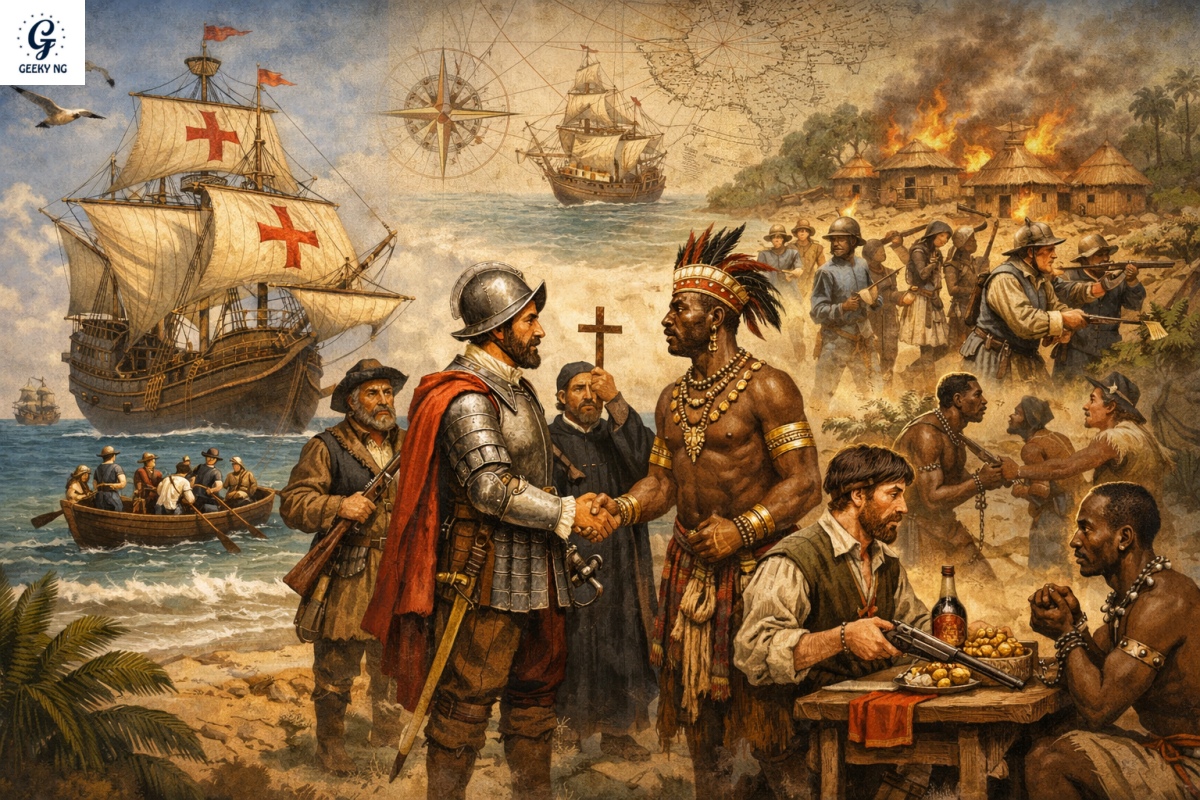
The history of Nigeria’s coastal states is incomplete without examining the dramatic encounters with European powers.
From the mid-15th century, when the Portuguese became the first Europeans to establish regular contact with West Africa, the Nigerian coastline, stretching along the Gulf of Guinea, became a stage for global trade, cultural exchange, and political intrigue.
For the coastal states, geography was both a blessing and a curse. Their access to the Atlantic Ocean gave them opportunities to grow as commercial hubs, but it also exposed them to centuries of exploitation, beginning with the transatlantic slave trade and culminating in colonization.
States and regions such as Bonny and Opobo (in Rivers State), Calabar, Lagos, Badagry (also in Lagos State), Brass (in Bayelsa State), and others—were at the frontline of this contact. Their stories reveal both resilience and vulnerability, shaping the course of Nigerian history.
Table of Contents
The Coastal States: Gateways to the Atlantic
Each coastal state had its own political structure and economic base before Europeans arrived. But the lure of foreign goods and alliances soon altered their priorities.
By mapping these regions, one can understand how their geography influenced their role in global history.
1. Lagos (Eko)
Once a settlement under the Benin Empire, Lagos was prized for its natural lagoon and waterways. Portuguese explorers first reached its shores in the late 15th century, naming it Lago de Curamo.
Later, the British seized on its strategic importance, eventually making it the capital of colonial Nigeria.
2. Badagry
Badagry’s coastal creeks provided safe anchorage for ships, making it one of the earliest ports of European contact.
By the 17th century, it became infamous as a center for the slave trade. Historical landmarks such as the “Point of No Return” still stand as reminders of its tragic past.
3. Bonny
In the Niger Delta, Bonny grew into a formidable trading kingdom. During the height of the slave trade, Bonny chiefs struck deals with European merchants, exporting thousands of enslaved people.
In the 19th century, Bonny successfully shifted to palm oil exports, preserving its commercial relevance.
4. Opobo
Founded in 1869 by King Jaja, Opobo represented African resilience against European dominance. Jaja challenged European traders by insisting that all palm oil trade pass through him.
His resistance, however, threatened British interests, and he was eventually exiled to the West Indies in 1887. His story symbolizes both the possibilities and limits of African agency.
5. Calabar (Old Calabar)
Located in Cross River state, Old Calabar became one of the busiest slave ports on the Bight of Biafra.
The Efik traders, including influential families like the Dukes and Eyambas, controlled commerce with Europeans. After abolition, Calabar remained central to palm oil trade and later became a base for missionaries
6. Brass (Nembe)
The Nembe people of Brass were strategic players in Niger Delta politics. Their resistance to European domination culminated in the 1895 “Akassa Raid,” when Nembe warriors attacked the Royal Niger Company for monopolizing trade.
Though they suffered a brutal reprisal, their defiance is remembered as a stand against imperial exploitation.
The Impacts of European Contact
European contact reshaped these coastal states in ways that were both beneficial and devastating.
Positive Impacts
1. Expansion of Global Trade: The coastal states were integrated into a global trading network linking Africa, Europe, and the Americas. Local products such as palm oil, ivory, and spices gained international markets.
2. Urban and Political Growth: Settlements like Lagos, Calabar, and Bonny expanded rapidly, developing into urban centers. The political influence of coastal leaders also increased as they controlled lucrative trade routes.
3. Cultural: Christianity, literacy, and Western education entered through missionary efforts in places like Calabar and Badagry. The first Nigerian primary schools and churches were built in these towns, producing early nationalists and intellectuals.
4. Technological Introduction: Exposure to European ships, firearms, and navigation techniques introduced new military and economic strategies. These tools changed warfare and defense among coastal states.
5. Diplomatic Alliances: Some rulers leveraged European contact to strengthen their power. The Oba of Benin, for instance, initially benefited from trade in pepper and ivory before refusing to participate in large-scale slave trading, showing that African leaders negotiated from positions of strength.
Negative Impacts
1. The Transatlantic Slave Trade: Perhaps the darkest chapter, the slave trade devastated coastal communities. Between the 16th and 19th centuries, millions of Africans were forcibly taken, leading to depopulation, social disintegration, and inter-ethnic wars. Badagry, Calabar, and Bonny became synonymous with this human tragedy.
2. Wars and Instability: The introduction of firearms fueled conflicts as states fought to capture slaves. Warfare destabilized societies and entrenched cycles of violence.
3. Economic Dependence: Traditional crafts and industries were sidelined. Coastal economies grew dependent on European demand, first for slaves, then for palm oil. This dependence weakened indigenous resilience.
4. Loss of Sovereignty: European powers slowly transitioned from trade partners to political rulers. Treaties signed under the guise of trade opened doors to colonial annexation. By the late 19th century, many coastal states had lost their independence.
5. Cultural and Religious Disruption: Indigenous belief systems and governance structures came under pressure. Christianity and European legal systems began to overshadow traditional practices, altering social hierarchies and cultural identity.
Stories of Leaders and Resistance
European contact was not a one-sided affair; African rulers often resisted, negotiated, or redefined the terms of engagement.
Let’s highlight a few examples:
King Jaja of Opobo; defied European traders by refusing to cede control of his kingdom’s trade. Though betrayed and exiled, he remains a symbol of African resistance.
The Nembe of Brass; staged the Akassa Raid against the Royal Niger Company’s monopoly. Though defeated, their courage demonstrated local opposition to economic exploitation.
The Oba of Benin; initially embraced trade with Europeans but later resisted the pressures of the slave trade. His kingdom remained relatively stable until Britain’s punitive expedition of 1897.
Duke Ephraim of Calabar; along with other Efik leaders skillfully balanced diplomacy and trade, ensuring their communities benefited from commerce while maintaining some autonomy.
These leaders remind us that African agency persisted even amid external domination.
A Mixed Legacy
The legacy of European contact with Nigeria’s coastal states is layered. On one hand, it opened new commercial and cultural horizons, laying the groundwork for modern seaports, education, and urban development.
On the other, it imposed centuries of slave trading, violence, and political manipulation that left deep scars.
The coastal states were not passive victims. They adapted, resisted, and sometimes collaborated, shaping their destinies within the constraints of global forces.
Their stories illuminate both the resilience of African societies and the destructive power of unchecked foreign exploitation.
Final Thoughts
The early encounters between Europeans and Nigeria’s coastal states were defining moments in the country’s history. They highlight the double-edged nature of contact; a door to opportunity and a path to exploitation.
From Lagos to Calabar, Bonny to Brass, these regions remind us that geography can make a people both powerful and vulnerable.
Today, the ruins of slave routes in Badagry, the memory of King Jaja in Opobo, and the stories of Nembe’s defiance stand as historical landmarks. They call on us to reflect not only on the tragedies of the past but also on the resilience that endured.
The mixed legacy of these encounters continues to shape Nigeria’s identity in the global community.
As the nation navigates modern challenges of globalization, trade, and cultural exchange, the lessons from its coastal states remind us that history is not just about what was lost, but also about the strength that survived.
Read Also: The Land And Peoples Of Nigeria: Geography, Physical Features, And Cultures