As another year begins, the internet floods with the usual chorus: set goals, build habits, become a new you!
But here’s what nobody talks about. The real bottleneck to your 2026 success isn’t motivation or willpower; it is something far more practical: How you manage what you know.
This here is personal knowledge management (PKM), the unattractive productivity revolution that is transforming how successful people in Nigeria and across Africa are building careers, launching businesses, and staying ahead in an increasingly information-saturated world.
Table of Contents
The Real Problem is You’re Drowning in Information, Starving for Insight
Think about your digital life right now. You’ve got bookmarked articles you’ll “read later” (you won’t), screenshots of useful tweets buried in your camera roll, PDFs downloaded to your phone that you can’t find anymore, brilliant ideas that visited you at 2 AM and vanished by morning, and notes scattered across WhatsApp messages to yourself, random phone apps, and crumpled paper.
This isn’t a productivity problem. It is a knowledge management crisis.
In Nigeria, the digital hunger is measurable in real-time, as according to the NCC, mobile data consumption hit a staggering record of 1.24 petabytes in November 2025 alone. For the average connected Nigerian, this translates to roughly 8 GB to 13.2 GB of data per month, with the most active users; primarily on networks like MTN and Airtel, processing nearly 440 MB of digital information every single day.
Globally, the scale is even more immersive because we aren’t just ‘reading’ information; we are living in it. According to research from the University of California, San Diego, we consume roughly 100,500 words daily – the equivalent of a 300-page novel. While this study was conducted over a decade ago, modern data experts at Optimaze suggest that in 2025, our sensory intake (video and audio) has pushed our daily data ‘load’ even higher, far exceeding the old 34GB estimates. In a country that ranks 5th globally for time spent on social media (averaging over 3.5 hours daily), our brains aren’t failing to store data, they are simply becoming world-class filters, discarding the ‘noise’ to focus on the signals that truly matter.”
What is Personal Knowledge Management (And Why It Matters More Than New Year Resolutions)
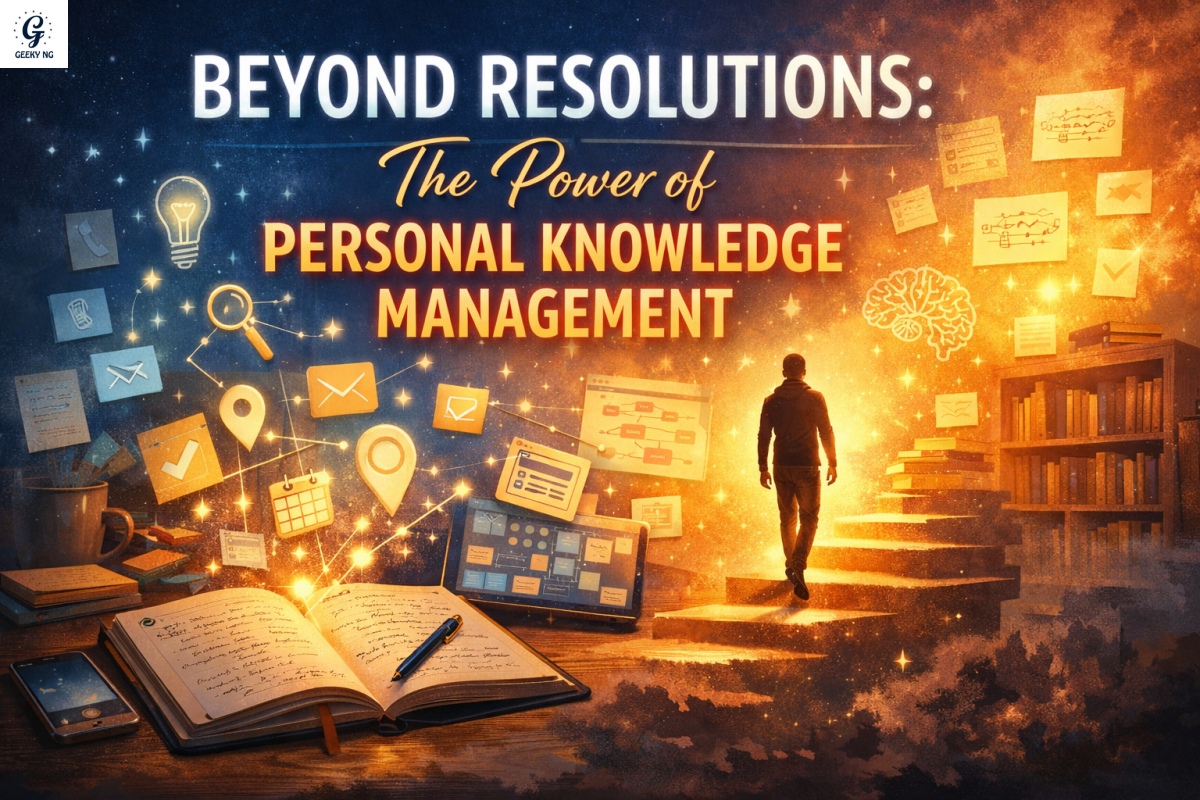
Personal knowledge management is simply the practice of capturing, organizing, and connecting information in ways that make it genuinely useful to your life and work. Think of it as building a “second brain” – an external system that remembers for you, connects dots you would miss, and makes you smarter over time.
Unlike New Year resolutions that rely on motivation (which are likely to fade), a good PKM system relies on process. Set it up once, maintain it minimally, and it compounds value for years.
For Nigerian professionals navigating multiple side hustles, freelance gigs, skill acquisition, and career pivots, having a reliable personal knowledge system isn’t luxury – it is infrastructure.
Building Your Second Brain: A Practical Framework for 2026
Step 1: Choose Your Digital Workspace (And Stick With It)
The first rule of personal knowledge management: one capture point beats five half-used apps.
Popular options include Notion (flexible, free tier generous), Obsidian (works offline, owns your data), Google Keep (simple, syncs everywhere), or even a well-organized Google Drive structure. The best tool is the one you’ll actually use consistently.
For Nigerians dealing with epileptic internet access, prioritize tools with strong offline functionality and reliable sync. Nothing kills a knowledge system faster than losing work because “NEPA” struck mid-thought.
Step 2: Create a Simple Capture Habit
Your brain wasn’t designed to be a storage device – see it as more of a processing unit. Every idea you try to “just remember” occupies mental RAM that could be used for actual thinking.
Create friction-free capture points:
- Voice memos for ideas while commuting through Lagos traffic
- Quick mobile notes when inspiration strikes
- Screenshot + immediate tagging for social media insights
- Weekly browser bookmark cleanups into your main system
The golden rule: capture immediately, organize later. Don’t let the perfect filing system prevent you from saving that breakthrough idea.
Step 3: The Magic of Progressive Summarization
Here’s where most knowledge management systems fail: people save everything but process nothing. That article you bookmarked? Still unread. That PDF you downloaded? Unopened.
Progressive summarization solves this. When you save something:
- First pass: Highlight the most interesting parts
- Second pass (when you revisit): Bolden the highlights of your highlights
- Third pass: Summarize in your own words at the top
This creates layers of compression. Six months later, you can scan your boldened highlights in 30 seconds instead of re-reading entire articles. This time-saving multiplies across hundreds of saved items.
Step 4: Connect Ideas, Don’t Just Collect Them
The difference between a folder system and a second brain is connections. Real insight happens when you link related ideas from different contexts.
In your PKM system, practice active linking: When you save something about fintech regulation, link it to your notes on cryptocurrency, startup funding, and Nigerian economic policy. When you learn a new coding framework, connect it to previous projects, similar technologies, and career opportunities.
Tools like Notion and Obsidian make this easy with bidirectional linking. Over time, you’ll build a web of knowledge where one idea leads to five others – that’s when your second brain becomes genuinely intelligent.
Step 5: Regular Reviews (The System That Maintains Itself)
Set two non-negotiable appointments with your knowledge system:
- Weekly review (15 minutes): Process what you captured, do first-pass highlights, make obvious connections
- Monthly review (1 hour): Deeper dives into accumulated notes, identify patterns, surface forgotten insights
Think of these as compound interest for your mind. Fifteen minutes weekly seems small, but across a year, that’s 13 hours of active knowledge processing – more than most people do in a lifetime.
Why This Beats Traditional New Year Goals
New Year resolutions assume future-you will have more discipline than present-you. Personal knowledge management assumes the opposite, as it is designed for “lazy,” distracted humans with too much going on.
The beauty of a good PKM system:
- It works even when motivation fades
- It gets more valuable with time, not less
- It supports every other goal (career growth, business launch, skill development)
- It’s measurable (you can literally see your knowledge compound)
Your 2026 Action Plan: Start This Week
Don’t wait for the perfect setup. Start with this:
This week: Choose one tool. Create three folders: Inbox (everything new), Archive (processed notes), Projects (active work).
This month: Commit to the weekly 15-minute review. Just show up. The habit matters more than perfection.
This quarter: Start connecting ideas. When you review notes, ask “what does this remind me of?” and create links.
By December 2026, you won’t just have a list of completed resolutions (or more likely, abandoned ones). You’ll have a personal knowledge ecosystem that’s made you genuinely smarter, more creative, and more effective.
The Compounding Effect
The most powerful aspect of personal knowledge management is compound growth, knowing that every note you take, every connection you make, every insight you capture adds to a growing asset that serves you for years.
While others restart from zero every January with fresh resolutions, you’ll build on a foundation that gets stronger with time. That’s not just a New Year upgrade, that of course, is a lifetime advantage.
Start building your second brain this week. Future you will thank present you.
Ready to level up your productivity and knowledge management in 2026? Share your current note-taking challenges in the comments, and let’s build smarter systems together.
Read also; New Year Goals