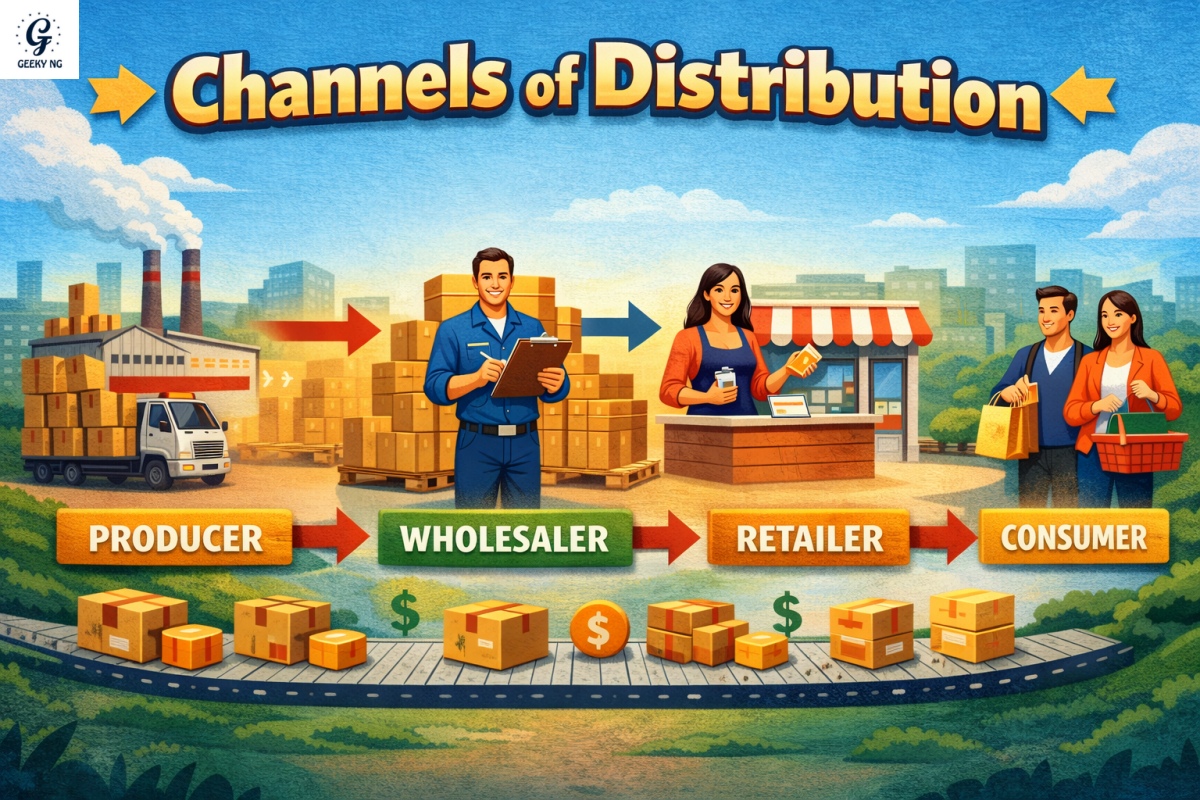
Channels of distribution refer to the various routes through which goods move from producers to consumers. These routes may involve one or more intermediaries known as middlemen.
Distribution is important because goods produced in one place must reach consumers in different locations at the right time and in the right quantity.
Without proper distribution, production efforts will be wasted and consumer needs will not be met.
Table of Contents
The Role of Government in Distributive Trade
- Provision of infrastructure: The government provides basic infrastructure such as good roads, railways, ports, airports, and electricity to support distributive trade. These facilities make it easier and cheaper to move goods from producers to markets and consumers.Good transport networks reduce delays, spoilage of goods, and high transport costs. When infrastructure is well developed, distribution becomes faster and more efficient.
- Regulation of trade and market activities: The government makes and enforces laws that regulate distributive trade. These laws help to control unfair practices such as hoarding, price fixing, false measurement, and adulteration of goods. By regulating market activities, the government protects both producers and consumers. This creates order and fairness in the distribution process.
- Consumer protection: The government protects consumers through agencies that monitor the quality, safety, and prices of goods. It ensures that goods sold in the market meet approved standards. Consumer protection laws help to prevent the sale of substandard and harmful products. This role builds consumer confidence in the market system.
- Price control and stabilization: The government sometimes controls or influences the prices of essential goods to prevent excessive price increases. This is done through price ceilings, subsidies, or direct intervention in the market. Price stabilization helps to make basic goods affordable to the general public. It also reduces the effects of inflation on consumers.
- Establishment of marketing boards and public enterprises: The government may establish marketing boards to help in the distribution of agricultural products. These boards buy produce from farmers at guaranteed prices and distribute them to local and international markets. This helps farmers to have a ready market for their goods. It also reduces the influence of exploitative middlemen.
- Provision of storage and warehousing facilities: The government provides storage facilities such as warehouses and silos to support distribution. These facilities help to store goods during periods of surplus for use during periods of scarcity. Proper storage reduces wastage and stabilizes supply in the market. This is especially important for agricultural products.
- Promotion of trade and commerce: The government promotes distributive trade by encouraging both local and international trade. It does this through trade agreements, trade fairs, and export promotion policies. By promoting trade, the government helps to expand markets for goods. This leads to increased production and better distribution.
- Financial support and incentives: The government provides financial support such as loans, grants, and subsidies to traders and distributors. These incentives help traders to expand their businesses and improve distribution networks. Financial support also encourages investment in transportation and storage facilities. This strengthens the overall distribution system.
- Maintenance of peace and security: The government ensures peace and security, which is necessary for effective distributive trade. When markets, transport routes, and business environments are safe, traders can operate freely. Security reduces the risk of theft and destruction of goods. This encourages smooth movement of goods across regions.
- Collection of market information and statistics: The government collects and publishes data on prices, demand, and supply of goods. This information helps producers and distributors to make informed decisions. Accurate market data improves planning and reduces uncertainty in trade. It also helps the government to plan better trade policies.
Economic Activities that can Improve the Distribution of Commodities in West Africa
- Improvement of transportation services: Improving transportation services such as road, rail, water, and air transport helps goods move easily from producers to consumers across West Africa. Good roads reduce travel time and transportation costs, making commodities cheaper and more accessible. Rail and water transport are useful for moving bulky goods like agricultural produce and minerals over long distances. Efficient transport systems reduce delays, spoilage, and losses, especially for perishable goods. This leads to better market supply and improved regional trade.
- Development of storage and warehousing facilities: The provision of modern storage facilities such as warehouses, silos, and cold rooms helps in preserving commodities before they reach consumers. Proper storage reduces post harvest losses and prevents spoilage of agricultural products. It allows goods to be stored during surplus periods and released during scarcity, which helps stabilize prices. Warehousing also supports bulk trading and long distance distribution. This improves the availability of goods throughout the year.
- Expansion of communication and information services: Effective communication systems such as mobile networks, internet services, and market information platforms improve the flow of information among producers, traders, and consumers. Farmers and traders can easily obtain information on prices, demand, and market locations. This reduces the problem of selling goods in the wrong markets or at unfavorable prices. Good communication also helps in coordinating transportation and distribution activities. As a result, commodities are distributed more efficiently.
- Promotion of regional and cross border trade: Encouraging trade among West African countries improves the movement of goods within the region. Regional trade agreements help reduce tariffs, border delays, and trade barriers. This allows commodities to move freely from areas of surplus to areas of shortage. Cross border trade increases market size and improves specialization among countries. It also strengthens economic cooperation and improves distribution efficiency.
- Investment in modern markets and logistics services: Building modern markets, distribution centers, and logistics hubs improves the organization of trade activities. These facilities provide proper stalls, storage areas, and transportation links for traders. Logistics services such as packaging, handling, and delivery help move goods safely and quickly. Modern markets reduce congestion and losses caused by poor handling. This leads to faster and more reliable distribution of commodities.
- Development of financial and credit services: Access to banking and credit facilities helps traders and distributors expand their activities. With adequate finance, traders can buy goods in large quantities and transport them to distant markets. Credit facilities also help farmers and small scale traders overcome capital problems. Financial services such as mobile money make payments easier and safer. This supports smooth trading and wider distribution of commodities.
- Encouragement of private sector participation: Supporting private businesses in trade and distribution increases efficiency and competition. Private firms invest in transport, storage, and distribution networks. Competition among private distributors helps reduce costs and improve service delivery. The private sector also introduces new methods and technologies into distribution. This leads to better availability of goods across the region.
- Government support and policy implementation: Government policies that support trade and distribution help improve the flow of goods. Investment in infrastructure, enforcement of trade regulations, and reduction of multiple taxes encourage smooth distribution. Governments can also support traders through subsidies and training programs. Stable policies create a favorable environment for distributive activities. This helps commodities reach consumers efficiently across West Africa.
Final Thoughts
Channels of distribution play a vital role in ensuring that goods reach consumers efficiently.
Middlemen, cooperatives, and the government all contribute to the smooth flow of goods. When distribution is well organized, prices are stable, goods are available, and economic activities grow.
Understanding distribution helps students appreciate how production and consumption are connected in an economy.
Tags
Channels of distribution, Distribution, Producer, Consumer, Middlemen, Wholesaler, Retailer, Agent, Broker, Intermediary, Bulk buying, Storage, Warehousing, Transportation, Market information, Price determination, Hoarding, Exploitation, Direct selling, Bypassing middlemen, Cooperative society, Distributive trade, Marketing boards, Government regulation, Infrastructure, Subsidy, Price control, Consumer protection, ECOWAS, Regional trade, Logistics, Trade efficiency
Read also: Division of Labour and Specialisation: Facts You Need to Know