Table of Contents
Introduction
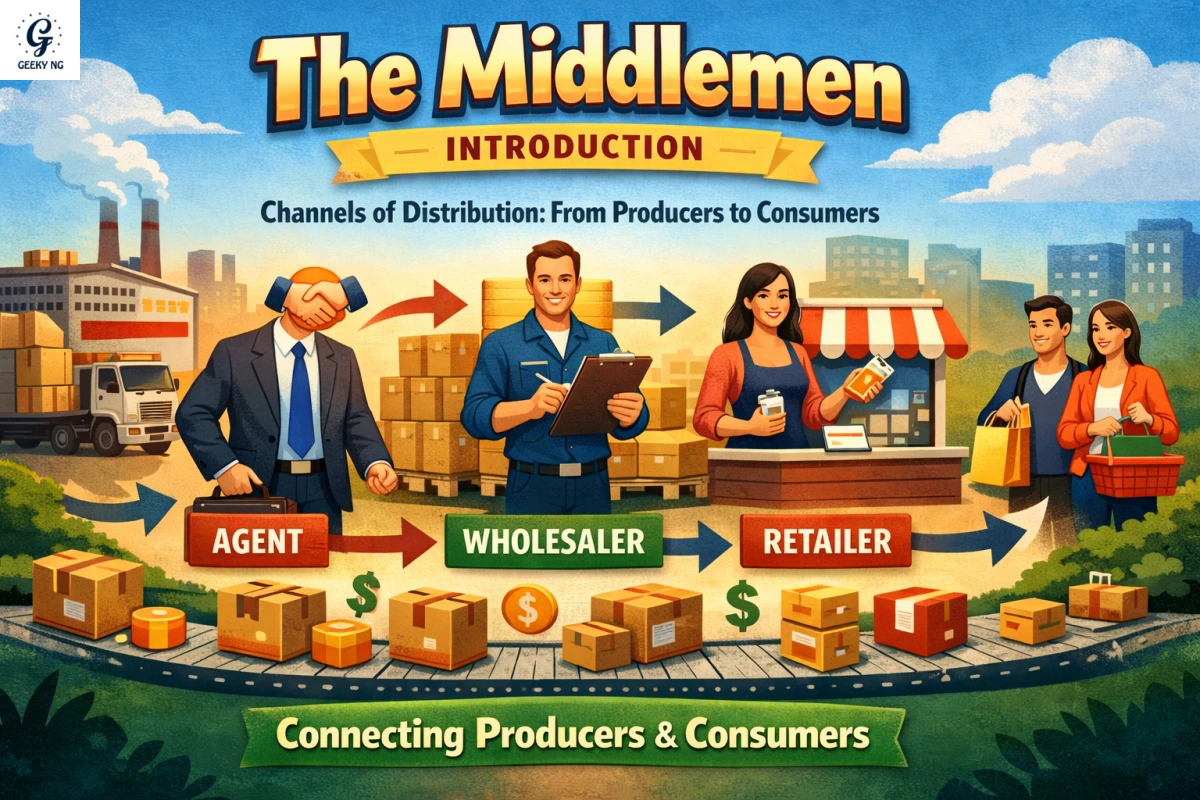
Channels of distribution refer to the various routes through which goods move from producers to consumers. These routes may involve one or more intermediaries known as middlemen.
Distribution is important because goods produced in one place must reach consumers in different locations at the right time and in the right quantity.
Without proper distribution, production efforts will be wasted and consumer needs will not be met.
The Middlemen
Examples of middlemen include wholesalers, retailers, agents, brokers, and distributors. A wholesaler buys goods in large quantities from producers and sells them in smaller quantities to retailers. A retailer sells goods directly to the final consumers.
Advantages of the Middlemen
1. Middlemen help producers to concentrate fully on production by taking responsibility for selling and distribution This allows producers to focus on improving the quality and quantity of goods.
Without middlemen, producers would have to spend time and resources looking for buyers. This division of labour increases efficiency in the economy
2. Middlemen make goods readily available to consumers in different locations. They move goods from areas of surplus to areas where they are needed. This ensures that consumers can easily find goods when they need them. It also helps to reduce shortages in the market.
3. Middlemen reduce the burden of storage on producers by providing warehouses and shops. Producers may not have enough space or resources to store large quantities of goods.
By storing goods, middlemen help to prevent wastage and spoilage. This is especially important for agricultural products.
4. Middlemen help in breaking bulk by buying goods in large quantities and selling them in smaller units. Consumers usually cannot afford or do not need goods in large quantities.
By selling in small units, middlemen make goods affordable and convenient for consumers. This improves access to goods in the market.
5. Middlemen provide credit facilities to retailers and sometimes to consumers. This helps traders to continue business even when they do not have enough capital. Credit sales encourage trade and increase the volume of goods exchanged. It also supports the growth of small businesses.
6. Middlemen bear part of the risks involved in trade, such as damage, theft, fire, and unsold goods. By taking on these risks, they protect producers from total loss. This encourages producers to continue producing goods. Risk bearing is an important function in distributive trade.
7. Middlemen provide useful market information to producers. They inform producers about consumer tastes, changes in demand, and prevailing prices. This information helps producers to plan production better. It also reduces the chances of producing goods that may not sell.
8. Middlemen help in stabilizing prices by ensuring a steady supply of goods in the market. They store goods during periods of surplus and release them during periods of scarcity. This helps to prevent sudden price increases or falls. Price stability benefits both producers and consumers.
Disadvantages of Middlemen
1. Increase in the final price of goods:
Middlemen often add their own profit margins to the cost of goods as they pass from producers to consumers. When there are many middlemen in the channel of distribution, the price of goods increases at each stage.
This makes goods more expensive for consumers and may reduce their ability to purchase essential items. High prices can also reduce demand in the market.
2. Exploitation of producers and consumers:
Some middlemen exploit producers by offering very low prices for their goods, especially when producers lack market information, but then sell these goods to consumers at very high prices.
This practice allows middlemen to make excessive profits while both producers and consumers suffer. Such exploitation leads to inequality in the distribution process.
3. Hoarding and artificial scarcity:
Middlemen may deliberately store goods for long periods in order to create artificial scarcity in the market. When goods become scarce, prices rise, and middlemen sell at higher prices.
This practice affects consumers negatively, especially during periods of shortage. Hoarding can also disrupt the normal flow of goods in the market.
4. Delay in distribution of goods:
The presence of many middlemen can slow down or delay the movement of goods from producers to consumers. Goods would have to pass through several hands before reaching the final buyer.
Perishable goods may spoil during this process, resulting in losses. Delays can also cause shortages in the market.
5. Unfair trade practices:
Some middlemen engage in dishonest practices such as false measurement, adulteration of goods, and misrepresentation of quality.
These practices reduce consumer confidence and harm the reputation of producers. Unfair practices can weaken trust in the market system.
6. Discouragement of producers:
When middlemen dominate the distribution process, producers may receive very little profit for their efforts. This can discourage producers from increasing production or investing in better methods.
Over time, low motivation among producers can reduce output. This negatively affects the overall economy.
7. Inflationary pressure in the economy:
Excessive profit taking by middlemen can contribute to rising prices of goods in the economy. As prices increase, the cost of living also rises.
This can lead to inflation, especially when middlemen control the supply of essential goods. Inflation reduces the purchasing power of consumers.
Reasons That May Warrant the Bypassing of Middlemen
1. To reduce the cost of goods to consumers:
Producers may decide to bypass middlemen in order to remove extra charges added along the distribution chain.
By selling directly to consumers, producers can offer goods at lower prices while still maintaining reasonable profit. This approach is common in direct farm sales, factory outlets, and online sales.
2. To increase the profit of producers:
Middlemen often buy goods at low prices and sell them at higher prices to make profit. When producers bypass middlemen, they are able to keep the profit that would have gone to intermediaries.
This is especially important for small scale producers who want to improve their income. Direct selling allows producers to control pricing and earn better returns on their goods.
3. When middlemen exploit producers or consumers:
Some middlemen exploit producers by offering very low prices for their goods, especially when producers lack market information. They may also exploit consumers by charging excessively high prices or engaging in hoarding.
Such unfair practices can force producers to look for alternative ways to reach consumers directly. Bypassing middlemen helps to reduce exploitation and promote fairness in trade.
4. Availability of improved transportation and communication:
Good roads, vehicles, mobile phones, and internet services make it easier for producers to reach consumers without assistance from middlemen. Producers can transport their goods directly to markets and advertise them easily.
Improved communication helps producers to know market prices and consumer demand. As a result, the need for middlemen is reduced.
5. Large scale production and organized distribution systems:
Large firms that produce goods in large quantities often have their own distribution networks. They can afford warehouses, delivery vehicles, and sales outlets.
Because of this, they do not rely on middlemen to distribute their products. Direct distribution helps such firms maintain control over quality, pricing, and supply.
6. Government policies and price control measures:
In some cases, the government may encourage producers to sell directly to consumers to control prices of essential goods. This may happen during periods of scarcity or inflation.
Government owned outlets and direct sales schemes are often used to reduce the influence of middlemen. Such policies help to make essential goods affordable and available to the public.
The Roles of Cooperatives in Distributive Trade
1. Elimination of unnecessary middlemen:
Cooperative societies help to reduce the number of middlemen in the distribution process. They buy goods directly from producers or sell members’ products straight to consumers.
This shortens the channel of distribution and reduces the cost of goods. By doing this, cooperatives help consumers to enjoy lower prices while producers earn better income.
2. Bulk purchasing and bulk selling:
Cooperatives purchase goods in large quantities on behalf of their members. Buying in bulk allows them to enjoy discounts and lower transportation costs. These savings are passed on to members through lower prices.
In the same way, cooperatives sell members’ products in large quantities, which helps them to access bigger markets and earn more income.
3. Provision of storage facilities:
Cooperatives provide warehouses and storage facilities for goods, especially agricultural produce. This helps to prevent spoilage and wastage of goods.
Members are able to store their products and sell them when prices are favourable. Storage also helps to ensure steady supply of goods in the market.
4. Stabilization of prices:
Cooperatives help to stabilize prices by avoiding sudden increases or decreases in prices. They discourage hoarding and speculative practices in the market.
By releasing goods gradually, cooperatives help to maintain steady prices. This benefits both producers and consumers and promotes market stability.
5. Protection of members from exploitation:
Cooperative societies protect their members from exploitation by powerful middlemen. They ensure that members receive fair prices for their goods and pay reasonable prices for purchased items.
Cooperatives also use standard weights and measures, which promotes honesty in trade. This builds trust and fairness in the distribution system.
6. Provision of credit and financial support:
Many cooperatives provide credit facilities to their members. This helps members to buy goods, improve production, or expand their trading activities.
Access to credit reduces dependence on moneylenders who may charge high interest rates. As a result, members can participate more actively in distributive trade.
7. Market information and education:
Cooperatives provide members with useful market information such as prices, demand, and consumer preferences. This information helps members to make better trading decisions.
Cooperatives also educate members on proper marketing and distribution practices. This improves efficiency and competitiveness in trade.
8. Promotion of unity and collective effort:
Cooperatives encourage members to work together for their common benefit. Through collective effort, members are able to achieve what they may not achieve individually.
This unity strengthens their bargaining power in the market. It also promotes discipline and cooperation in distributive trade.
Final Thoughts
Channels of distribution play a vital role in ensuring that goods reach consumers efficiently. Middlemen, cooperatives, and the government all contribute to the smooth flow of goods.
When distribution is well organized, prices are stable, goods are available, and economic activities grow. Understanding distribution helps students appreciate how production and consumption are connected in an economy.
Tags
Channels of distribution, Distribution, Producer, Consumer, Middlemen, Wholesaler, Retailer, Agent, Broker, Intermediary, Bulk buying, Storage, Warehousing, Transportation, Market information, Price determination, Hoarding, Exploitation, Direct selling, Bypassing middlemen, Cooperative society, Distributive trade, Marketing boards, Government regulation, Infrastructure, Subsidy, Price control, Consumer protection, ECOWAS, Regional trade, Logistics, Trade efficiency
Read Also: 5 Reasons Why Manufacturing Industries Are Cited In Cities