Table of Contents
Introduction
In Economics, we deal with many figures such as prices, income, production, population, growth rates, and costs. To understand these figures clearly and make meaningful comparisons, economists use statistical tools known as average or mean.
While students are familiar with the arithmetic mean, there are other important averages used in economic analysis, especially when dealing with growth rates, ratios, and large variations in data.
These include the Geometric Mean, the Harmonic Mean, and the Quadratic Mean. Each of these tools serves a specific purpose and helps economists analyse data more accurately and make sound economic decisions.
Meaning
The geometric mean is a type of average that is used when values are multiplied together rather than added. It is especially useful in economics when dealing with growth rates, percentages, index numbers, and changes that occur over time.
Instead of adding the numbers and dividing by the total, the geometric mean multiplies all the values together and then finds the root of the product based on the number of values. It gives a more accurate average when data are increasing or decreasing at different rates, such as population growth, inflation, or business profits over several years.
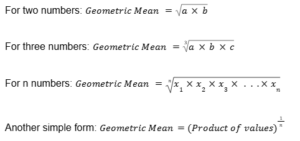
Formula
Examples
Example 1: Find the geometric mean of 4 and 9.
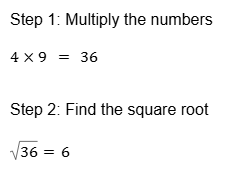
Geometric Mean = 6
Example 2: A business grows by 10% in the first year and 20% in the second year.
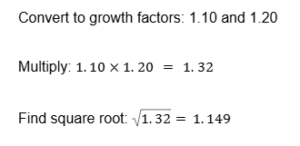
Average growth rate ≈ 14.9%
Advantages of Geometric Mean
It is suitable for growth rates
The geometric mean is very suitable for measuring growth rates because growth usually happens in a multiplicative way, not an additive way.
For example, when prices, population, income, or production increase over time, each year’s growth builds on the previous year’s value. The geometric mean captures this compounding effect properly. This makes it more accurate than the arithmetic mean when calculating average growth over several periods. That is why it is widely used in economics to measure inflation rates, interest rates, and population growth.
It reduces the effect of very large values
One major advantage of the geometric mean is that it reduces the influence of extremely large values in a data set. In many economic data sets, some values may be unusually high compared to others.
The arithmetic mean can be heavily affected by such extreme values, which may give a misleading average. However, the geometric mean balances the values by multiplying and then taking roots, which reduces the impact of outliers. This makes the result more stable and reliable in certain situations.
It is useful in calculating index numbers
The geometric mean is commonly used in constructing index numbers, such as price index numbers. Index numbers measure changes in prices, quantities, or values over time. Since index numbers often involve percentage changes and ratios, the geometric mean is more appropriate than other types of averages.
It gives a more accurate measure of proportional changes and ensures that upward and downward changes are treated fairly. This is why economists prefer it in many index number calculations.
It gives more accurate results for percentage changes
When dealing with percentage increases and decreases over time, the geometric mean provides more accurate results than the arithmetic mean. This is because percentage changes are multiplicative in nature.
For example, if a value increases by 20 percent in one year and decreases by 20 percent the next year, the overall effect is not zero. The geometric mean properly reflects this situation. Therefore, it is especially useful in analyzing investment returns, inflation trends, and economic growth over time.
Disadvantages of Geometric Mean
It is difficult to calculate manually
The geometric mean involves multiplying all the values together and then finding a root, such as a square root or cube root. When the numbers are many or large, the multiplication can become long and stressful.
Finding roots without a calculator is also not easy for most students. Because of this, the geometric mean is less convenient for quick classroom calculations compared to the arithmetic mean.
It cannot be used if any value is zero
If one of the values in a set of data is zero, the product of all the values becomes zero. When the product is zero, the geometric mean will also be zero, even if the other values are large. This gives a misleading result.
Therefore, the geometric mean cannot be properly applied when any observation in the data is zero.
It is not easy for beginners to understand
Unlike the arithmetic mean, which simply involves addition and division, the geometric mean requires multiplication and root extraction. These steps may confuse students who are not strong in mathematics.
Because of this, many learners find it harder to understand the concept and interpretation of the geometric mean at the early stage of study.
It cannot be used with negative numbers
The geometric mean is based on finding roots of products. If the product of the numbers is negative, it is not possible to find a real square root or other even roots.
This makes the geometric mean unsuitable for data sets that include negative values. As a result, it has limited application in situations where economic data may include losses or negative growth.
Final Thoughts
Geometric Mean is best for growth rates and percentages. This tool helps economists analyze data correctly and make better decisions.
Read more: Data Analytics: A Prerequisite For Growth In Every Organisation