Introduction
In Economics, we deal with many figures such as prices, income, production, population, growth rates, and costs.
To understand these figures clearly and make meaningful comparisons, economists use statistical tools known as average or mean. While students are familiar with the arithmetic mean, there are other important averages used in economic analysis, especially when dealing with growth rates, ratios, and large variations in data.
These include the Geometric Mean, the Harmonic Mean, and the Quadratic Mean. Each of these tools serves a specific purpose and helps economists analyse data more accurately and make sound economic decisions.
Meaning
The harmonic mean is a type of average that is used mainly when dealing with rates, ratios, or values expressed as “per unit,” such as price per item, speed per hour, or output per worker.
Instead of adding the values directly, we take the reciprocal of each value, find their average, and then take the reciprocal of that result. It is especially useful when the quantities being averaged are related to the same total amount, such as equal distances or equal quantities.
The harmonic mean gives more weight to smaller values, which makes it suitable for calculating average rates in economics.
Formula
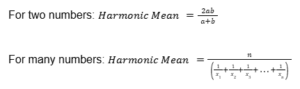
Where n = number of values.
Examples
Example 1: Find the harmonic mean of 4 and 6.

Harmonic Mean = 4.8
Example 2: A car travels 60 km at 40 km/h and another 60 km at 60 km/h.
Find the average speed.
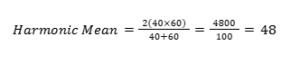
Average speed = 48 km/h
Advantages of Harmonic Mean
It is suitable for rates and ratios
The harmonic mean is very useful when dealing with rates such as speed, price per unit, cost per item, and productivity per worker. In Economics, many figures are expressed in the form of “per unit” or “per time” values, for example naira per kilogram or output per hour. In such cases, using the arithmetic mean may give a misleading result.
The harmonic mean gives a more accurate average when the data are expressed as ratios or rates, especially when the quantities involved are constant.
It gives more importance to smaller values
The harmonic mean gives greater weight to smaller numbers in a set of data. This is important in economic analysis because smaller values can significantly affect the overall average, particularly in cases involving costs or rates.
For example, if one worker produces very little compared to others, the harmonic mean reflects that low productivity more clearly than the arithmetic mean. This makes it useful when lower values are more important in decision making.
It gives correct average speed when distances are equal
The harmonic mean provides the correct average speed when a vehicle travels equal distances at different speeds. If we use the arithmetic mean in this situation, the result will not be accurate.
For example, if a car travels 60 km at 40 km per hour and another 60 km at 60 km per hour, the harmonic mean gives the true average speed of the entire journey. This makes it very important in transport economics and other areas where equal distances are involved.
It reduces the effect of large values
The harmonic mean reduces the influence of very large values in a data set. Because it is based on the reciprocals of numbers, extremely large values do not greatly increase the average.
This makes the harmonic mean more balanced in situations where a few high figures might distort the result. In economic studies involving income per unit or cost per unit, this property helps in obtaining a more realistic average.
Disadvantages of Harmonic Mean
It is difficult to calculate
The harmonic mean is more difficult to calculate than the arithmetic mean because it involves finding the reciprocals of all the values first, that is, dividing 1 by each value.
After that, the reciprocals are added together and then divided into the total number of observations. This process takes more time and effort, especially when there are many values. In examinations or manual calculations, students may easily make mistakes when working with fractions. Because of this complexity, it is not commonly used at basic levels unless the question clearly requires it.
It cannot be used if any value is zero
One major weakness of the harmonic mean is that it cannot be calculated if any of the values is zero. This is because the formula requires dividing 1 by each value.
Since division by zero is mathematically undefined, the entire calculation becomes impossible if even one value is zero. In real economic data, some rates or quantities may be zero, which makes the harmonic mean unsuitable in such cases.
It is not suitable for all types of data
The harmonic mean is mainly used for rates and ratios, such as speed, price per unit, or cost per item. It is not appropriate for general data like income levels, production figures, or population numbers. Using it for the wrong type of data may give misleading results. Therefore, economists must first understand the nature of the data before deciding to apply the harmonic mean.
It is sensitive to very small values
The harmonic mean gives greater weight to smaller values. While this can be useful in some situations, it can also create problems. If one value in the data set is extremely small, it can greatly reduce the harmonic mean and distort the overall result. This means that the average may not properly represent the majority of the data. In economic analysis, this sensitivity can lead to conclusions that do not accurately reflect real conditions.
Read Also: https://www.fao.org/food-safety/en/
Final Thoughts
Harmonic Mean is best for rates and ratios. This tool helps economists analyse data correctly and make better decisions.
Read more: Read The Nature of Mathematics Online