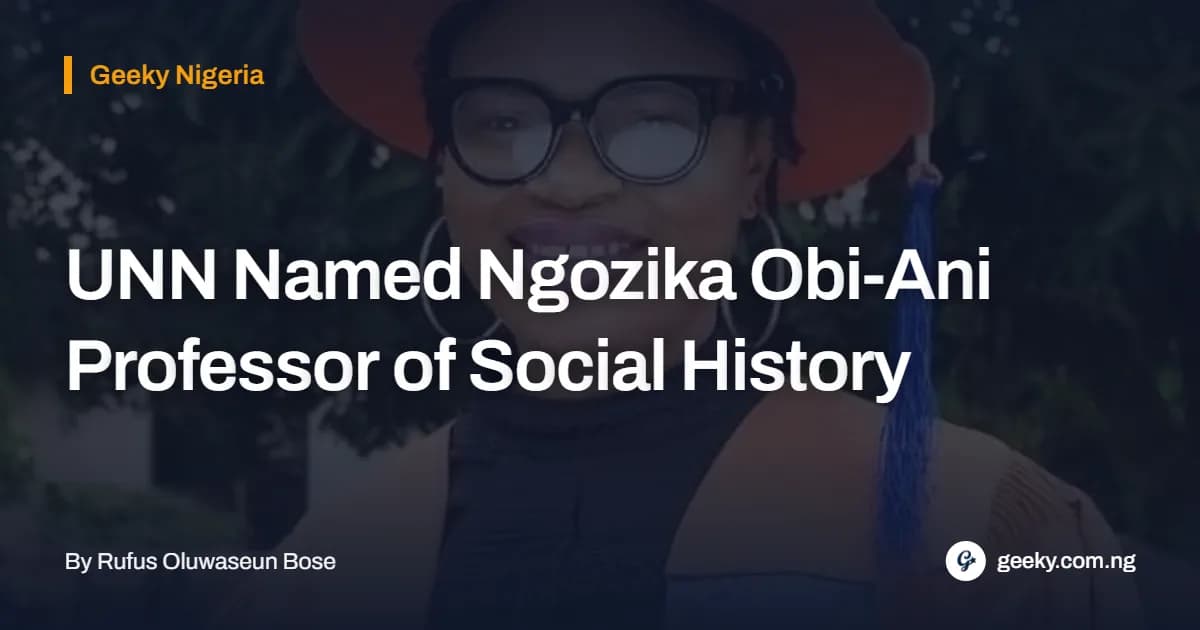
Ngozika Obi-Ani Named UNN Distinguished Professor of Social History and Conflict Studies.
The University of Nigeria, Nsukka (UNN), has appointed Dr Ngozika Anthonia Obi-Ani as a Distinguished Professor of Social History, War, Conflict, and Memory Studies. The appointment recognises the contributions of Ngozika Obi-Ani to historical scholarship, conflict research and academic mentorship.
The appointment was announced at the university’s Appraisals Committee session on Monday, October 26, 2026, according to EduCeleb.
Obi-Ani, a historian in UNN’s Department of History and International Studies, is known for her research into the Nigeria–Biafra War, collective memory, cultural identity, gender relations and the long-term social and political consequences of conflict.
Her appointment has drawn congratulatory messages from former students and academic mentees, who have praised her commitment to teaching, research and the development of emerging scholars.
A mentor whose influence extends beyond the classroom
Among those who congratulated Obi-Ani is Mathias Chukwudi Isiani, a lecturer in UNN’s Department of History and International Studies and a PhD student in the United States.
Isiani credited her guidance with helping shape his academic journey, describing her as an influential mentor who encouraged his growth as a researcher and scholar.
Accounts shared by her mentees also highlight her accessibility, humility and willingness to support former students pursuing postgraduate education and international academic opportunities.
Beyond her research and publications, the career of Ngozika Obi-Ani reflects the importance of mentorship in strengthening Nigeria’s academic community and preparing the next generation of historians.
Researching the Nigeria–Biafra War and collective memory
A major focus of Obi-Ani’s scholarship is the Nigeria–Biafra War and its continuing influence on identity, historical consciousness and political developments in southeastern Nigeria.
Her doctoral research examined the war and the occupation of Nsukka and Enugu between 1967 and 1979, drawing on interviews with survivors to document the experiences of Igbo communities during and after the conflict.
Her subsequent work has explored war trauma, intergenerational memory, gender and post-war grievances. She has also investigated how historical experiences influence national identity and contemporary separatist agitations.
An important dimension of her research is the role of women in African history, including experiences and contributions that have often received limited attention in conventional historical accounts.
By examining how individuals and communities remember conflict, the work of Ngozika Obi-Ani connects historical research with contemporary discussions about identity, reconciliation and the enduring consequences of war.
More than 50 academic publications by Ngozika Obi-Ani
Obi-Ani has developed a broad publication record spanning conflict studies, cultural heritage, gender relations, governance and social change. Her ResearchGate profile reportedly lists 57 publications. Her recent and earlier works include:
- A Question of Memory?: The Biafran Struggle in Perspective, published in December 2025 in Conflict and Society. The article examines how socioeconomic challenges shape the revival of memories of the Nigeria–Biafra War among survivors and their descendants.
- War Is Fearful: The Recollection of War Memories Through Personal Naming Practices in Southeastern Nigeria, co-authored in May 2025 with Eyo Mensah and Utomobong Nsebot. The study considers how personal naming practices preserve and transmit memories of war across generations.
- Ndish i and Alekwu Cultural Beliefs and Gender Inequality Among Communities in Nigeria, another 2025 publication, which explores indigenous beliefs, cultural practices and gender relations.
- Unforgotten Shadows: Exploring the Dynamics of Biafra Agitation in South-East Nigeria, a 2024 article that investigates the historical and political context of renewed separatist agitation in the region.
- A 2024 book chapter examining farmer-herder violence in eastern Nigeria through the 2016 Nimbo-Ukpabi incident in Enugu State.
- Memories of Nigeria-Biafra War, 1967–1970: A Case of Nsukka Igbo, which appeared in a 2023 Palgrave Macmillan collection on remembering mass atrocities and cultural representations in Africa.
That last work documents how communities in the Nsukka cultural zone remember the war and the consequences of the occupation by federal forces.
Scholarship beyond war and conflict
Although the Nigeria–Biafra War remains central to her research, Obi-Ani’s academic interests extend to colonial history, traditional institutions, political development, cultural preservation and social transformation.
In a 2021 article titled Creativity, Spirituality and Society: A Study in Preservation of Ikenga and Of Sculptures in Contemporary Igbo Society, she and her co-authors examined the cultural and spiritual significance of traditional Igbo objects and the challenges of preserving them amid modernisation.
Her 2019 publication, “Indigenous” Institutions in Colonial Igboland: The Imilike Revolt of 1918, explored indigenous institutions and resistance during British colonial rule.
She has also investigated the exploitation of women and teenage girls through so-called baby factories in southeastern Nigeria. Her 2020 article, Women, and the Upsurge of “Baby Factories” in Southeastern Nigeria: Erosion of Cultural Values or Capitalism?, examined the social vulnerabilities associated with the practice.
Other areas of her research include urbanisation in Onitsha, agricultural transformation, Nigeria’s political development following the 1914 amalgamation, pan-Africanism, public health and the influence of social media.
This wide-ranging portfolio demonstrates how historical inquiry can contribute to contemporary debates about governance, cultural identity, gender inequality and social change.
International fellowships and research networks
Obi-Ani’s academic engagement extends beyond Nigeria through international fellowships, research collaborations and professional associations.
Her profile at Columbia University’s Institute for the Study of Human Rights identifies her as an African Humanities Program fellow and an alumna of the Partnership for African Social and Governance Research in Nairobi, Kenya.
She is also associated with the Historical Society of Nigeria, the Lagos Studies Association and the Conflict Research Network West Africa.
Her research and fellowship affiliations include institutions and programmes in Austria, the Netherlands, South Africa and France. Among them are the Vienna Centre for Advanced Studies at the University of Vienna, the Netherlands Institute for Advanced Study, the Stellenbosch Institute for Advanced Study, the African Studies Centre Leiden and Université Grenoble Alpes.
She has also participated in initiatives associated with the African Peacebuilding Network of the Social Science Research Council and the African Humanities Program.
These international connections have provided opportunities for scholarly exchange and have situated her work within wider conversations on African history, conflict, gender and collective memory.
A milestone for Ngozika Obi-Ani and historical scholarship at UNN
The appointment recognises Obi-Ani’s contributions to historical research and the study of war, conflict, and memory.
For her former students and mentees, however, her influence extends beyond academic publications and professional distinctions. Their tributes highlight the encouragement, guidance and opportunities she has provided to scholars developing their own careers.
Her appointment represents a significant milestone in her academic journey and underscores the role of sustained research, international collaboration and mentorship in advancing historical scholarship in Nigeria.
As her work continues to explore how societies remember conflict and navigate its consequences, the scholarship of Ngozika Obi-Ani offers an important contribution to understanding Nigeria’s past and the ways history continues to shape its present.