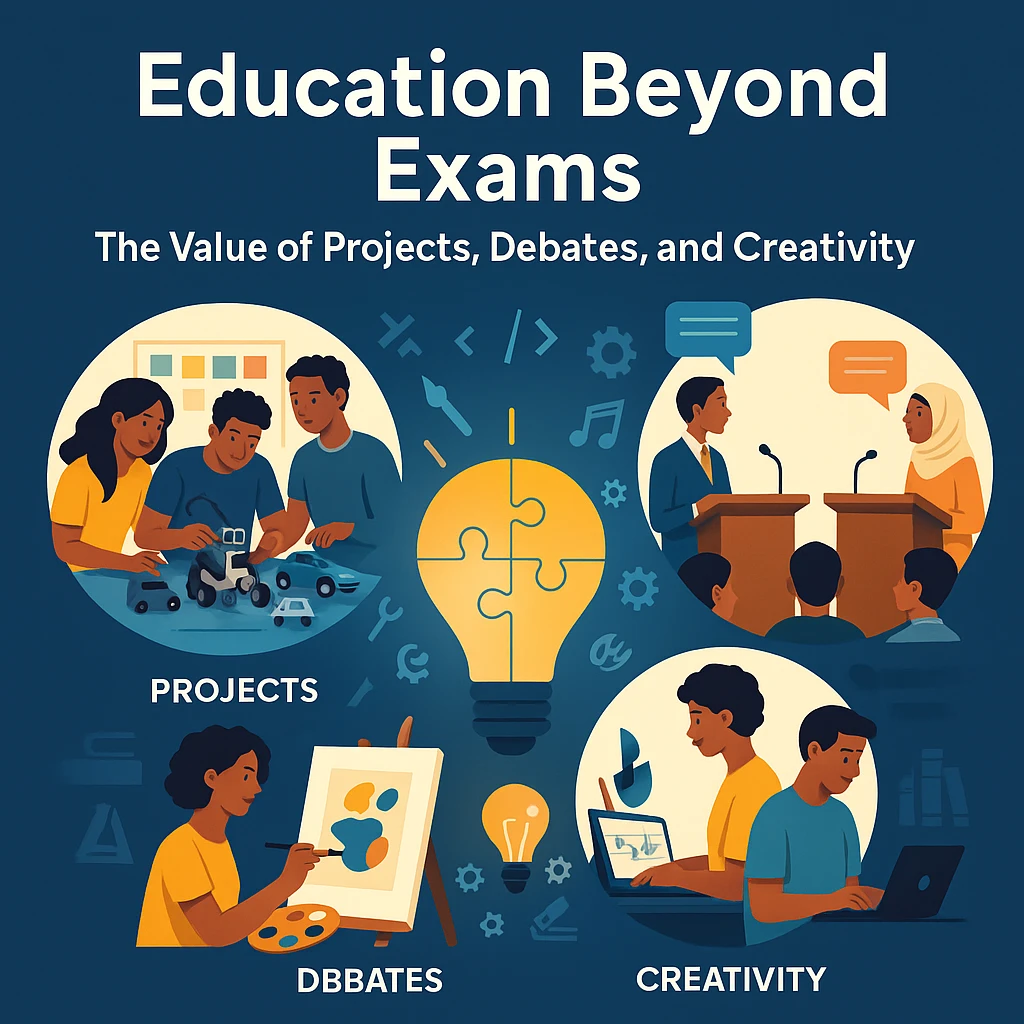
From primary school to the university level, success is often measured by how many A’s a student can gather in WAEC, JAMB, NECO or university exams.
But, should education only be about passing written tests alone? A school system where students are valued not just for bubbling answers on exam sheets but also for their creativity, their ability to defend an idea in a debate, or their skill in completing a hands-on project is what true education should look like.
The Nigerian educational system has, for too long, placed exams on a pedestal. However, as the world changes, especially with technology, it is becoming clearer that exams alone cannot prepare students for the future.
What will make the difference are projects that develop problem-solving skills, debates that sharpen confidence and intellectual constructivism, and creative tasks that unlock hidden talents.
As we often say, “A child who is not taught will sell the house built by his father.” If we fail to prepare children with more than exam skills, the future of the nation is at risk.
Table of Contents
Education Beyond Exams is More Than Paper, Pen and Pencil
Education beyond exams simply means moving away from measuring learning strictly by written tests and exploring broader ways of assessing students.
It is an approach that values practical projects, healthy debates, critical thinking, and creativity alongside examinations.
Projects refer to activities where students research, design, and create solutions to real-life challenges.
Debates are structured arguments that encourage learners to think logically, defend their points with evidence, and communicate persuasively.
Creativity, on the other hand, is the ability to come up with not only an original, but unique and valuable ideas that can solve problems as quickly as possible.
This shift in education does not mean that examinations are useless. Instead, it highlights the need for balance between examination and real-life experiences, where exams are complemented by other methods of evaluation that capture the true intelligence and potential of Nigerian students.
As the saying goes, “However far a stream flows, it never forgets its source.” Obviously, exams are a core part of our educational system, but they must connect with broader skills that reflect real life.
Why Nigerian Schools Must Move Beyond Exams
1. Exams Do Not Measure True Intelligence
Exams are often about memory. A student may cram and pour everything on paper, but that may not mean the student truly understands and can replicate same in a real life situation.
In most Nigerian schools, students who are very intelligent in practical skills, like designing, speaking, or building, are pushed aside because they perform badly in exams. Education beyond exams allows schools to recognize these other forms of intelligence.
2. Projects Encourage Real-Life Problem Solving
Projects help students to link what they learn in class with the real world. For example, a science project on renewable energy can inspire students to create solutions for Nigeria’s electricity challenges.
Such projects do not only boost confidence but also prepare young Nigerians to think and innovate, not just to pass exams.
Just like another popular saying goes, “Knowledge without practice is like a healthy tree that cannot bear fruits.” Projects ensure that learning bears real fruits.
3. Debates Build Confidence and Leadership
Debates give students a voice. In a country like Nigeria, where young people are often told to remain silent until they are older, debates teach students how to speak boldly, defend ideas, and respect opposing views.
This is a skill that exams alone can never measure, but it is essential for producing future leaders; “The child who washes his hands will eat with elders.”
Through debates, students learn to present themselves, their ideas and opinions with respect and the right confidence that earns them a seat at important tables.
4. Creativity Fuels Innovation
When schools encourage creativity, they produce thinkers and leaders of industries who can design new apps, write inspiring stories, or create businesses that solve Nigeria’s recurring problems.
Creativity is the engine of innovation, and without it, education becomes boring and lifeless. Nigeria needs more creators than memorizers if it truly wants to move forward.
The Benefits of Education Beyond Exams
- It increases confidence and self-expression through hands-on experiences.
- Students can develop teamwork and leadership skills through projects and debates.
- Students can unlock hidden talents in music, art, STEM, or entrepreneurship.
- Teachers move from being strict examiners to facilitators of creativity, while building confidence.
- Teachers enjoy more interactive classes with active student participation.
- The nation stands to benefit from the emergence of a generation of problem-solvers, critical thinkers and innovators.
From homegrown solutions to challenges like unemployment, technology gaps, and leadership crises, Nigeria stands to produce peculiar solutions to its peculiar challenges.
Education Beyond Exams in Action
Some private schools in Lagos, Rivers, and Ogun States now make projects part of final grading. A student may be asked to design a small business plan or create a science model.
In Northern Nigeria, debates have become a common way for secondary schools to groom public speaking skills.
Across the country, creative arts and books festivals are showing that education can thrive outside exam halls. These examples prove that Nigerian schools can embrace education beyond exams if they are truly intentional.
Key Takeaways
- Education beyond exams values creativity, projects, and debates as much as test results.
- Nigerian schools must embrace multiple ways of measuring intelligence.
- Experience is the best form of learning. Projects prepare students for real-life problem-solving.
- Other methods of evaluation like debates build confidence, leadership, and communication skills.
- Creativity is the fuel Nigeria needs for innovation and progress.
By repeating and reinforcing these key takeaways, we remind ourselves that true education is a balance between exams, real-life experiences and creativity.
Final Thoughts
Education in Nigeria cannot remain tied to exams alone. Projects, debates, and creative innovations must be part of the classroom experience if we want students who can solve problems, lead communities, and create new opportunities.
The benefits are clear; students gain confidence, teachers enjoy interactive classrooms, and Nigeria receives a generation of innovators.
So the real question is this, will Nigerian schools continue to prioritize exams as the only measure of success, or will they boldly embrace education beyond exams?
Parents, teachers, and policymakers must reflect deeply on this. The time has come to change the story. As a student, start taking projects and debates seriously.
As a teacher, integrate creativity into your lessons. As a policymaker, design policies that balance exams with practical assessments.
And as a Nigerian, ask yourself, how can I contribute to building an education system that values knowledge, creativity, and real skills beyond exams?
After all, there is a proverb that says, “Tomorrow belongs to the people who prepare for it today.”
Read Also: Nutrition And Sports Performance In Schools