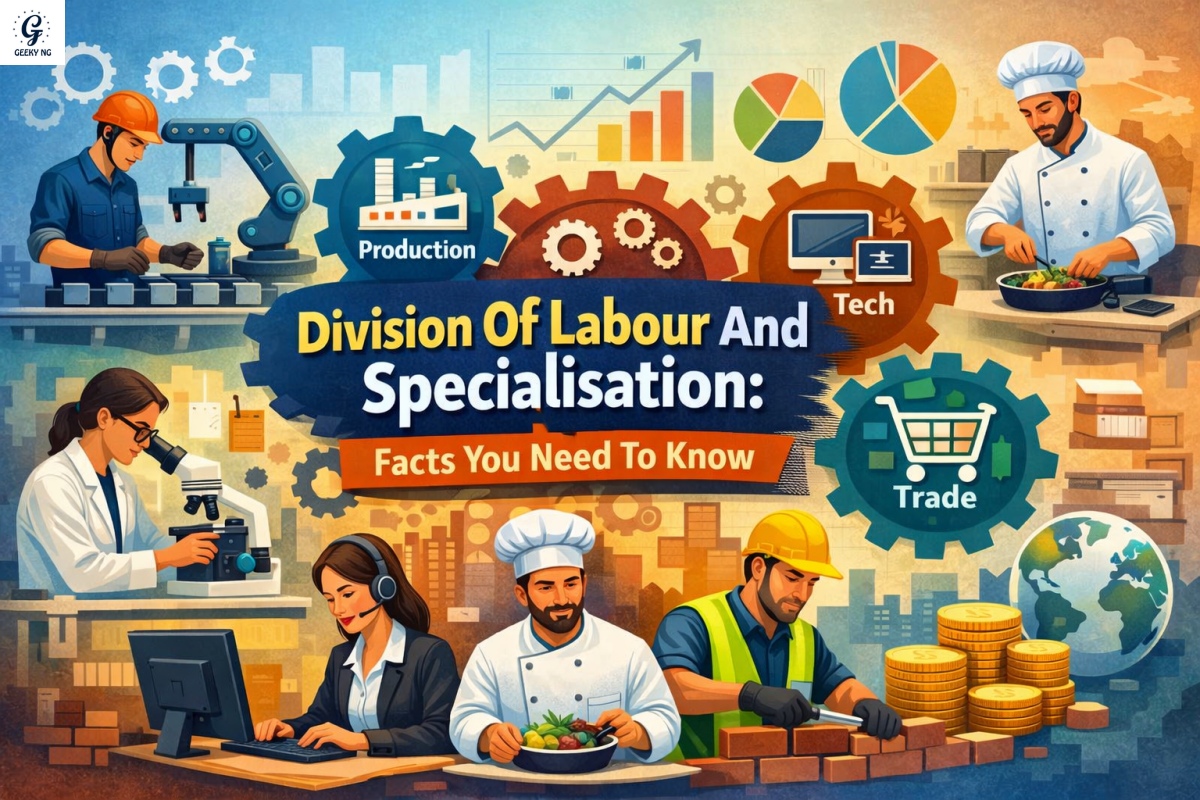
Division of labour and specialisation are viable practices which result-oriented organizations use to maximize efficiency and productivity in their businesses.
The idea of breaking tasks into specific categories and thereof assigning them to specific professionals is not a far-off concept. It is an age-old concept that has kept myriads of firms afloat. This strategy is most implemented because of its orderly and competent outcomes.
Division of labour and specialisation have underrated perks and obvious limitations. Here are some important facts you need to know about them;
Table of Contents
Division of Labour
This is the process of breaking down production activity or task into smaller, specialized parts, with each part assigned to a different individual or group to perform.
Here, instead of one person doing all the work from start to finish, each person focuses on a specific part of the task. This system increases efficiency and productivity because workers become skilled and faster at doing a particular job.
Division of labour is commonly seen in factories, farms and even in homes, where duties are shared among people based on their abilities or preferences.
Specialisation
Specialisation is the process by which individuals, businesses, regions, or countries focus on producing a limited range of goods or services in which they have the most skill, efficiency, or advantage.
Instead of trying to produce everything they need, they concentrate on what they do best and rely on others to supply the rest through trade.
This leads to improved productivity, better quality output, and efficient use of resources, as each party becomes more experienced and proficient in their specific area of work. Specialisation often results from division of labour and plays a key role in economic growth and international trade.
Types of Specialisations
1. Occupational Specialisation:
Occupational specialisation occurs when an individual focuses on a particular occupation or profession, becoming highly skilled in that area. Rather than a person doing many different jobs, one becomes an expert in one.
For example, a person may choose to be a doctor, teacher, welder, or tailor and spend years gaining knowledge and experience in that single field. This allows for greater efficiency and higher quality of work because the person concentrates on one task.
2. Industrial Specialisation:
Industrial specialisation takes place when an entire industry or company focuses on producing a specific type of product or providing a specific service. Rather than making many different goods, the firm channels all its resources into perfecting one.
For example, a company may specialise in making only shoes, cement or soft drinks. This leads to better use of equipment, expertise, and often helps the business to reduce costs and increase production.
3. Regional Specialisation:
Regional specialisation refers to a situation where a particular region or area becomes known for producing a certain product or service due to its natural resources, climate, skills, or tradition.
For example, the northern region of Nigeria is known for groundnut farming, while the southern region may specialise in oil production. This helps regions to produce efficiently and trade with others for goods they do not produce.
4. International Specialisation:
International specialisation happens when a country concentrates on producing goods and services it can create most efficiently and in large quantities, often due to its natural resources, skilled labour or technology.
For instance, Nigeria specialises in crude oil, Ghana in cocoa, and Japan in electronics. Through international specialisation, countries can engage in trade, buying what they don’t produce and selling what they produce best, thereby encouraging global economic cooperation and development.
Advantages of Division of Labour and Specialisation
· Increased Productivity:
When a worker focuses on one specific task, they become more skilled and efficient at it. This leads to faster completion of work and a higher number of goods produced.
Over time, this increased speed and skill result in more output with the same effort, which benefits both the worker and the employer.
· Time-Saving:
Division of labour helps to save time that would otherwise be spent moving from one task to another or learning how to do different jobs.
Since each person focuses on a single job, they can perform it without delay, reducing wasted time and speeding up the overall production process.
· Higher Quality Goods:
When workers specialise in a particular task, they tend to master it and perform it with more accuracy and precision.
This leads to better quality products because the worker becomes experienced and avoids common mistakes, thereby improving the standard of the finished goods.
· Use of Machinery:
Division of labour makes it easier to use machines in production because tasks are broken into simple, repeatable steps.
Machines can be designed to handle specific tasks, which increases efficiency and allows for mass production. Workers also become better at handling the machines for their specific duties.
· Cheaper Products:
As production becomes faster and more efficient due to division of labour and specialisation, the cost of producing each item goes down. This reduction in cost allows producers to sell goods at lower prices, making them more affordable for consumers while still earning profit.
· Development of Talents:
By focusing on one area, workers have the opportunity to develop their natural talents and gain expert knowledge in that task. This can open up more career opportunities for them in the future and allow them to become professionals in their field.
Disadvantages of Division of Labour and Specialisation
· Monotony of Work:
When a worker keeps repeating the same task every day, the job becomes boring and uninteresting. This can reduce motivation and make the worker less productive over time. For example, if someone’s only job is to tighten screws on a machine all day, they may become tired of it and lose interest in the work.
· Loss of Skill and Creativity:
Because a worker only focuses on one part of a job, they may not learn how to do other tasks. Over time, they might lose the ability to perform other activities that require different skills. For instance, a worker who only paints cars may forget how to assemble parts or fix engines, which reduces their overall usefulness.
· Interdependence of Workers:
In a production line, every worker depends on others to complete their part. If one person fails to do their job or if a machine breaks down at one stage, the whole production process may stop. This makes the system fragile, since everyone relies on others to keep things moving.
· Unemployment Due to Technological Change:
When production becomes more specialised, machines are often used to replace human workers. This means that workers who used to do those tasks may lose their jobs. For example, a machine might now package goods faster than a human, making the worker unnecessary and unemployed.
· Limited Job Mobility:
A worker who is specialised in just one task may find it hard to switch jobs if that task is no longer needed. Because their skill is narrow, it may not be useful in other areas. For instance, a worker who only operates a specific factory machine might struggle to get a job in another industry without retraining.
Limitations of Division of Labour and Specialisation
· Small Market Size:
Division of labour and specialisation work best when there is a large market with many people who want to buy the products or services being offered. However, in areas where the population is small or people have limited purchasing power, producers may not sell enough to justify breaking work into different stages.
For example, a shoemaker in a small village may not have enough customers to hire one person to cut, another to sew, and another to polish the shoes.
· Nature of the Product:
Some goods or services are not suitable for division of labour. These are usually products that require personal attention, creativity or custom work. For instance, a barber styling a customer’s hair cannot divide the task among many workers without affecting the quality or satisfaction of the service. Such jobs require one person to do most or all of the work.
· Lack of Capital:
Division of labour often needs machines, tools, and a structured workplace, which can be expensive. If a business does not have enough money (capital) to buy equipment or hire more workers, it may not be able to divide tasks effectively. This is common in small businesses or developing areas where resources are limited and production is done manually.
· Lack of Skill:
For division of labour to be successful, workers must be trained and skilled in specific areas. In places where there is poor education or little access to vocational training, it becomes difficult to find workers who can handle specialised roles. As a result, employers are forced to let one person do many tasks, even if it reduces efficiency.
· Risk of Over-Dependence:
Divided tasks means every worker or department depends on others to complete the final product. If one part fails, it can delay the whole production process. Similarly, countries that specialise in only one product become dependent on other nations for all their other needs, which can be risky during crises or trade restrictions.
Final Thoughts: Division of Labour and Exchange
Division of labour involves breaking down a production process into smaller tasks, with each worker focusing on a specific task. As individuals and firms specialise in particular roles, they become more efficient and produce more goods than they personally need.
This creates the need for exchange, where people trade the surplus of what they produce for other goods and services they do not produce. For example, a farmer who specialises in growing yams may trade with a tailor who makes clothes. In this way, division of labour encourages trade, promotes the use of money, and supports the growth of markets and economic interdependence among individuals, firms, and even countries.