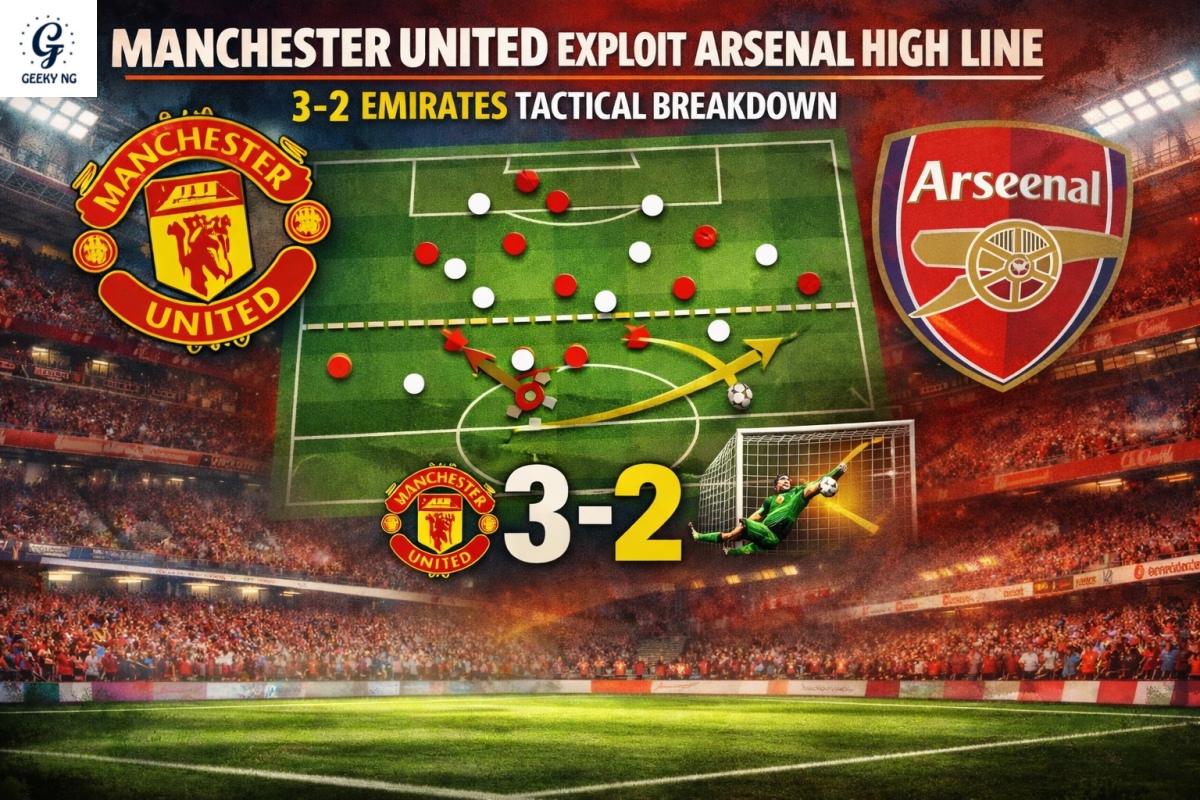
Manchester United delivered a tactical masterclass at the Emirates Stadium on Sunday, exploiting Arsenal’s aggressive high defensive line to secure a dramatic 3-2 victory that has blown the Premier League title race wide open.
The result ended Arsenal’s perfect home record this season and showcased Michael Carrick’s side at their counter-attacking best, capitalizing ruthlessly on the spaces the Gunners left exposed in their pursuit of goals.
Arsenal entered the contest with an opportunity to extend their advantage at the summit to seven points following earlier results, but instead saw their cushion reduced to just four points after a performance that raised serious questions about their defensive vulnerability.
For United, sitting fourth on 38 points, the victory represents their second statement win in recent weeks and signals their growing credentials as genuine top-four contenders.
The contest epitomized the tactical battle between two contrasting philosophies: Arsenal’s possession-based dominance versus United’s devastating efficiency on the break. Whilst the Gunners controlled 57% of possession and forced nine corners, it was the visitors’ clinical edge in transition that proved decisive, with United scoring three goals from a limited number of clear-cut opportunities.
The match statistics tell a fascinating story of tactical execution over territorial superiority, with United goalkeeper Senne Lammens producing three spectacular saves to preserve his side’s slender advantage during periods of sustained Arsenal pressure.
This Emirates thriller will be remembered not just for its drama, but for the tactical lessons it provided about the risks inherent in playing a high defensive line without adequate protection.
Table of Contents
Arsenal’s High-Risk Defensive Strategy Backfires
Arsenal’s commitment to a high defensive line has been instrumental in their title challenge this season, allowing them to compress the pitch and suffocate opponents in their own half. However, against United’s pace and directness, this approach became a significant liability. The Gunners’ backline repeatedly pushed up beyond the halfway line, leaving vast expanses of space for United’s quick forwards to exploit.
Bryan Mbeumo’s 37th-minute equaliser perfectly illustrated this vulnerability. Following Martin Zubimendi’s loose pass in midfield, United transitioned with lightning speed, catching Arsenal’s defenders stranded high up the pitch. Mbeumo, demonstrating composure beyond his years, capitalized on the space afforded to him and finished clinically to restore parity just eight minutes after Lisandro Martínez’s unfortunate own goal had given Arsenal the lead.
The pattern repeated itself five minutes into the second half when Patrick Dorgu thundered home United’s second. Once again, Arsenal’s defensive line had pushed aggressively forward, creating the kind of space that elite attackers crave. Dorgu’s strike, which crashed against the underside of the crossbar before nestling in the net, stunned the Emirates faithful and demonstrated United’s ruthless exploitation of tactical weaknesses.
Carrick’s Counter-Attacking Blueprint
Michael Carrick’s tactical approach centered on defensive solidity and explosive transitions. United sat in a compact mid-block, absorbing Arsenal’s possession and waiting patiently for opportunities to strike. This disciplined structure frustrated the hosts, who despite their territorial dominance struggled to create high-quality chances against United’s well-organized defensive shape.
Kobbie Mainoo’s performance in midfield proved crucial to United’s game plan. The young midfielder’s ability to shield the defense whilst quickly releasing forward passes enabled United to bypass Arsenal’s press and launch attacks at pace. His vision and execution in setting up Matheus Cunha’s decisive 87th-minute winner exemplified the intelligence underpinning United’s approach.
Arsenal’s Set-Piece Prowess Keeps Them Alive
Despite their defensive frailties, Arsenal demonstrated their considerable threat from dead-ball situations. Mikel Merino’s 84th-minute equalizer, bundled home from close range following one of Arsenal’s nine corners, briefly appeared to have salvaged a point for the hosts. The Gunners’ set-piece coaching has been among the Premier League’s finest this season, and they consistently troubled United’s defense from these situations.
However, United’s ability to withstand this pressure and then deliver the killer blow three minutes later speaks to their growing maturity under Carrick. Cunha’s magnificent curling effort from outside the area sealed a famous victory and highlighted the fine margins that separate success from disappointment at the elite level.
Implications for the Title Race
This result carries significant ramifications for the Premier League’s top four. Arsenal, now winless in three league matches, remain top on 50 points but will feel the pressure mounting as Manchester City and Aston Villa, both on 46 points, circle ominously. Questions will inevitably be asked about whether Arsenal’s defensive approach requires adjustment, particularly against opponents with genuine pace in transition.
For United, this victory validates Carrick’s tactical approach and demonstrates their capacity to compete with the division’s elite. Their recent wins against both Manchester City and Arsenal suggest a team finding its identity at precisely the right moment in the season.