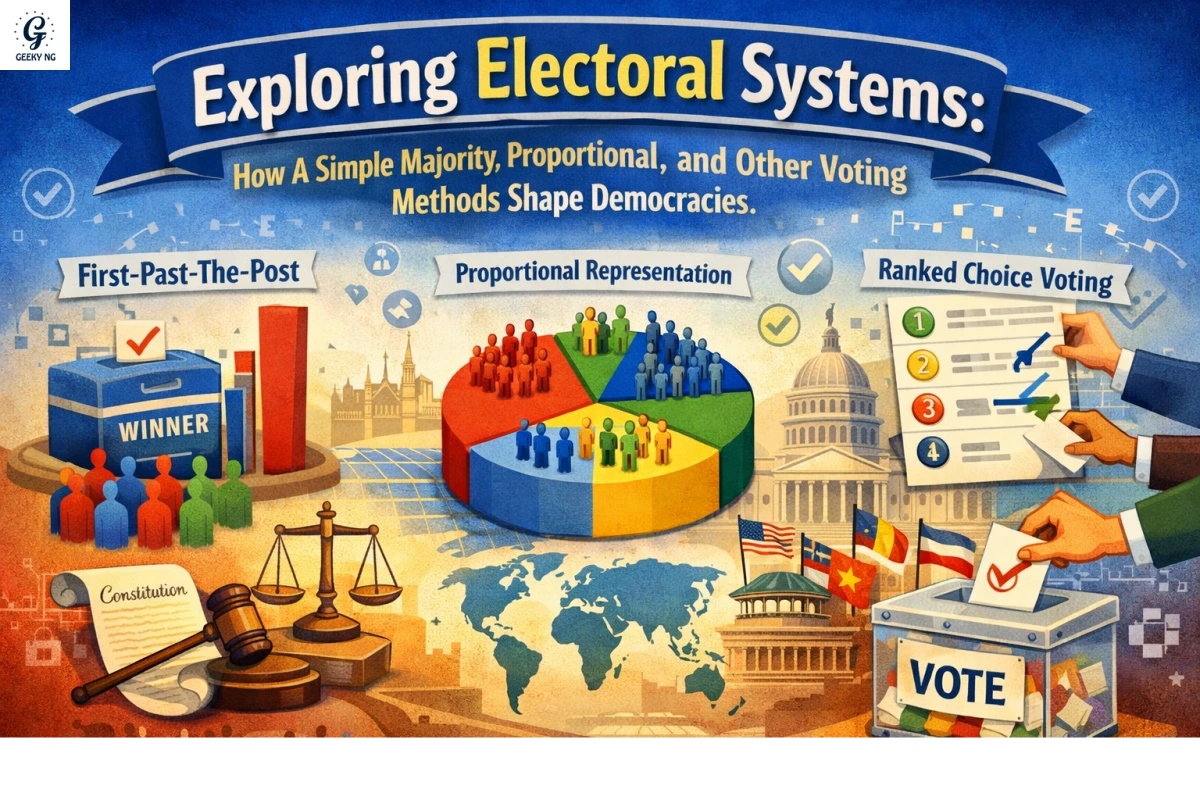
Electoral systems play a crucial role in shaping how democracies function around the world.
The way votes are counted and translated into seats can drastically affect the outcome of elections and the representation of citizens. Different countries use various voting methods, each with its strengths and weaknesses.
Understanding these systems helps us see how they influence political decisions and the fairness of the democratic process. In this note, we will explore the key types of electoral systems, how they work, and their impact on the way democracy functions.
Table of Contents
SIMPLE MAJORITY SYSTEMS
The simple majority system is one of the most widely used electoral systems globally. In this system, the candidate with the most votes wins the election.
This approach is sometimes referred to as “first-past-the-post” or “winner-takes-all.” The simple majority system does not require a candidate to achieve a specific percentage of votes; rather, the candidate with the highest number of votes is declared the winner.
The simple majority system is commonly used in single-member constituencies, where one representative is elected to represent a particular area or district. This system is straightforward to understand, which contributes to its widespread adoption. E.g., the United States (presidential elections), the United Kingdom (parliamentary elections), and Nigeria (National Assembly elections).
Advantages of the Simple Majority System:
- Easy to understand and implement.
- Clear and quick results.
- Encourages a two-party system, promoting stable government.
- Voters’ choices are easy to count.
Disadvantages of the Simple Majority System:
- Can result in a winner with less than half the votes, leading to minority rule.
- May discourage smaller parties or independent candidates.
- Often leads to “safe seats” where a party has uncontested dominance.
- It can reduce voter turnout, as some may feel their vote doesn’t count.
ABSOLUTE MAJORITY SYSTEM
The absolute majority system requires a candidate to receive more than 50% of the votes to win an election. This system ensures that the winner has broad support from the electorate, which can lead to more stable and effective governance.
If no candidate achieves an absolute majority in the first round of voting, a runoff election may be held between the top two candidates to determine the winner. This system is often used in presidential elections. E.g., France (presidential elections) and Australia (alternative vote system).
Advantages of the Absolute Majority System:
- Ensures that the winner has majority support, leading to more stable governance.
- Reduces the likelihood of extremism, as candidates must appeal to a wider audience.
- Promotes coalition-building and consensus politics.
Disadvantages of the Absolute Majority System:
- The need for a second-round runoff can increase costs and extend the election period.
- Voter fatigue or disillusionment may arise due to the extra round of voting.
- Smaller parties or candidates may be excluded from the process, leading to a lack of diversity in government.
PROPORTIONAL REPRESENTATION SYSTEM
The proportional representation system is designed to reflect the diversity of voter preferences in the composition of the elected body.
In this system, seats are allocated to parties or groups based on the proportion of votes they receive. This approach ensures that smaller parties and minority groups have a voice in the legislative body.
Proportional representation systems are often used in multi-member constituencies, where multiple representatives are elected to represent a particular area or district. E.g., Germany (federal elections) and New Zealand (parliamentary elections).
Advantages of the Proportional Representation System:
- Encourages a diverse range of political parties and ideas.
- Ensures minority groups have a voice in government.
- Promotes fairer representation of voters’ choices.
Disadvantages of the Proportional Representation System:
- It may lead to coalition governments, which can be unstable.
- Can make it harder to form a clear majority, resulting in gridlock.
- Voters may feel less directly connected to their representatives.
DIRECT ELECTORAL SYSTEM
The direct electoral system allows citizens to directly vote for their representatives or leaders. This approach is often used in presidential or parliamentary elections, where citizens choose their leaders or representatives directly. E.g., the United States (presidential elections) and Nigeria (presidential elections).
Advantages of the Direct Electoral System:
- Promotes direct accountability of leaders to the people.
- Encourages greater citizen participation and engagement in the political process.
- Clear and unambiguous result, with no intermediaries.
Disadvantages of the Direct Electoral System:
- May lead to populism, with candidates focusing on winning votes through popularity rather than effective governance.
- It can result in voters choosing candidates based on charisma rather than policy.
- Risks creating divisive and polarised political environments.
INDIRECT ELECTORAL SYSTEM
The indirect electoral system involves citizens electing representatives who then choose leaders or representatives. This approach is often used in parliamentary systems, where citizens elect members of parliament who then select the prime minister or other leaders. E.g., the United Kingdom (parliamentary system) and Germany (Bundesrat).
Advantages of the Indirect Electoral System:
- Promotes deliberative decision-making among elected representatives.
- Can lead to more stable governance as the leaders are selected by a group rather than directly by the public.
- Encourages collaboration and negotiation among politicians.
Disadvantages of the Indirect Electoral System:
- Reduces the direct influence of citizens on the selection of leaders.
- May create a disconnect between citizens and elected leaders.
- It can lead to less transparent decision-making, with citizens unable to see who is responsible for leadership choices.
SPECIAL CASE FOR PRESIDENTIAL ELECTIONS IN NIGERIA
In Nigeria, the presidential election has a unique electoral system that combines the principles of the simple majority system with the requirement of securing a certain number of votes across the country.
For a candidate to win in the first round, they must:
- Secure the highest number of votes nationwide (simple majority).
- Win at least 25% of the votes in at least two-thirds (24 states) of Nigeria’s 36 states and the Federal Capital Territory (FCT).
If no candidate achieves both conditions, a runoff election is held between the top two candidates. This special requirement ensures that the winner has broad national support and not just a majority in a few regions.
Final Thoughts
Understanding the different types of electoral systems is crucial for appreciating the complexities of democratic governance.
Each system has its strengths and weaknesses, and the choice of system can significantly impact the nature of representation, governance, and the effectiveness of democratic institutions.
Whether a system encourages broader participation, ensures stability, or promotes diverse representation, it plays a key role in shaping how a country functions politically.
Read also: Elections and the Electoral Process: Building Democratic Governance in Nigeria
POSSIBLE ASSESSMENT QUESTIONS & ANSWERS
Objective Questions
1. Which of the following is another name for the simple majority system?
A) First-past-the-post
B) Majority voting
C) Proportional representation
D) Two-round system
E) Direct electoral system
Answer: A
2. In the absolute majority system, what percentage of votes is required to win?
A) 45%
B) 50%
C) 60%
D) 55%
E) 40%
Answer: B
3. Which electoral system ensures that seats are allocated based on the proportion of votes a party receives?
A) Simple majority
B) Absolute majority
C) Proportional representation
D) Indirect system
E) Direct system
Answer: C
4. Which country uses the proportional representation system in parliamentary elections?
A) United States
B) Germany
C) United Kingdom
D) Australia
E) Nigeria
Answer: B
5. What is one advantage of the direct electoral system?
A) Promotes deliberative decision-making
B) Encourages greater citizen participation
C) Often leads to coalition governments
D) Reduces political party competition
E) Makes it difficult to form a majority
Answer: B
6. Which of these electoral systems is most likely to result in coalition governments?
A) Simple majority system
B) Absolute majority system
C) Proportional representation system
D) Indirect electoral system
E) Direct electoral system
Answer: C
7. Which of the following is NOT a disadvantage of the simple majority system?
A) Can result in minority rule
B) Can lead to a two-party system
C) Can create safe seats
D) Results in coalition governments
E) May discourage smaller parties
Answer: D
8. In the indirect electoral system, who chooses the leaders?
A) Citizens directly
B) A group of elected representatives
C) Political parties
D) Electoral commission
E) The President
Answer: B
9. What is the unique feature of Nigeria’s presidential election system?
A) Simple majority system
B) The candidate must win 25% in at least two-thirds of states
C) The winner must secure a proportional vote
D) Runoff elections are never held
E) All citizens vote for the prime minister
Answer: B
10. Which of the following is an example of a country that uses the absolute majority system for presidential elections?
A) United States
B) Nigeria
C) France
D) Germany
E) United Kingdom
Answer: C
Theoretical Questions
1. Explain the main feature of the simple majority system and give an example of a country that uses it.
Answer: The simple majority system is where the candidate with the highest number of votes wins, even if they do not have more than half the votes. An example of a country that uses the simple majority system is the United Kingdom in parliamentary elections.
2. What are the advantages and disadvantages of the proportional representation system?
Answer: The proportional representation system ensures a fair distribution of seats based on the votes each party receives. This gives smaller parties a voice. However, it often leads to coalition governments, which may be unstable. This system is used in countries like Germany.
3. How does the absolute majority system promote stability in governance?
Answer: The absolute majority system requires a candidate to secure more than 50% of the votes, ensuring that the winner has broad support. This system promotes stability by minimizing the risk of extremism and encouraging candidates to appeal to a wider electorate. It is used in countries like France.
4. What is the special feature of the Nigerian presidential election system that sets it apart from other countries?
Answer: The Nigerian presidential election system requires the candidate to win the most votes nationwide (simple majority) and to secure at least 25% of the votes in at least two-thirds of Nigeria’s states and the Federal Capital Territory (FCT). This ensures that the winner has broad national support.
5. Compare the direct electoral system with the indirect electoral system in terms of voter participation.
Answer: In the direct electoral system, citizens directly vote for their representatives or leaders, promoting higher voter participation and accountability. While, the indirect electoral system involves citizens electing representatives who then choose the leaders, reducing direct voter influence on leadership selection but promoting more deliberative decision-making.