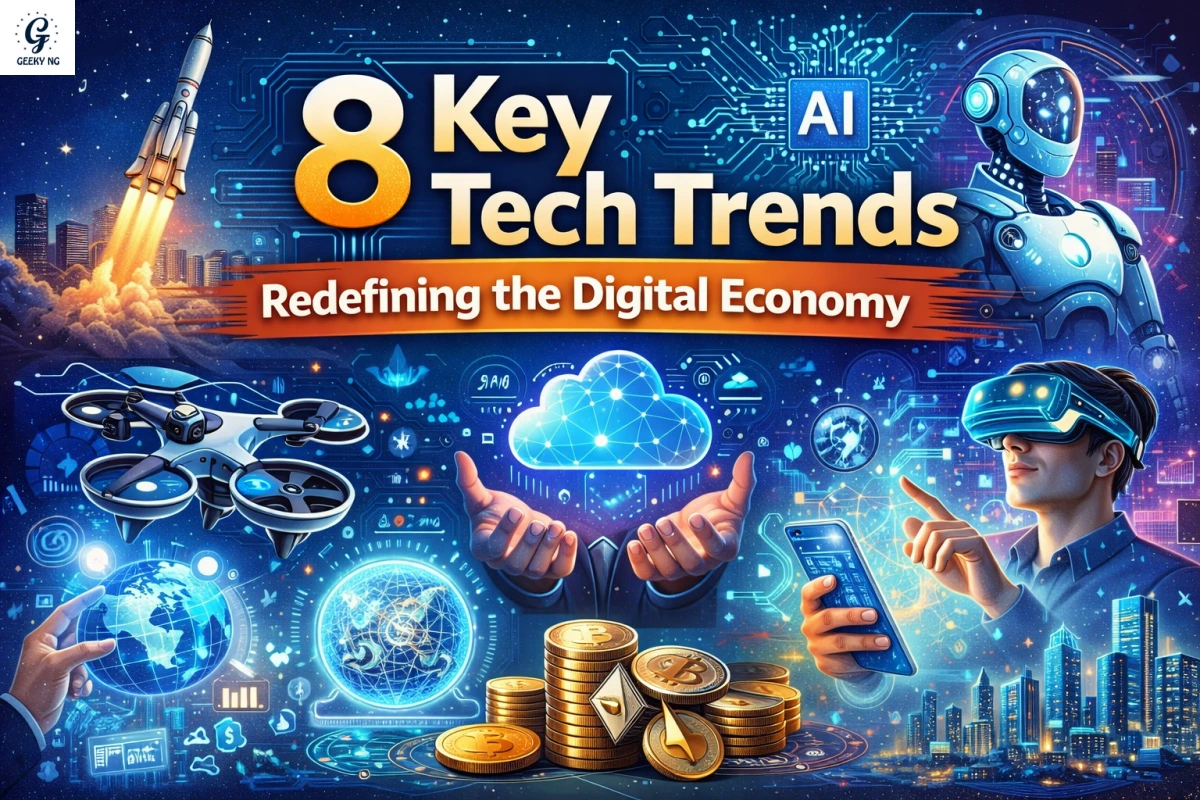
The digital economy is transforming how people live, work, communicate, and transact.
New technologies are emerging to reshape industries at a fast rate, strengthened by rapid innovation and accelerated by global shifts like remote work. These digital trends are setting higher in the 21st century, from smarter AI to decentralized finance.
Table of Contents
The key technology trends include:
1. Artificial Intelligence and Machine Learning: The Intelligence Layer of the Digital Economy
In the world today, AI isn’t just a a regular word — it’s now the core of business operations across various sectors. AI systems has made it possible to automate repetitive tasks, improve workflows, and reduce cost of operation.
Different machine learning models can now analyze datasets that ordinarily seem overwhelming to reveal trends, impact decision-making, and personalize customer experiences.
For instance, chatbots improve accessibility and enhance customer service. AI is a key to differentiate competitiveness as it scales from automations to smart supply chains, amongst other things.
2. Cloud and Edge Computing: Infrastructure for Digital Growth
The major backbone contributing to the up-scalability of the digital economy is cloud computing. Organizations now prefer multi-cloud and hybrid cloud, thereby distributing workloads across multiple providers for optimization.
Edge computing is a renowned complement for cloud. It is specifically very useful in real-time analytics and applications like IoT.
3. Redefining Trust, Ownership, and Value Transfer through Web3 and Blockchain
These tools help to decentralise, disrupting traditional digital infrastructures that have been put in place. Major themes include decentralised finance (DeFi), non-fungible tokens (NFTs), and smart contracts.
4. Internet of Things (IoT): Connecting the Physical and Digital Worlds
IoT is the network of devices that are connected one way or the other. It ranges from smart thermostats to industrial sensors and is useful in generating streams of data. It optimizes energy usage and reforms traditional business models.
5. 5G and Next-Gen Connectivity: Faster, More Reliable Digital Access
The emergence of 5G networks is increasing connection speeds, and enabling devices to work concurrently. It provides a platform for immersive technologies such as virtual reality (VR) and augmented reality (AR). It improves mobile commerce and other digital services.
6. Cybersecurity and Digital Trust: Protecting the Digital Economy
Security threats is on the increase as digital adoption grows. A strategic priority for businesses and government to be protected from this is cybersecurity. Technologies that enhance privacy have been developed to aid this.
7. Quantum Computing: The Next Frontier of Computing Power
Thought not at the forefront yet, quantum computing has the capacity to solve problems that are way beyond the abilities of classical computing. It is on a mission to maximize difficulties in finance and logistics optimization, and advance drug discovery.
8. Digital Payments and Financial Technologies (FinTech)
This technology is now widely known. The seamless movement of money has helped the digital economy thrive so well. This has led to the establishment of mobile wallets, digital banks, amongst others.
Overall, it has impacted the evolution of finance. Consumers are in love with it because of reduction in transaction costs and its enabling of new business models.
Final Thoughts
The digital economy is on a roll. From traditional banking to e-commerce and all, there is still more to come. The world concurs with this evolution, no doubt.
Read Also: Top 10 Tech Skills Nigerian Employers Are Looking For