Table of Contents
Introduction
Economists use mathematical and statistical tools to analyse data and solve problems. These tools help in making decisions about production, prices, income, and employment.
In this lesson, we will study some basic tools used in economic analysis.
Linear Equations
A linear equation is a mathematical statement that shows the relationship between numbers and an unknown value, where the unknown appears only to the power of one.
This means the variable is not squared or raised to any higher power. Linear equations usually form a straight line when drawn on a graph and are used in economics to represent simple relationships such as cost, revenue, demand, and supply. An example of a linear equation is 2x + 5 = 15.
How to Solve Linear Equations
To solve a linear equation, we find the value of the unknown.
Example 1
Solve: 2x + 5 = 15
Step 1: Subtract 5 from both sides.
2x + 5 – 5 = 15 – 5
2x = 10
Step 2: Divide both sides by 2.

x=5
Example 2
Solve: 3x – 4 = 11
3x = 11 + 4
3x = 15
x = 5
Importance of Linear Equation in Economics
- Price determination: Linear equations help economists and business owners to calculate prices in simple market situations. For example, when the cost of producing goods and the expected profit are known, a linear equation can be used to determine the selling price. This makes it easier for firms to set prices that cover costs and also attract customers.
- Quantity determination: Linear equations are useful in finding the quantity of goods to produce or sell. By using simple demand or supply relationships, producers can estimate how much to supply in order to avoid shortages or surplus. This supports better planning and efficient use of resources.
- Cost analysis: Businesses use linear equations to calculate total cost, fixed cost, and variable cost. This helps managers understand how costs change when production increases or decreases. As a result, firms can make better decisions about expansion, production levels, and budgeting.
- Revenue calculation: Linear equations are used to calculate total revenue from the sale of goods and services. By multiplying price by quantity, firms can easily form equations that show how revenue changes. This helps in forecasting sales and setting business targets.
- Profit planning: Profit is the difference between total revenue and total cost. Linear equations help firms to calculate profit and also determine the level of output where profit is highest. This allows businesses to plan for growth, reduce losses, and improve performance.
Simultaneous Equations
Simultaneous equations are a set of two or more equations that contain the same unknown variables and are solved at the same time in order to find the correct values of those variables. The solution must satisfy all the equations together, not just one of them.
In economics, they are used to show relationships between different variables such as demand and supply, where the value of one variable depends on another.
Methods of Solving
Here are two methods to solve simulteaneous equations:
Substitution method
The substitution method involves making one variable the subject of the formula in one equation and then replacing it in the other equation.
Steps:
- Choose one of the equations and make one variable the subject of the formula.
- Substitute the expression for that variable into the second equation.
- Solve the new equation to get the value of one variable.
- Substitute the value obtained back into any of the original equations.
- Solve to get the value of the second variable.
- Check the answers by substituting them into both equations.
Example 3
Solve:
2x + y = 7
x = 3 – y
Step 1: Substitute x = 3 – y into the first equation.
2(3 – y) + y = 7
Step 2: Expand and simplify.
6 – 2y + y = 7
6 – y = 7
Step 3: Solve.
–y = 7 – 6
–y = 1
y = –1
Step 4: Substitute y into x = 3 – y.
x = 3 – (–1)
x = 4
Therefore, x = 4 and y = –1.
Elimination method
The elimination method involves removing one of the variables by adding or subtracting the equations.
Steps:
- Write the equations in standard form.
- Make the coefficients of one variable the same in both equations. This may require multiplying one or both equations.
- Add or subtract the equations so that one variable is eliminated.
- Solve the resulting equation to get the value of one variable.
- Substitute this value into any of the original equations.
- Solve to find the second variable.
- Check the solution by substituting the values into both equations.
Example 4
Solve:
x + y = 10
x – y = 2
Step 1: Add both equations.
(x + y) + (x – y) = 10 + 2
2x = 12
x = 6
Step 2: Substitute x into one equation.
6 + y = 10
y = 4
Importance of Simultaneous Equations in Economics
- Demand and supply analysis: Simultaneous equations are very important in analysing demand and supply in the market. Economists use them to represent the demand and supply functions, which depend on price and quantity. By solving these equations together, it becomes possible to understand how consumers and producers behave and how changes in factors such as income, taxes, or cost of production affect the market.
- Market equilibrium determination: One major use of simultaneous equations in economics is to determine the equilibrium price and quantity in a market. Equilibrium occurs where demand equals supply. Since both demand and supply are represented by different equations, they must be solved at the same time to find the point where they are equal. This helps businesses and governments to make decisions about pricing, production, and policy.
- Income and expenditure models: Simultaneous equations are also used in national income analysis. Economists use them to study the relationship between income, consumption, investment, and savings. These relationships often depend on one another, so solving the equations together helps to determine the level of national income in an economy. This is useful for planning economic growth and development.
Word Problems Leading to Equations
Word problems leading to equations refer to questions that describe real-life economic or everyday situations using words instead of numbers and symbols.
In such problems, students are required to carefully read and understand the situation, identify the unknown values, and then translate the information into mathematical statements in the form of linear or simultaneous equations.
This process helps students to connect mathematics with practical economic activities such as buying and selling, production, budgeting, and income distribution.
By forming and solving these equations, students can find solutions to real problems and make better economic decisions.
Steps to Solve
- Read the problem carefully.
- Identify the unknown.
- Form an equation.
- Solve the equation.
- Interpret the answer.
Example 5
The cost of 3 pens and 2 notebooks is 700 naira. If each pen costs 100 naira, find the price of a notebook.
Let the price of a notebook be x.
3(100) + 2x = 700
300 + 2x = 700
2x = 400
x = 200
Example 6
The sum of two numbers is 20 and their difference is 4.
Let the numbers be x and y.
Step 1: Form equations from the statement.
Sum means addition: x + y = 20
Difference means subtraction: x – y = 4
Step 2: Add the two equations.
(x + y) + (x – y) = 20 + 4
Step 3: Simplify.
2x = 24
Step 4: Solve for x.
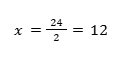
Step 5: Substitute the value of x into one of the equations.
12 + y = 20
Step 6: Solve for y.
y = 20 – 12
y = 8
Therefore, the two numbers are 12 and 8.
Final Thoughts
Basic mathematical and statistical tools help economists to understand and analyse economic problems. They help in decision making and planning.
Read more: Meaning Of Economics And Related Concepts