Table of Contents
Introduction
In Economics, we deal with many figures such as prices, income, production, population, growth rates, and costs. To understand these figures clearly and make meaningful comparisons, economists use statistical tools known as average or mean.
While students are familiar with the arithmetic mean, there are other important averages used in economic analysis, especially when dealing with growth rates, ratios, and large variations in data. These include the Geometric Mean, the Harmonic Mean, and the Quadratic Mean.
Each of these tools serves a specific purpose and helps economists analyze data more accurately and make sound economic decisions.
Meaning
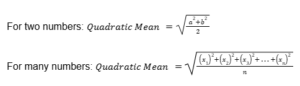
The Quadratic Mean, also known as the Root Mean Square, is a type of average obtained by first squaring each value in a data set, finding the arithmetic mean of those squared values, and then taking the square root of that mean.
This method gives greater weight to larger values because squaring makes big numbers much larger. It is useful when dealing with data where large values are more important, such as in measuring variation or in certain economic and statistical calculations.
The quadratic mean is usually equal to or greater than the arithmetic mean, except when all the values are the same.
Formula
Examples
Example 1: Find the quadratic mean of 3 and 4.

Quadratic Mean ≈ 3.54
Example 2: Find the quadratic mean of 2, 4 and 6.

Quadratic Mean ≈ 4.32
Advantages of Quadratic Mean
It gives more weight to larger values
One major advantage of the Quadratic Mean is that it gives more importance to larger numbers. This happens because each value is squared before calculating the average. When a number is squared, it becomes much larger, especially if it is already big.
For example, 10 squared becomes 100, while 2 squared becomes only 4. This means large values influence the final result more than small values. In economic analysis, this is useful when large variations or high figures must be carefully considered, such as in measuring income differences or large production outputs.
It is useful in measuring variation
The Quadratic Mean is helpful when economists want to measure variation or dispersion in data. Since it squares each value, it removes negative signs and focuses on the magnitude of differences. This makes it useful in statistical calculations that involve fluctuations, such as changes in prices, output levels, or economic performance.
In advanced economics and statistics, it forms the basis for calculating measures like standard deviation, which helps economists understand how widely values are spread around the average.
It is important in statistics and economics research
Another advantage is that the Quadratic Mean is widely used in scientific, statistical, and economic research. Many advanced economic models and statistical formulas depend on squared values. For example, when economists analyse errors in forecasting or measure variability in economic data, the Quadratic Mean is applied.
Its mathematical properties make it reliable for research work where precision is important. Although it is not commonly used in simple classroom calculations, it plays an important role in higher-level economic studies.
It is always greater than arithmetic mean for unequal values
The Quadratic Mean is always greater than the arithmetic mean when the values are not equal. This is useful because it shows clearly when there is variation in data. If all the values are the same, both means will be equal. But when the values differ, the Quadratic Mean becomes larger, reflecting the presence of differences in the data set.
This property helps economists understand the degree of inequality or fluctuation in economic figures, such as income distribution or changes in production levels.
Disadvantages of Quadratic Mean
It is more difficult to calculate
The quadratic mean involves several steps. Each value must first be squared, then all the squared values are added together, divided by the total number of values, and finally the square root is taken. This process is longer than that of the arithmetic mean or even the geometric mean.
For students at Grade 11 level, this can be confusing, especially when dealing with many numbers. Without a calculator, the calculation can take time and may lead to mistakes.
It is affected by very large values
The quadratic mean gives more weight to large numbers because the values are squared before averaging. When a number is squared, it becomes much larger. For example, 10 squared is 100, while 2 squared is only 4. This means that if one value in a set is very large, it can dominate the result and make the average appear higher than most of the data.
As a result, it may not give a true picture of the overall situation.
It is not commonly used in basic economic analysis
In everyday economic studies at secondary school level, most calculations use the arithmetic mean. The geometric mean is used for growth rates, and the harmonic mean is used for rates and ratios.
The quadratic mean is mainly used in advanced statistics, engineering, and scientific research. Because it is not frequently applied in basic economics, students may not see its practical use in common economic problems.
It may give a value that does not represent the real situation clearly
Since the quadratic mean gives extra importance to large values, the final result can be higher than most of the numbers in the data set. This can make interpretation difficult. In economic analysis, an average should help explain the general trend of the data.
However, the quadratic mean may exaggerate the effect of extreme values and make the data appear more spread out than it actually is.
Final Thoughts
Quadratic Mean is used when large values need more emphasis. This tool helps economists analyze data correctly and make better decisions.
Read more: The Nature of Mathematics: Read Online or Download