Lesson Objectives
By the end of this lesson, students should be able to:
- Define and explain measures of central tendency.
- Calculate the mean, mode, and median from a given data set.
- State the merits and demerits of each measure.
- Apply the concepts to simple real-life economic data.
Meaning of Measures of Central Tendency
Measures of central tendency are statistical tools used to find a single value that best represents or summarizes a set of data. They show the “center” or most typical value in a distribution of numbers. In Economics, these measures help us to make sense of data such as income levels, prices, production output, and consumption patterns by identifying what is common or average within a group. The three main types of measures of central tendency are the mean, mode, and median.
Mean
The mean, also known as the average, is a measure of central tendency that represents the sum of all the values in a data set divided by the number of values. It gives a single value that summarizes the entire data set and helps to identify a central or typical value. The mean is commonly used in economics to find average income, expenditure, production, or prices.
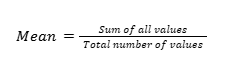
Example 1: Calculating Mean Test Score
A student took five Economics tests and scored the following marks: 60, 75, 70, 65, and 80. Find the mean (average) score.
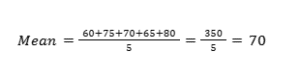
So, the student’s average score across the five tests is 70. This gives a general idea of the student’s overall performance.
Merits of Mean
One of the major merits of the mean is that it is easy to calculate and understand. The process simply involves adding all the values in a data set and dividing the total by the number of values. This simplicity makes it a popular and widely used measure in economics, statistics, and daily life situations. Students, researchers, and policymakers can quickly determine the average of figures such as income, prices, or test scores. Additionally, the mean makes use of every value in the data set, which gives it a comprehensive view of the entire distribution.
Demerits of Mean
A key disadvantage of the mean, is that it is easily affected by extreme values, also known as outliers. For instance, if one value in the data is much higher or lower than the others, it can distort the mean and make it less accurate as a representative of the data set. Another limitation is that the mean may not be a value that actually appears in the data. This makes it sometimes less meaningful in practical situations, especially when dealing with small or unusual data sets.
Mode
The mode is a measure of central tendency that refers to the value that appears most frequently in a data set. It is the only measure that can be used with both numerical and categorical data, making it useful in many economic and statistical analyses. The mode is especially helpful when identifying consumer preferences or the most frequent economic outcomes.
Example 2: Numerical Data
Data Set: 4, 6, 7, 7, 8, 9, 10
In this set, the number 7 appears twice, while all other numbers appear only once.
Therefore, the mode = 7.
Example 3: Categorical Data
Data Set (Students’ Favorite Fruits): Banana, Apple, Orange, Banana, Apple, Banana, Mango
Banana appears three times, which is more than any other fruit.
Therefore, the mode = Banana.
Example 4: Multi-Modal Data
Data Set: 3, 5, 5, 7, 7, 9, 10
In this set, the numbers 5 and 7 both appear twice, while the other numbers appear only once. Since two different values occur with the highest and equal frequency, the data set has two modes. Therefore, the set is bimodal, and the modes are 5 and 7.
Merit of Mode
The mode is a very simple and easy-to-understand measure of central tendency. Its greatest advantage is that it identifies the most frequently occurring value in a data set, which can be very useful in identifying trends or popular preferences. For example, in business or economics, the mode can show the most commonly purchased product or the most popular price range. Another benefit of the mode is that it is not affected by extreme values or outliers, making it a good choice when the data is heavily skewed or has irregular values. The mode can also be used for non-numerical data, such as colors, brands, or categories.
Demerit of Mode
One disadvantage is that a data set may not have a mode at all, especially if no number repeats. In some cases, there may be more than one mode, making interpretation confusing. Another issue is that the mode does not use all the values in the data set, which means it may not reflect the overall distribution accurately. This can make the mode a weak measure when comparing different groups or making detailed economic decisions.
Median
The median is a measure of central tendency that represents the middle value in a set of data when the values are arranged in ascending (or descending) order. If the number of values in the dataset is odd, the median is the exact middle number. However, if the number of values is even, the median is calculated by taking the average of the two middle numbers. The median is particularly useful when analyzing data with extreme values or outliers, as it is not affected by unusually high or low numbers.
Steps to Calculate Median
- Arrange data in order.
- If odd number of values, pick the middle one.
- If even number, average the two middle values.
Example 5 (odd)
Data Set: 9, 7, 11, 4, 10
Step 1: Arrange the numbers in order: 4, 7, 9, 10, 11
Step 2: Count the number of values: 5 (odd).
Step 3: Find the middle number: The 3rd value is 9.
Answer: Median = 9
Example 6 (even)
Data Set: 9, 8, 14, 5, 12, 11
Step 1: Arrange the numbers in order: 5, 8, 9, 11, 12, 14
Step 2: Count the number of values: 6 (even).
Step 3: Identify the two middle values: 9 and 11
Step 4: Find the average of the two middle values:
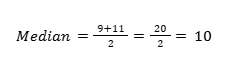
Answer: Median = 10
Merits of the Median
The median is a useful measure of central tendency, especially when dealing with skewed or uneven data. One major advantage is that the median is not affected by extreme values. This means that even if the highest or lowest numbers are far from the rest of the data, the median still gives a fair representation of the middle. It is particularly useful in income distribution, where a few very high incomes could distort the average, but the median shows the typical income level more clearly. The median also gives a clear middle point, helping to divide the data into two halves.
Demerits of the Median
Despite its strengths, the median also has some drawbacks. One disadvantage is that it does not consider all the values in the data set—only the position of the middle value is used. This means important information might be ignored. Additionally, when the number of values is even, the median is calculated by averaging the two middle numbers, which may not be as straightforward. Finally, in complex data sets with many repeated values or grouped data, finding the median can be more difficult and may require arranging the data carefully or using formulas.
Final Thoughts
- Mean is the average value.
- Mode is the most frequent value.
- Median is the middle value.
- Each measure has strengths and weaknesses.
- They help economists summarize and interpret data.
Read also: Meaning of Economics and Related Concepts