
Lesson Objectives
By the end of this lesson, students should be able to:
- Define and explain the concepts of demand and supply.
- Explain how demand and supply determine price.
- Describe the concept of equilibrium.
- Identify the determinants of equilibrium price, quantity, and point.
- Explain how changes in demand and supply affect equilibrium.
- Apply the concept of demand and supply to real-life situations.
Introduction To Demand and Supply
Demand and supply are two fundamental concepts in economics that determine how goods and services are exchanged in the market.
Demand refers to the quantity of a good or service that consumers are willing and able to purchase at different prices over a given period of time. According to the law of demand, as the price of a good decreases, the quantity demanded increases, and as the price increases, the quantity demanded decreases, assuming other factors remain constant.
On the other hand, supply is the quantity of a good or service that producers are willing and able to offer for sale at various prices over a period of time. The law of supply states that as the price of a good rises, the quantity supplied increases, and as the price falls, the quantity supplied decreases, all other factors being equal. These two forces interact in the market to determine the prices of goods and services.
Concept Of Equilibrium
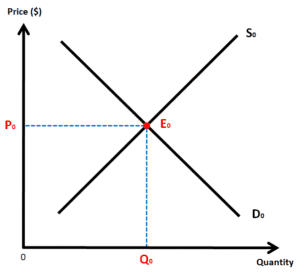
Equilibrium in economics refers to the point where the quantity of a good demanded by consumers equals the quantity supplied by producers. This point of balance determines both the equilibrium price—the price at which goods are sold—and the equilibrium quantity—the amount of goods bought and sold at that price. At this point, there is neither a shortage nor a surplus in the market.
Equilibrium occurs where the demand and supply curves intersect on a graph. This intersection is known as the equilibrium point. This is regarded as a stable position because, at this price, the market clears, meaning that all goods produced are sold, and all consumers who want to buy at that price can do so.

Determination Of Price by Demand and Supply
Price in a market is determined by the interaction of demand and supply. When demand increases but supply remains the same, buyers are willing to pay more, which triggers a price increase. On the other hand, when supply increases but demand remains unchanged, sellers may lower prices to attract buyers.
This interaction leads to a point where the quantity demanded by consumers equals the quantity supplied by producers—this is known as the equilibrium. If the price is set below this point, there will be a shortage, meaning more people want to buy than there are goods available. If the price is set above the equilibrium, there will be a surplus, meaning more goods are available than people are willing to buy. Therefore, the market price naturally moves toward the equilibrium where there is no shortage or surplus.

Determinants Of Equilibrium Price, Quantity, And Point
Equilibrium can change due to shifts in demand or supply caused by various factors such as;
1. Change In Income
When people’s income increases, they are able to buy more goods and services. This causes the demand for goods to rise, leading to a rightward shift in the demand curve. As a result, the equilibrium price and quantity will both increase. On the other hand, if income decreases, people will demand less, shifting the demand curve to the left and causing the equilibrium price and quantity to fall.
2. Change In Taste or Preference
Consumers’ preferences greatly affect demand. If a product becomes fashionable or widely liked, more people will want to buy it, increasing demand. This shifts the demand curve to the right and raises the equilibrium price and quantity. If the product goes out of style or is no longer preferred, demand will decrease, shifting the demand curve leftward and reducing both price and quantity at equilibrium.
3. Price Of Related Goods
The demand for a good can be influenced by the price of related goods. These include substitutes (goods used in place of each other) and complements (goods used together). For example, if the price of rice increases, people may buy more garri instead, increasing the demand for garri. This raises its equilibrium price and quantity. If the price of a complement like bread rises, the demand for butter may fall, shifting its demand curve to the left and lowering equilibrium price and quantity.
4. Population Changes
An increase in the population means more consumers in the market, which raises demand for goods and services. As demand increases, the demand curve shifts to the right, pushing up the equilibrium price and quantity. Conversely, a decrease in population will reduce demand, shifting the demand curve to the left and lowering equilibrium.
5. Change In Production Cost
When the cost of producing goods (such as wages, raw materials, or electricity) goes up, producers may supply less at the same price. This shifts the supply curve to the left, reducing the quantity supplied and raising the equilibrium price. If production costs fall, it becomes cheaper to produce goods, and suppliers may increase supply. This shifts the supply curve to the right, lowering the price and increasing the equilibrium quantity.
6. Technological Improvement
When producers use better technology, they can produce goods more efficiently and in larger quantities. This leads to an increase in supply, shifting the supply curve to the right. As a result, the equilibrium price falls while the equilibrium quantity increases. In contrast, outdated or poor technology can reduce supply and increase production costs, leading to higher prices and reduced equilibrium quantity.
7. Number Of Producers
If more firms enter a market to produce a particular good, the total supply of that good increases. This shifts the supply curve to the right, causing the equilibrium price to fall and the quantity to rise. However, if some producers leave the market, supply decreases, shifting the supply curve leftward, leading to a higher price and a lower quantity at equilibrium.
8. Natural Factors (e.g., Weather, Disasters)
Natural events like droughts, floods, or diseases can reduce the supply of agricultural goods, shifting the supply curve to the left and increasing the price. Good weather or favourable growing conditions, on the other hand, increase supply and shift the curve to the right, reducing prices and increasing the equilibrium quantity.
Changes In Equilibrium
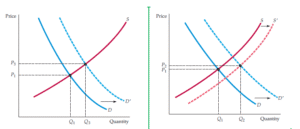
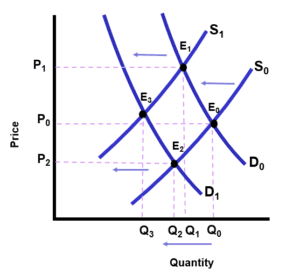
Changes in equilibrium occur when there is a shift in either the demand or supply curve, leading to a new equilibrium price and quantity. When demand increases—perhaps due to higher income or greater preference for a product—the demand curve shifts to the right, resulting in a higher equilibrium price and quantity. Conversely, a decrease in demand shifts the curve to the left, causing the equilibrium price and quantity to fall.
On the supply side, an increase in supply—maybe due to better technology or more producers—shifts the supply curve to the right, leading to a lower equilibrium price and a higher quantity. However, a decrease in supply, such as from bad weather or higher production costs, shifts the curve to the left, raising the equilibrium price while reducing the quantity. These changes illustrate how market conditions directly affect prices and availability of goods.
Simple Applications
The concept of demand and supply can be seen in many everyday situations. For instance, during the rainy season, the supply of tomatoes often decreases due to poor weather conditions affecting farms. As a result, the price of tomatoes goes up because demand remains the same or increases.
Similarly, during promotional sales, the price of phones may drop, encouraging more people to buy them—this is an example of increased demand due to lower prices. In the case of fuel scarcity, a reduction in supply leads to higher prices and long queues at fuel stations.
Another common example is when a new product, such as a smartphone, is released into the market; initial demand is usually high, which pushes up the price until more units are produced to meet demand. These examples show how changes in demand and supply affect prices and availability of goods and services in the real world.
Lesson Summary
- Price and quantity in a market are determined by the interaction of demand and supply.
- Equilibrium occurs where demand equals supply.
- Any shift in demand or supply changes the equilibrium.
- These concepts apply to everyday market activities and help us understand price changes.
Read also: Warehousing: Importance and Types