
Topic: Concept of Demand
Lesson Objectives
By the end of this lesson, students should be able to:
- Define demand and explain what it means in economics.
- Interpret a demand schedule.
- Draw and explain a demand curve from a demand schedule.
- State and explain the Law of Demand and its meaning in everyday life.
- Identify and describe different types of demand.
- List and explain the factors that affect demand other than price.
Meaning of Demand
Demand is the amount of a good or service that people are willing and able to buy at different prices over a certain period of time.
It is important to understand that demand is not just wanting something, but having the money or ability to pay for it. For example, many people may want a new phone, but only those who can afford to buy it have actual demand.
Demand shows the relationship between the price of a product and the quantity consumers are ready to purchase. As the price changes, the quantity demanded usually changes too.
Demand Schedule
A demand schedule is a table that shows the relationship between the price of a good and the quantity that consumers are willing and able to buy at each price. It helps us understand how demand changes when the price changes.
For example, when the price of a product is high, fewer people may want to buy it, so the quantity demanded is low. On the other hand, when the price is low, more people are willing to buy the product, so the quantity demanded increases.
This pattern can be clearly seen in the demand schedule, which lists different prices alongside the quantities demanded at those prices. By studying the demand schedule, we can predict how consumers might react if prices rise or fall.
| Price (₦) | Quantity Demanded (units) |
| 100 | 10 |
| 80 | 20 |
| 60 | 30 |
| 40 | 40 |
| 20 | 50 |
From this table, as the price decreases, the quantity demanded increases.
Demand Curve
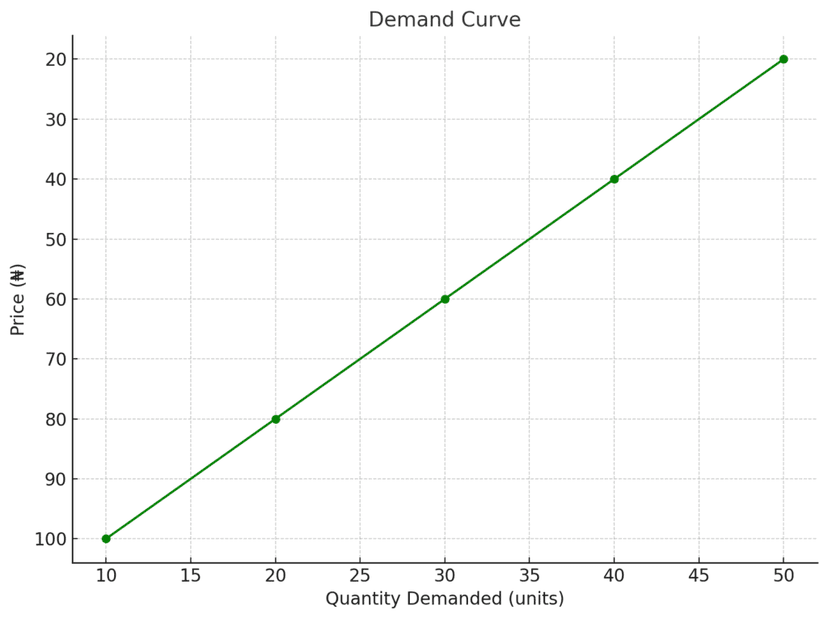
The demand curve is a graphical representation of the demand schedule. It shows the relationship between the price of a good and the quantity demanded on a graph.
On the graph, the price is shown on the vertical axis, while the quantity demanded is shown on the horizontal axis. The curve usually slopes downwards from left to right, meaning that, as the price falls, the quantity demanded rises. This downward slope reflects the inverse relationship between price and demand.
Law of Demand
The law of demand states that, all other things being equal, when the price of a good increases, the quantity demanded decreases. Conversely, when the price decreases, the quantity demanded increases.
This means that there is an inverse relationship between price and demand. The law of demand helps explain consumer behaviour in the market. For instance, if the price of bread goes up, fewer people will buy it; if the price falls, more people will buy it.
Types of Demand
There are different types of demand in economics:
Individual Demand
Individual demand refers to the quantity of a good or service that one consumer is willing and able to buy at different prices over a period of time.
It reflects personal preferences, income level, and needs of that single consumer. For example, if a student is not willing to buy 2 bottles of soda at ₦200 each, but only 1 bottle at ₦300, that shows their individual demand.
This type of demand helps businesses understand the buying behaviour of a single customer. It is also the basis for calculating the larger market demand, when combined with the demands of other individuals.
Market Demand
Market demand is the total quantity of a good or service that all consumers in a market are willing and able to buy at various prices, over a period of time. It is obtained by adding together the individual demands of all consumers in the market.
For instance, if three people each, are willing to buy 2, 3 and 5 loaves of bread at ₦100, the market demand at that price is 10 loaves.
Market demand is important because it gives producers a full picture of how much of their product is needed at different prices. It also helps in setting prices and making production decisions.
Composite Demand
Composite demand refers to a situation where a good is demanded for more than one purpose. A good example is sugar, which is used for making tea, baking and producing sweets. Because the same product is used in various ways, a rise in demand for one purpose can affect its availability and price for other uses.
For instance, if more sugar is needed for industrial use, the price may rise, affecting households who need it for cooking. Composite demand makes it important for producers and government to manage supply carefully.
Derived Demand
Derived demand is the demand for a good or service that arises not for its own sake, but because it is needed to produce another good or service. A common example is the demand for wood, which depends on the demand for furniture or paper.
If the demand for furniture increases, then the demand for wood (used to make it) also rises. This type of demand is common in industry and production sectors. It helps businesses in planning for raw materials, based on consumer demand for the final product.
Joint Demand
Joint demand occurs when two or more goods are used together to satisfy a particular need or want. These goods are called complementary goods.
For example, cars and petrol have joint demand because a car cannot run without fuel. If the demand for cars increases, the demand for petrol will likely increase too.
Joint demand means that the price or availability of one product can directly affect the demand for its complement, which is important for businesses that sell related products.
Factors that Affect Demand
Several factors can cause demand to increase or decrease, other than price:
Income of Consumers
The income of consumers plays a significant role in determining the level of demand for goods and services. When people experience an increase in income, they generally have more money to spend, which leads to an increase in the demand for normal goods such as clothing, electronics and food.
This is because higher income increases purchasing power, making previously unaffordable items more accessible. On the other hand, when income decreases, people tend to reduce their spending, leading to a fall in demand.
However, there are also inferior goods, such as second-hand clothing or local substitutes, whose demand may increase when income falls, because consumers look for cheaper alternatives.
Price of Related Goods
Demand for a product can be significantly affected by the price of related goods, which are categorised into substitutes and complements. Substitutes are goods that can be used in place of each other, like butter and margarine or tea and coffee.
If the price of a substitute increases, consumers may switch to the cheaper option, causing the demand for the cheaper good to rise.
On the other hand, complementary goods are those that are used together, like cars and petrol or printers and ink. If the price of a complementary good increases, the demand for the related good is likely to fall, because using both together becomes more expensive.
Consumer Preferences and Tastes
Changes in consumer preferences and tastes greatly influence demand. When a good or service becomes fashionable or gains positive attention through trends, social media or advertising, more people want to buy it, increasing demand.
For example, if a celebrity promotes a certain brand of shoes, many consumers may want to own a pair, raising demand. However, if consumer taste shifts away from a product due to changing trends or negative publicity, its demand will likely decline.
Therefore, producers and marketers often study consumer behaviour to keep up with changing preferences.
Population Size
The size and composition of a population also impact demand. A larger population usually means more people are in need of goods and services, which leads to higher demand overall.
For example, in densely populated cities, there is usually higher demand for housing, food, transport and education. Conversely, in areas with low or declining population, demand for many goods and services may be lower, due to fewer buyers.
The age structure of the population can also matter, that is, if the population has more young people, demand may be higher for educational materials, toys and gadgets.
Expectations about Future Prices
Consumer expectations about future prices can influence their current purchasing decisions. If people believe that prices of goods will increase in the near future, they are likely to buy more now, thereby increasing current demand.
For example, if consumers expect the price of petrol to rise next week, they might fill their tanks today, raising present demand.
On the other hand, if consumers expect prices to drop, they may delay their purchases, which will reduce current demand. These expectations can be influenced by government announcements, economic trends or global market changes.
Government Policies
Government policies such as taxation, subsidies and regulations, can affect the demand for various goods and services. When the government imposes high taxes on a product (like alcohol or cigarettes), the price increases and demand usually decreases.
On the other hand, if the government offers subsidies or reduces taxes on essential items, like fertilizer or rice, it makes them cheaper and increases their demand. Regulations that restrict or promote certain goods, such as banning unhealthy drinks in schools or promoting local products through campaigns, can also influence demand. Overall, government actions can either encourage or discourage the consumption of specific products.
Final Thoughts
- Demand is the amount consumers want and can pay for a product at different prices.
- A demand schedule shows this relationship in a table.
- A demand curve is a graph representing this relationship, sloping downward.
- The law of demand shows the inverse relationship between price and quantity demanded.
- There are different types of demand such as individual, market, composite, derived, and joint.
- Many factors affect demand besides price, including income, prices of related goods, tastes, population, and expectations.
Learn more: Complementary Goods, Substitute Goods