Lesson Objectives
By the end of the lesson, students should be able to:
- Explain the meaning of population distribution and structure.
- Define and explain age distribution and its importance.
- Describe the economic implications of an increase in the dependent population.
- Explain sex, occupational, and geographical distribution.
What is Population Distribution & Structure
Population distribution refers to the way people are spread out or arranged across different areas of a country or region. It shows how the population is divided between urban and rural areas, or between places with high and low population densities. Population structure, on the other hand, describes the composition of the population based on characteristics such as age, sex, occupation, and location. It helps to show the number of people who are young, working, or old, as well as the balance between males and females in a population.
Age Distribution
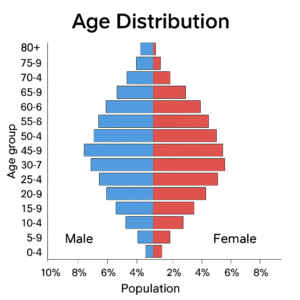
Age distribution refers to the way a country’s population is divided into different age groups, showing how many people fall within each age category. It helps to identify the proportion of young people (usually ages 0–14), working-age adults (ages 15–64), and elderly dependents (ages 65 and above) in the population. This breakdown gives a clear picture of the structure of the population and helps governments and planners understand the balance between those who are working and those who depend on others for support. This structure can be shown with a population pyramid, which illustrates the number of males and females in each age group.
Importance of Age Distribution
- Planning: Age distribution is very important for the government and policymakers because it helps them plan for the future. By knowing how many people fall within each age group, the government can make better decisions about what services are needed. For example, if there are many young people, more schools and teachers will be required. If there are more elderly people, more hospitals and care homes will be needed.
- Labour Supply: The working-age group (usually between 15 and 64 years) represents the labour force of a country. A proper understanding of age distribution helps the government and businesses estimate how many people are available and capable of working. If a country has a large proportion of people in this age range, it means there is enough labour to drive production and economic growth.
- Dependency Ratio: Age distribution helps to determine the dependency ratio, which measures the number of dependents (children and the elderly) compared to the working-age population. A high dependency ratio means that many people rely on a smaller number of workers for support. This affects the economy because the working group has to provide for more dependents, reducing their ability to save and invest.
- Economic Growth: The age structure of a population affects a nation’s level of economic growth. A country with many people in the working-age group is likely to experience faster economic development because more people are involved in productive activities. Conversely, if the population has too many dependents, economic growth may slow down due to lower productivity and higher spending on non-productive needs such as childcare and pensions.
- Social Services: Knowledge of age distribution helps the government and private organisations decide what types of social services are most needed. For instance, a youthful population will require more schools, sports facilities, and child health services. An ageing population, on the other hand, will need more hospitals, pension schemes, and elderly care centres.
Economic Implications of an Increase in Population of Dependents
If the number of dependents (young and old) becomes too large, it leads to:
- Increased Financial Burden on the Working Population: When the number of dependents, that is, children below working age and elderly people, becomes very large, the working population has to take care of more people. This means that workers will spend a larger portion of their income on food, clothing, education, and healthcare for their dependents.
- Greater Government Expenditure on Social Services: A high dependent population means the government has to spend more on social services such as schools, hospitals, pensions, and welfare programs. For example, many children will require more schools and teachers, while many elderly people will need more healthcare facilities.
- Low Savings and Investment Levels: When families and the government spend most of their income on maintaining dependents, the level of savings in the economy falls. Low savings mean that banks and other financial institutions will have less money to lend to investors and entrepreneurs. Consequently, fewer businesses will be established, and economic growth will slow down.
- Reduced Labour Force and Low Productivity: Many dependents in a country mean that fewer people are available to work and produce effective services. Since dependents are not part of the labour force, they do not contribute directly to production. This shortage of workers can lead to lower output and reduced national income. In the long run, the country may face economic stagnation because fewer productive people are generating wealth to support the entire population.
- Increased Poverty and Lower Standard of Living: When too many people depend on a few workers, income is spread thinly among a large population. Families will struggle to provide for their needs, leading to increased poverty levels. With little income left after meeting basic needs, many people cannot afford effective housing, healthcare, or education.
Sex Distribution
Sex distribution refers to the way the total population of a country or region is divided between males and females. It shows the number of men and women in a given population and is usually expressed as a ratio or percentage.
Importance of Sex Distribution
- Understanding the Labour Force Composition: Sex distribution helps a country know how many males and females make up the labour force. In most economies, men and women participate in different types of work. For example, men may dominate physically demanding jobs such as construction, while women may be more involved in teaching or healthcare.
- Influence on Marriage and Birth Rates: The number of males and females in a population affects marriage patterns and birth rates. If there are more men than women, some men may find it difficult to get married, which can reduce the birth rate. On the other hand, if there are more women, it may lead to early marriages and higher birth rates.
- Planning for Education, Employment, and Health Needs: Knowing the proportion of males and females in a population helps the government design appropriate educational, employment, and health programs. For instance, if the number of women is higher, more maternity and childcare facilities will be needed.
- Determining Economic and Social Development: Sex distribution gives an idea of how effectively a country can use its human resources for economic development. A balanced sex ratio means both men and women can contribute to production and national growth. However, if one gender is underrepresented in the workforce due to cultural or social barriers, it can slow down development.
- Social and Cultural Planning: Sex distribution is also useful for social and cultural planning. Communities and governments can use this information to promote programs that support family life, gender equity, and community participation. For example, regions with more young women may focus on empowering them through entrepreneurship and education, while areas with more men may promote skills training and job creation.
Occupational Distribution
Occupational distribution refers to the way people in a country are engaged in different types of jobs or economic activities. It shows how the working population is spread across various sectors of the economy, such as the primary sector (farming, fishing, mining), secondary sector (manufacturing and construction), and tertiary sector (services like teaching, banking, and trading).
Importance of Occupational Distribution
- Indicator of Economic Development: Occupational distribution helps to show the level of economic development of a country. In developing countries like Nigeria, most people are engaged in primary occupations such as farming, fishing, and mining, while in developed countries, more people work in manufacturing and service industries. This difference helps economists understand how advanced a country’s economy is.
- Helps in Government Planning: Knowing how people are distributed across different occupations helps the government to plan effectively for the country’s needs. For example, if many people work in agriculture, the government can focus on improving farming tools, fertilisers, and rural infrastructure.
- Guides Educational and Manpower Planning: Occupational distribution helps the government and educational institutions plan the type of education and training needed in the country. If the data shows a shortage of skilled workers in technical or health-related fields, the government can establish more technical schools, universities, and training programs in those areas.
- Reveals Labour Shortages and Surpluses: By studying occupational distribution, it becomes easy to identify which sectors have too many workers and which ones lack enough labour. For example, if there are too many people in agriculture but too few in manufacturing, policies can be made to encourage people to move into industrial work.
- Assists in Economic Policy Formulation: Occupational distribution provides useful information for economic decision-making and policy formulation. When the government understands how the population is engaged across different sectors, it can design better fiscal, employment, and investment policies. For instance, knowing that most people depend on agriculture may influence tax incentives or subsidies for farmers.
Geographical Distribution
Geographical distribution refers to the way people are spread or settled across different parts of a country or region. It shows how the population is unevenly distributed, with some areas having a high concentration of people (densely populated) while others have few inhabitants (sparsely populated).
Factors affecting geographical distribution include:
- Availability of Jobs: One of the main reasons people move to certain areas is the availability of employment opportunities. Regions with many factories, offices, markets, and business centres attract large numbers of people because they offer a better chance of earning a living.
- Fertility of Soil: The quality of the soil plays a major role in determining where people settle. Areas with fertile soil are effective for farming, which supports food production and attracts many people who depend on agriculture for their livelihood.
- Climate and Weather Conditions: Climate greatly influences where people choose to live. People tend to settle in areas with moderate temperatures and adequate rainfall because such conditions support farming and comfortable living. Areas that are too hot, too dry, or too cold are usually sparsely populated.
- Security: Security and safety are essential for human settlement. People naturally avoid areas that experience frequent conflicts, wars, or attacks, as their lives and property may be at risk. For example, insurgency and banditry in some parts of northern Nigeria have caused people to migrate to safer areas, leading to low population density in those regions.
- Availability of Social Amenities: Social amenities such as good roads, schools, hospitals, electricity, and clean water make life easier and more comfortable. Areas that are well developed with these facilities tend to attract more people, leading to higher population density. s
- Industrialisation and Infrastructure: Industrialisation and infrastructure are key drivers of population distribution. Industrialised areas provide jobs, better housing, and improved transportation systems, all of which attract people from less developed regions. Effective infrastructure—such as roads, railways, airports, and communication networks—also encourages settlement because it makes movement and business easier.
Final Thoughts
- Population distribution shows how people are spread across a country, while population structure shows how people are grouped according to age, sex, occupation, and location.
- Age distribution divides people into young, working, and old groups and helps governments plan for education, jobs, and health care.
- When the number of dependents is high, there is more pressure on the working population and the economy.
- Sex distribution helps to understand the ratio of males to females and how it affects labour supply and population growth.
- Occupational distribution shows how people are engaged in farming, industries, and services. This helps measure economic development.
- Geographical distribution explains how people are spread across different parts of Nigeria.
Read also: Understanding the Challenges and Opportunities of Ageing Populations
Tags
Population, Population Distribution, Population Structure, Population Density, Demography, Census, Dependency Ratio, Age Groups, Young Dependents, Working Population, Old Dependents, Population Pyramid, Labour Force, Planning, Economic Growth, Dependency, Males, Females, Gender Composition, Labour Force Participation, Birth Rate, Marriage Rate, Gender Balance, Occupation, Employment, Economic Activities, farming, fishing, mining, manufacturing, construction, services, trade, education, Development Indicator, Settlement Pattern, Urban Areas, Rural Areas, Industrialisation, Infrastructure, Migration, Climate, Soil Fertility, Security