Introduction
Meaning of Production Possibility Curve
The Production Possibility Curve, PPC, is a graphical representation that shows the maximum combinations of two different goods or services that an economy can produce using its available resources and current level of technology. It illustrates the limits of production when resources such as land, labour, capital, and entrepreneurship are fully and efficiently used. Because these resources are scarce, an economy cannot produce unlimited quantities of all goods at the same time.
The curve also demonstrates the economic concepts of scarcity, choice, and efficiency.
When a country decides to produce more of one good, it must reduce the production of another good because the same resources cannot be used for both at the same time.
Therefore, the PPC helps economists and students understand how societies make decisions about the allocation of limited resources in order to satisfy unlimited human wants.
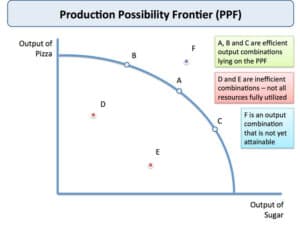
The curve also shows three important economic ideas:
-
Scarcity of resources
-
Choice between alternatives
-
Efficient use of resources
If production takes place inside the curve, it means resources are not fully used. If production is on the curve, resources are fully and efficiently used. Production outside the curve is not possible with current resources and technology.
Relationship between PPC and Opportunity Cost
Opportunity cost is the value of the next best alternative that is sacrificed when a decision is made. Because resources such as land, labour, capital, and time are limited, individuals, firms, and governments cannot produce or obtain everything they want. As a result, choosing one option means giving up another option.
The benefit that would have been gained from the alternative that is not chosen is known as the opportunity cost. For example, if a farmer decides to use a piece of land to grow maize instead of rice, the rice that could have been produced on that land represents the opportunity cost of producing maize.
Opportunity cost, therefore, reflects the cost of foregone alternatives when scarce resources are used for a particular purpose.
|
Combination |
Rice (tons) |
Cars (units) |
|
A |
0 |
10 |
|
B |
2 |
9 |
|
C |
4 |
7 |
|
D |
6 |
4 |
|
E |
8 |
0 |
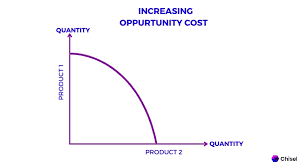
The Production Possibility Curve illustrates opportunity cost. For example, when production moves from point A to B, the country gains 2 tons of rice but loses 1 car. The lost car is the opportunity cost of producing additional rice. As production continues to increase rice, more and more cars must be sacrificed. This is why the PPC is usually curved.
Why Opportunity Cost Increases
Opportunity cost increases because the factors of production are not equally suitable for producing all goods. Some resources are more efficient in producing one type of good than another.
At the beginning of production, resources that are best suited for producing rice are used first, so the sacrifice of cars is small. However, as production continues to expand, resources that are less suitable must also be used. Because these resources are not very efficient in producing rice, a larger quantity of cars has to be given up. As a result, the opportunity cost increases as more units of rice are produced.
Final Thoughts
-
The Production Possibility Curve shows the maximum combinations of two goods that can be produced with available resources.
-
It illustrates scarcity, choice, and opportunity cost. Opportunity cost increases as more of one good is produced.
Read more:
Concept of Supply