Teachers Need New Skills for the AI Age, not a Pink Slip.
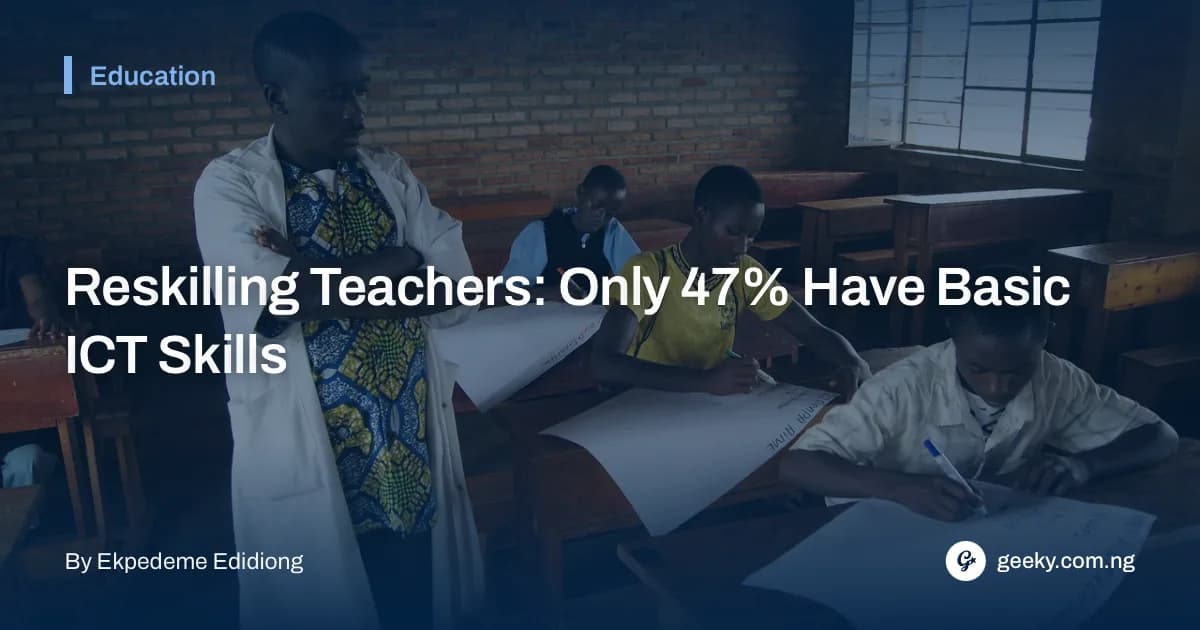
Nigeria must focus on reskilling teachers rather than replacing them with artificial intelligence (AI). This is because just 47 per cent of the country's teachers have basic ICT skills.
Imagine a classroom where students no longer wait for a teacher to explain a difficult topic. They simply ask an AI chatbot. Within seconds, they receive an explanation, examples, and even practice questions.
It sounds like the future. But it is already happening.
AI is changing how people work, communicate and learn. Education is no exception. From automated assessments to personalised learning platforms, technology is gradually changing the traditional classroom.
Naturally, this raises an uncomfortable question: Will AI eventually replace teachers?
For Nigeria, that is the wrong question. The more important question is whether we are preparing our teachers to work with these technologies, and reskilling teachers is how we begin.
We should be.
AI is changing the classroom
For generations, teachers have been the primary source of knowledge in schools. They prepare lessons, explain difficult concepts, set examinations and assess students' performance.
That arrangement is changing.
AI tools such as ChatGPT, Google Gemini and Microsoft Copilot can now perform some tasks that traditionally take teachers hours to complete. They can generate lesson plans, prepare examination questions, summarise textbooks and explain complicated subjects.
Consider a mathematics teacher preparing a lesson on quadratic equations. Instead of spending hours developing different examples, the teacher can use AI to generate exercises for students at different ability levels.
A student who struggles with the topic can also request another explanation.
Learning becomes more flexible.
However, having access to information is not the same as understanding it. And that distinction matters.
A Teacher is more than a Source of Information
There is something technology still struggles to replicate: the human side of teaching.
A good teacher notices when a student is losing interest. They recognise when a child is struggling, even when that child doesn't ask for help. They encourage, correct, mentor and sometimes provide emotional support.
These responsibilities go beyond delivering lessons.
Children also develop important social skills through interactions with their teachers and classmates. They learn discipline, cooperation, responsibility, and respect. These lessons are not always found in textbooks.
Artificial intelligence can provide information. It cannot fully replace human relationships.
UNESCO Director-General Audrey Azoulay made this distinction clear in January 2025. She said AI must complement “the human and social dimensions of learning, rather than replace them.“
That is an important principle for Nigeria.
The goal should be to make teachers more effective, not make them unnecessary. Reskilling teachers serves exactly that aim.
Nigeria's Education System has a bigger challenge
Before discussing the benefits of AI, we must recognise the condition of education in Nigeria.
The country already struggles with teacher shortages, overcrowded classrooms, inadequate learning materials and unequal access to quality education. Introducing new technology without addressing these problems could make matters worse.
The Federal Ministry of Education's 2024/2025 Annual School Census dashboard reports approximately 39.8 million learners and 1.18 million teachers. However, only 53.7 per cent of the 230,844 listed schools had reported their data at the time of reporting. The figures should therefore be treated with that limitation in mind.
The digital divide is another concern.
A UNICEF report published in February 2025 highlighted that only 36 per cent of Nigeria's population used the internet, while just 47 per cent of teachers had basic information and communication technology (ICT) skills.
Think about what this means.
A school in Abuja or Lagos with reliable electricity, internet access and digital devices may find it relatively easy to introduce AI into its classrooms. A school in a rural community without these facilities faces a different reality.
We cannot build an education system that leaves one group behind.
Technology should reduce educational inequality, not deepen it.
Reskilling teachers is the real priority
Nigeria must begin by preparing teachers for the changes taking place around them.
Reskilling teachers does not mean asking every teacher to become a programmer or technology expert. It means giving them the practical knowledge to use digital tools effectively in their work.
For example, teachers should learn how to operate AI to:
Develop lesson plans and classroom activities.
Generate examination questions and marking guides.
Create simplified explanations for difficult subjects.
Identify learning gaps and prepare additional exercises.
Develop teaching materials for students with different learning needs.
Verify information and identify AI-generated errors.
These skills can save time and improve classroom delivery.
But training must be practical.
A two-hour seminar introducing teachers to ChatGPT will not be enough. Teachers need opportunities to use these tools, make mistakes, ask questions and apply what they learn.
Professional development must become continuous.
There are already encouraging steps. In February 2025, the Federal Government announced an AI training programme targeting 6,000 selected senior secondary school teachers across the country. This is a useful starting point for reskilling teachers, but the scale of Nigeria's teaching workforce means the programme must grow considerably.
The training should also reach primary school teachers, technical instructors and educators in rural communities.
Nobody should be left out.
The risks we cannot ignore
AI offers opportunities, but it also creates new problems.
One concern is academic dishonesty. Students can use AI to write assignments, answer examination questions and complete projects without necessarily understanding the subject.
This could become a serious problem if schools do not adapt their assessment methods.
Teachers must find better ways to assess learning. Oral presentations, practical demonstrations, classroom discussions and individual projects can help establish whether students genuinely understand what they are being taught.
There is also the issue of accuracy.
AI tools sometimes produce convincing but incorrect answers. A student researching Nigerian history, for instance, may receive information containing factual errors. Without proper guidance, the student might accept it as correct.
Teachers must therefore help students develop critical thinking and fact-checking skills.
Data privacy also deserves attention. Schools must be careful about the information students share with AI platforms. Personal details, examination records and other sensitive information should not be uploaded carelessly.
Then there is cultural relevance.
AI-generated teaching materials should reflect Nigerian experiences. A lesson on agriculture should include examples of crops, farming practices and challenges familiar to Nigerian students. We should not depend entirely on educational content designed for foreign classrooms.
Government must do more than introduce Technology
Nigeria needs a clear and practical approach to AI in education, and reskilling teachers must sit at its centre.
The Federal Government's National EdTech Strategy (2025–2030) provides a framework for improving digital infrastructure, teacher capacity, education data systems and the responsible use of emerging technologies.
The challenge is implementation.
Government must invest in electricity, internet connectivity, affordable devices and teacher training. State governments also have an important role to play because many public schools depend on their funding and supervision.
Colleges of education and universities should review their teacher-training programmes. Future teachers must graduate with the tech skills needed to work in modern classrooms.
Private technology companies can contribute by developing affordable learning platforms and providing training opportunities.
However, teachers must be involved in these decisions. They understand the realities of the classroom better than anyone designing technology from outside it.
As Education Minister Dr Tunji Alausa stated during the 2026 World Teachers' Day commemoration in Abuja:
”These tools can help teachers reach learners and tailor instruction, but the judgement, encouragement and human connection of a skilled teacher remain indispensable."
That is the direction Nigeria should take.
The future is a partnership
AI will change the teaching profession. Some routine responsibilities will become easier, and teachers will have access to tools that were unimaginable a decade ago.
But the teacher's role will remain important.
Imagine a classroom where AI helps prepare learning materials, identifies areas where students need additional support and provides practice exercises. The teacher can then spend more time mentoring students, encouraging creativity and helping them understand difficult ideas.
That is a better use of technology.
Nigeria does not need classrooms without teachers. It needs classrooms where teachers have the skills, resources, and confidence to use technology effectively. Reskilling teachers is how it gets there.
The AI revolution is not a reason to abandon the teaching profession. It is a reason to invest in it.
We should not replace the people who educate our children. We should equip them to educate the generation that will shape our future.