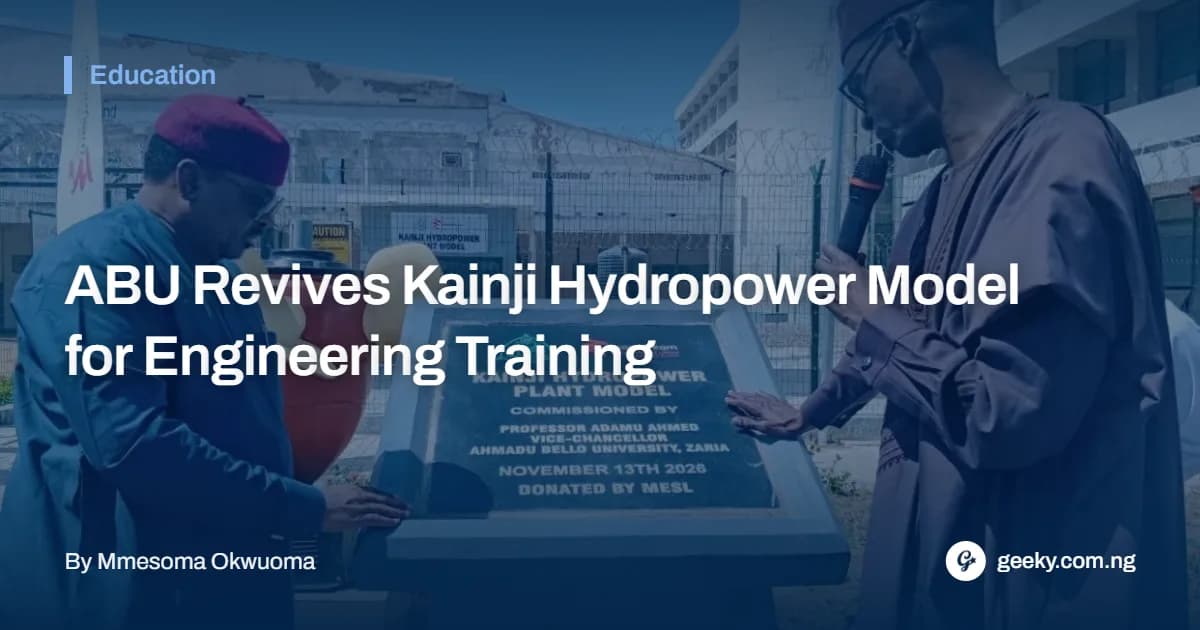

Engineering students at Ahmadu Bello University (ABU), Zaria, now have a working facility for practical training, research and innovation, after the institution returned its Kainji Hydropower Model to service. Mainstream Energy Solutions Ltd. did the repairs under the company's Corporate Social Responsibility scheme, and the restored model was formally opened on Friday.
At the ceremony, the university's Vice-Chancellor, Professor Adamu Ahmed, called the company's support a significant milestone for university-industry collaboration.
According to him, the model had been out of action for decades, which limited what it could contribute to engineering education. With the repairs done, he said, students will be able to see for themselves how the operation and management of hydropower systems work.
The purpose of the restored Kainji Hydropower Model
Ahmed noted that the facility would support teaching and research across several engineering disciplines:
- civil engineering
- water resources engineering
- mechanical engineering
- electrical engineering
- computer engineering
The model, he went on, will also open the way to research on how power is generated, distributed and consumed, and how that consumption is monitored. It could further back study into spotting electricity theft and into finding answers to some of Nigeria's energy challenges.
Professor Ahmed praised Mainstream Energy Solutions for bringing the facility back into working order, and urged the two parties to deepen their ties through formal agreements on innovation, research and specialised training in engineering.
Mainstream to give engineering students hands-on placements at Kainji
The Managing Director of Mainstream Energy Solutions, Mr Sirajo Abdullahi, reaffirmed the company's commitment to supporting ABU.
The company says it will host five to 10 engineering students every year for hands-on placements at the Kainji Hydropower Plant, with each placement lasting between two and three weeks.
He explained that the trainees would get first-hand insight into how power is produced, how machinery is serviced and how key parts are installed.
Mainstream would also pay for the students' travel, lodging, and meals for the duration of the programme.
Abdullahi added that the firm would explore further ways to involve students in the installation of new generating units.
He further disclosed that the plants Mainstream runs at Kainji, Jebba and Shiroro have a combined generating capacity above 2,000 megawatts.
According to him, Mainstream had returned more than six of the turbines at Kainji to operation, and all six of Jebba's turbines were running. Kainji was due for further expansion work before the year's end.
ABU plans research and innovation centre
According to Professor Jibrin Mohammed-Kaura, who heads ABU's Faculty of Engineering, the plan goes back to 2018, the year the university first thought about bringing back its hydropower model, a facility that had sat idle for a number of years.
Mohammed-Kaura added that the proposal was spurred on by Ahmed, then serving as Director of University Advancement, as well as support from a past Vice-Chancellor, Professor Ibrahim Garba.
Mainstream Energy Solutions later provided the support needed to bring the project to completion.
Kaura said the faculty plans to turn the installation into a hub for hands-on instruction, research at postgraduate level and cooperation between disciplines.
It would further foster innovation driven by industry needs in hydropower, as well as renewable energy technology, and so equip engineering students for what employers will demand of them later.
He gave an assurance that the university would give priority to making good use of the Kainji Hydropower Model and keeping it maintained. The faculty would likewise seek to commercialise its research findings and convert innovations developed in the laboratory into workable answers for industrial users and for society.
For Nigeria’s power sector, this partnership offers a practical blueprint for bridging the gap between classroom theory and industry demands. By combining campus-based simulation with direct field exposure at Kainji, ABU and Mainstream Energy Solutions are helping build a homegrown pipeline of skilled engineers capable of driving sustainable energy solutions nationwide.