
Everyone knows the PR maxim that avoiding a problem beats fixing it afterwards. Yet Jensen Huang repeating it in the face of Nvidia's gloomy headlines would feel too easy.
The main points:
- The controversy around Jensen Huang has grown far beyond a private matter into a wider saga involving security, governance and shareholder trust.
- Reports of an alleged affair with a Chinese business executive began the row, which American spy agencies reportedly suspect was linked to China's Ministry of State Security.
- Nvidia's value fell sharply, with a reported $493 billion lost by Friday, November 13.
- Reliance on a single figure leaves Nvidia exposed, and the company needs credible leaders beyond Jensen Huang.
- Crisis planning cannot replace good governance, and reputation depends on internal culture and long-term relationships with stakeholders.
What matters is how a controversy of this size gains momentum and how widely its effects travel. It also matters what is needed to win back trust when the harm reaches far beyond the person at the centre. By Friday, November 13, a reported $493 billion had disappeared from Nvidia's value.
How a Private Row Became a Public Saga
It is often said that sex sells, yet it can also be costly. The row now engulfing Jensen Huang, Nvidia's ex-CEO, shows as much. It began with reports of a supposed affair with a Chinese business executive, Alice Huang. American spy agencies suspect she was enlisted by China's Ministry of State Security.
It has since grown into a far larger saga. It takes in private relationships, power in the workplace, how the company is run, security concerns for the country, the trust of shareholders, and a lively internet meme culture.
The matter has outgrown the private life of one billionaire. Gossip is one thing; security at the level of the state is another. The episode now serves as a case study of what follows when an individual's behaviour, the standing of a company and the interests of rival powers collide.
African tech founders will recognise the danger. Where investors back the founder and the wider ecosystem puts its faith in them, how they conduct themselves privately can swiftly become everyone's business.
The unusual feature of this story is how many different audiences are reading and spreading it, each taking its own meaning from the same news reports. It has turned into an echo chamber that spans the worlds of government, commerce, tech, markets and pop culture, and goes well beyond them.
US policymakers see allegations that raise worries about the safety of the nation. They also worry about the exposure of one of America's most vital technology firms, whose chips are central to the worldwide AI infrastructure boom. Investors worry about leadership, governance and what their money is putting at risk.
Jensen Huang has become inseparable from the company's rise and its commanding hold on the market, so any doubt over his position casts doubt on Nvidia's future. Among staff and the broader industry, there are lingering questions about who holds sway and the duties of those in charge.
Beyond them lies everybody else. On social media, a separate news cycle has emerged, fuelled by memes and commentary produced by AI. Such reach makes the crisis hard to handle. No single statement will be received in the same way by a minister, a fund manager, a member of staff and an ordinary person online. The words of the company then turn into a news story of their own.
Crisis Planning and Reputation Risk for Jensen Huang
Crisis Planning and Reputation Risk for Jensen Huang
Viewed through a public relations lens, one striking detail comes from WIRED. It reported that Huang hired a crisis communications agency, one known for handling celebrity and executive controversies of a private nature, as far back as October 2025.
Should that be correct, it would mean he was already gauging the reputational danger of his private situation long before news of it reached the public.
Still, readying yourself for a story is not the same as steering events once it goes public. Crisis communications work means grasping where someone is exposed, mapping out possible scenarios, pinpointing the audiences that matter, and drafting replies in advance.
It cannot work miracles, and communications specialists are limited by the information they receive. Outsiders see only the results on show, never the private discussions that shaped them.
One central lesson is the risk of letting a firm's identity fuse with a single individual. Huang has served as the face Nvidia presents to the world and, arguably, of the AI boom as a whole. He is a figure people recognise at once, much as they do Jobs, Gates, or Musk.
When the public starts to see a chief executive and the company as one and the same, that individual's standing becomes the firm's biggest vulnerability. To guard against this, a company needs a character that rests on a number of respected leaders able to speak for it without leaning on the founder.
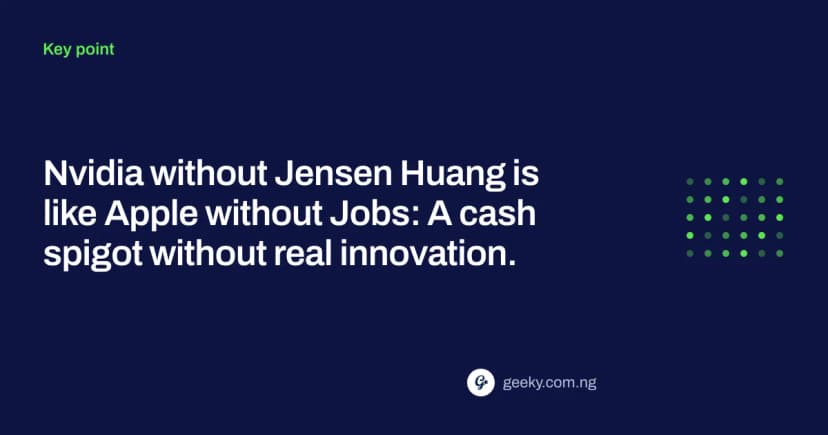
Practically, this means cultivating a wide bench of credible voices, taken from both senior management and technical experts. Semafor's reporting summed up the risk this way: “Nvidia without Jensen Huang is like Apple without Jobs: A cash spigot without real innovation.”
That remark captures the core difficulty facing Nvidia. The question is whether it can keep its vision, its pace of innovation and its sway intact without the man who has run it for more than thirty years. Calming the market will take more than unveiling a succession plan, particularly given the commentary around Colette Kress, who is serving as interim CEO. Nvidia has to show that its future extends beyond Jensen Huang.
The financial fallout has been considerable. On 9 November, after Jensen Huang's admission, Nvidia's shares dropped 4.3%, erasing roughly $190 billion of the company's value on the stock market. On 12 November, once his resignation became known, the stock slid by as much as 14% in the opening hours of trading. For a short time it wiped out up to $601 billion of its valuation on the exchange, according to Bloomberg, before finishing the day down 4.3%.
Nvidia was already contending with wider market jitters over AI valuations. When the personal standing of a chief executive is damaged, it becomes hard to separate his image from the company's. Damage to reputation carries genuine commercial risk. Before any recovery plan can be carried out, the board has to put governance back in order and calm the markets.
See: University of Mississippi racism targets three Black students
Jensen Huang Scandal: What This Means for Africa's Tech Scene
Scandal is no stranger to African tech. Founders have courted controversy, governance has faltered and reputations have been bruised, although nothing here has matched the size or the money at stake in this case. Since the ecosystem is still trying to earn the trust of investors abroad, these lessons count.
It is too limited to think of PR purely as a way to announce funding rounds or win media coverage. A firm's reputation rests on its internal culture, its governance arrangements and the lasting relationships it has built with stakeholders well ahead of any crisis.
Huang's route to rebuilding his personal credibility depends on accountability, steady conduct and a clear grasp of how far the effects reach. Nvidia, for its part, must convince investors, staff and its business allies of two things. Its pipeline of innovation is undamaged, and the handover of leadership can be trusted.
The event that sets off a crisis is seldom the whole story. What matters just as much is the build-up of weaknesses, the decisions taken internally, and the way these collide with a news cycle that never stops. In Nvidia's case the saga is still unfolding, and when other headlines briefly pull attention away, that offers a pause, not an answer.
Public relations can plan, counsel and handle communications, yet it cannot conjure credibility that is absent or stand in for good governance. Messaging cannot stay ahead of the facts forever. In time, the focus moves away from the headlines themselves and onto the conduct that produced them.
Jessica Hope founded Wimbart, a London public relations firm that has won several awards, and serves as its CEO. The company specialises in communications for African and emerging markets, covering the technology and business sectors.
Hope also speaks at events around the world and presents the podcast The Wimbart Way. In addition, she mentors up-and-coming professionals working in PR and in the African tech ecosystem.
See: EcoCare Initiative shows Nigerian students can act on climate now
The original report was published by TechCabal.