Kunle Afolayan plans a museum to preserve African cinema
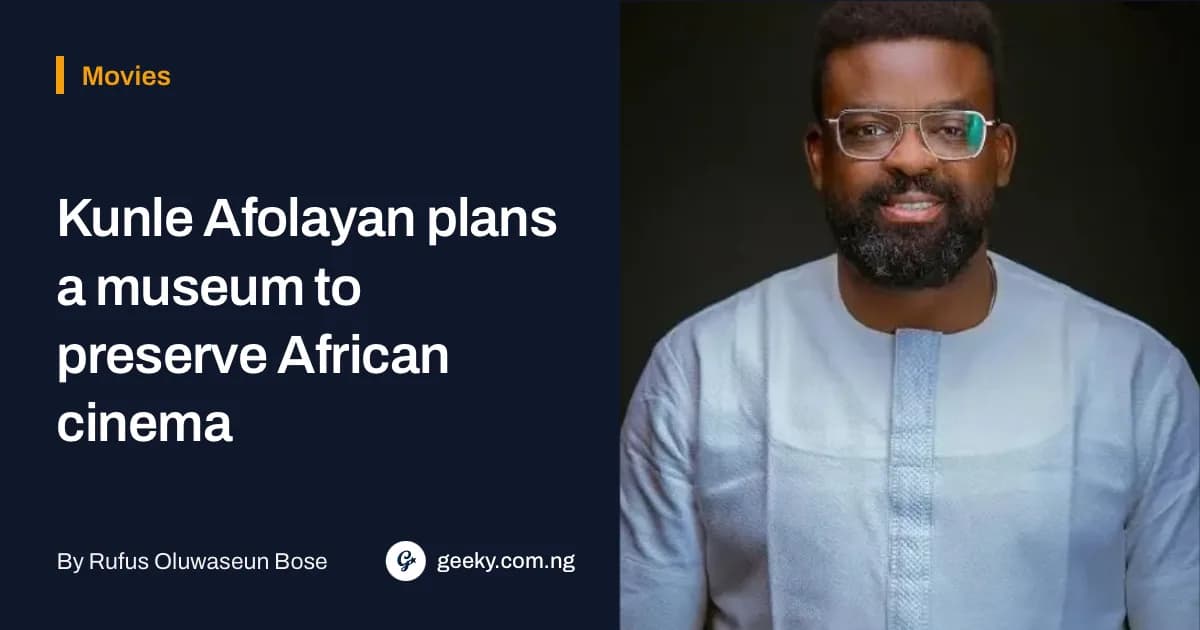
Nigerian filmmaker Kunle Afolayan is planning a Museum of African Cinema and the ITAN Screen Gathering and Awards, two projects meant to protect the continent's film history, and he is still looking for partners to back both. The future he imagines for African cinema, says Afolayan, grows out of an unwavering resolve to safeguard what has gone before.
“We’re so rich in culture, but all over the world, there is no place where you can go to see, study or experience the history of African cinema,” Afolayan told Variety at the International Salon for Audiovisual Content of Abidjan (SICA) in the Ivory Coast, now in its 4th year, where he is giving a keynote speech.
The planned museum and ITAN Screen Gathering
He directed the Netflix hit “Aníkúlápó”, and is now getting ready to unveil a pair of projects with a continent-wide reach: the Museum of African Cinema, and the ITAN Screen Gathering and Awards, a non-competitive event that will hold its first edition in October 2027 at his KAP Film Village and Resort in Nigeria.
The event takes its name from a Yoruba term that carries the sense of both a tale and the past. The line-up so far is as follows:
- It will run for three days.
- About 200 guests are expected.
- An open-air cinema will screen a selection of eight to 10 films.
Afolayan is still looking for partners to back both projects.
Why Kunle Afolayan wants to preserve African films
The museum grew out of an effort by Afolayan’s to preserve the legacy of his father, the film director Adeyemi Afolayan, popularly called Ade Love. After tracing the elder man's reels to the U.K., he set about restoring them in 2012, and five of them have so far been revived.
“You can imagine just how many films have been made in Africa and even the families of the filmmakers don’t have access to them. They don’t even know where the films are,” he remarks.
Afolayan recalls that, starting at age 12, he went along with his father's touring cinema business through West Africa, taking in Lagos, Cotonou, Togo, Abidjan, and Ghana. He remembers the experience warmly: “It’s like an artist going on tour. We’d be showing my father’s films in town halls, schools, the cinemas, in open-air venues,”
Afolayan had seen at close quarters how well Nigerian productions of the 1970s and 1980s were made on 35 mm and 16 mm stock. He was troubled as financial strain and the arrival of digital filmmaking sped up production and lowered the standard of the finished work.
On starting out as a filmmaker himself, Afolayan set out to combine what digital technology makes possible with the polish that marked an earlier era.
“I’m not going to compromise on sound, I’m not going to compromise on picture and I must tell a story that will have universal appeal,” he recalls.
Art, business and owning the IP
What his father went through also showed him why filmmakers need a head for business. The fall in the value of the Naira made it ever harder to afford printing films overseas, and Afolayan saw how exposed an artist can be when no business plan stands behind the work. Pointing to the lasting commercial worth of Francis Ford Coppola's “The Godfather,” he asks “Why can’t we do that as Africans?”
“I’m an artist, but I balance it with commercial concerns, because I have to make sure my family, my crew are fed. I want continuity and I want sustainability,” he adds.
From 2009, Afolayan borrowed from banks to bankroll his own films, then repaid the sums. Government-backed money later enabled him to buy the plot in Lagos where KAP Hub is located: an arts complex that houses a cinema with 120 seats, a school for film, a studio and hotel-style comforts. He also operates a second business, KAP Film Village and Resort in Oyo State, to the north of Lagos, pairing studio space with a hundred rooms for guests, and it also accepts jobs commissioned by outside companies.
“A lot of filmmakers or practitioners in the art space really don’t develop or build things that will outlive them outside the craft,” he observes. “It’s not just craft. It’s also business.”
Keeping hold of the IP he creates sits at the heart of this business outlook. Afolayan points out that every project he has done with the global streamer Netflix has been a co-production in which he keeps the IP rights for good, bar one exception, “A Naija Christmas,” whose IP belongs to Netflix.
Afolayan draws a line between film-makers from Anglophone Africa, who had no choice but to find their own funds, and a good number of their Francophone peers, who often lean on international funding programmes. He believes that directors and producers across the continent ought to safeguard the enduring commercial worth of their work.
“These are your assets. This is your future,” he stresses, repeating the counsel he offered to filmmakers who assembled at SICA some two years earlier. “When you’re done using it, pass it down to your children.”
A pan-African outlook, from Benin to Abidjan
Afolayan’s pan-African outlook has shaped his creative work for a long time. His 2016 feature “The CEO” was filmed in five African countries, and “Citation” carried him to Senegal and Cape Verde. Neither film relied on formal co-production deals with those countries.
A newer collaboration involving Benin has already produced a three-month residency in filmmaking. Trainees first learned their craft in Cotonou, then travelled to Nigeria to finish a pair of short films, which are currently screening at festivals around the world. The joint work with the West African neighbour also covers building up film infrastructure and possible joint productions, and Afolayan has suggested several ideas on both fronts.
Going back to SICA gives him a chance to push those cross-border discussions forward. For Afolayan, Abidjan is well-known ground: in 2016 he screened “The CEO” at the cinema inside the Sofitel Hôtel Ivoire, the venue that hosts the market.
“I’m all about pan-Africanism,” he says, presenting SICA as a chance to “meet with people of like minds, but most importantly, let’s discuss how to break down these barriers and collapse all the borders.”
Besides encouraging closer cooperation between filmmakers across Africa, he hopes to find partners overseas who can distribute his body of work, making use of the Abidjan marketplace.
In other news, “Aníkúlápó” will return for a third season in January 2027, building on the achievements of the first Yoruba-language movie and the Netflix series that followed it. Afolayan is likewise holding talks with MultiChoice about a possible fresh programme.
Whether he is working on a creative project or a business venture, Kunle Afolayan remains motivated by a desire for Africans to hold the rights over their own stories. “I’m going to tell my story from my perspective and I want you to respect it,” he says firmly as he wraps up.