
Tables
A table is a systematic way of arranging data into rows and columns to make it easier to read, understand, and interpret. It allows information to be displayed in a compact and organised format, often with headings for each row and column, to clearly show what the data represents. Tables are commonly used in economics to present numerical data such as prices, quantities, incomes, and expenditures. They help break down complex information into manageable parts, making it easier for students, researchers, and economists to spot patterns, compare values, and draw conclusions. A well-structured table provides a clear view of relationships between variables and acts as a foundation for creating charts and graphs.
The usefulness of tables in economic analysis cannot be overemphasised. They provide a quick and accurate method of summarizing large volumes of data without overwhelming the reader. Economists rely on tables to compare data across different time periods, regions, or sectors, which helps in identifying trends, making forecasts, and guiding decision-making. For example, a table showing the annual inflation rates of a country over ten years can reveal whether the economy is becoming more stable or volatile. In addition, tables are often used in reports, research papers, and presentations to support findings with evidence, making them a vital tool for communication and analysis in economics.
|
Year |
Price of Rice (₦) |
Quantity Demanded (kg) |
|
2020 2021 2022 |
100 120 140 |
200 180 160 |
Charts
A chart is a graphical representation of data designed to make information easier to understand at a glance. It is one of the basic tools used in economic analysis to summarize, compare, and communicate data effectively. Charts help to simplify complex data and reveal patterns, trends, and relationships that may not be obvious in tables. By using shapes, colors, and proportions, charts present numerical information in a visual format that is easier to interpret. Economists, students, and businesses use charts regularly to present findings, support decisions, or illustrate economic activities.
There are several types of charts, but the most common ones include bar charts and pie charts. A bar chart uses rectangular bars of varying lengths to show the size of different items or values. It is ideal for comparing quantities across different categories, such as comparing the sales of different products in a store. A pie chart, on the other hand, is a circular chart divided into slices, where each slice represents a part of the whole. It is useful for showing percentages or proportions, such as how a family’s income is divided between food, rent, education, and other expenses. Each type of chart serves a specific purpose and is chosen based on the kind of data being analysed.
Example: Create a bar chart using this data
|
Item |
Quantity Bought |
|
Rice Beans Garri Yam |
5 3 4 2 |
To draw a bar chart using the data provided, first, prepare a graph paper or use a drawing tool. On the horizontal axis (X-axis), write the names of the items: Rice, Beans, Garri, and Yam. On the vertical axis (Y-axis), mark numbers that represent the quantity bought, starting from zero up to the highest quantity, which is 5 in this case. For each item, draw a vertical bar that reaches the height corresponding to its quantity; for example, the bar for Rice should be the tallest, reaching up to 5 units. Finally, give the chart a title to make the information easy to understand.

Example: Create a pie chart using this data
|
Item |
% of Monthly Budget |
|
Food Transport School Fees Others |
40 20 30 10 |
To draw a pie chart using the data provided, you need to convert each percentage into degrees of a circle. Since a circle has 360 degrees, multiply each percentage by 360 and divide by 100 to find the angle for each segment.
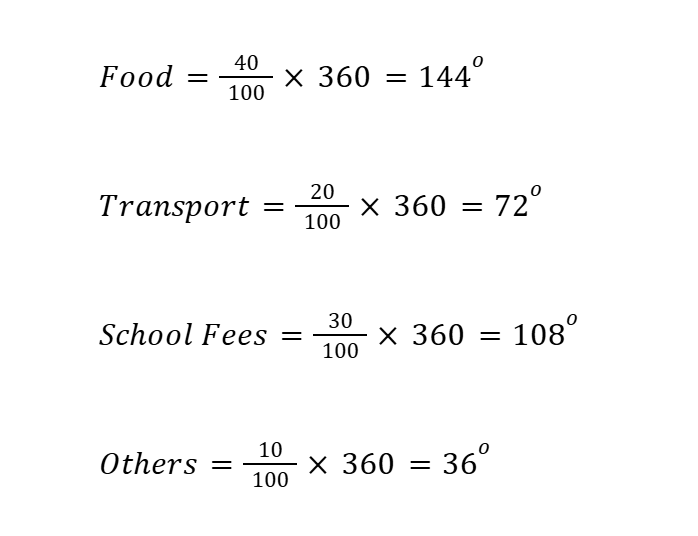
After calculating the angles, use a protractor and compass to draw the circle, then mark and shade each sector according to the angles and label them clearly with the category names.

Graphs
A graph is a visual representation that shows the relationship between two or more variables, often using lines, curves, or bars. In Economics, graphs help to simplify complex data and make it easier to understand patterns, trends, and comparisons. They are essential tools for analysing changes in variables such as price, quantity, income, or time. A typical graph consists of two axes: the horizontal axis (X-axis) and the vertical axis (Y-axis), where each axis represents a variable. By plotting points and connecting them, economists can conclude and make predictions based on how one variable changes in response to another.
There are several types of graphs used in economic analysis. The line graph is one of the most common types. Used to show trends over time by connecting data points with a continuous line. Another important type is the demand and supply curve, which shows how the quantity of goods demanded or supplied responds to changes in price; the demand curve typically slopes downward, while the supply curve slopes upward. Each type of graph serves a specific purpose, and choosing the right graph helps in clearly communicating economic information.
Example: Create a line graph using this data
|
Year |
Income (₦) |
|
2020 2021 2022 2023 |
50,000 60,000 70,000 80,000 |
To draw a line graph using the given data, first draw two lines to form your axes: a horizontal line (X-axis) and a vertical line (Y-axis). Label the X-axis as Year and the Y-axis as Income (₦). Next, choose a suitable scale for both axes based on the range of values—for example, the X-axis should have the years 2020 to 2023 spaced evenly, and the Y-axis should show income from ₦50,000 to ₦80,000 in equal intervals. Plot each point by finding where the year and the corresponding income meet on the graph—for instance, for the year 2020 and income ₦50,000, place a dot where those two values intersect. After plotting all the points, connect them with straight lines to complete your line graph, which should show a rising trend in income over the years.

Example: Create demand and supply curves using this data
|
Price (₦) |
Quantity Demanded |
Quantity Supplied |
|
100 200 300 400 500 |
50 40 30 20 10 |
10 20 30 40 50 |
To draw demand and supply curves, begin by carefully examining the data in the table that shows different prices along with corresponding quantities demanded and supplied. On a graph, label the vertical axis (Y-axis) as Price (₦) and the horizontal axis (X-axis) as Quantity. Plot the points for quantity demanded at each price, then join the points with a smooth line sloping downward from left to right—this forms the demand curve, showing that as price increases, quantity demanded decreases. Next, plot the points for quantity supplied at each price, and connect them with a line that slopes upward from left to right, forming the supply curve, which shows that as price increases, quantity supplied also increases. The point where both curves intersect is known as the equilibrium point, representing the price and quantity at which demand equals supply.

Final Thoughts
The basic tools of economic analysis, which include tables, charts, and graphs, are essential for organising, presenting, and interpreting economic data in a clear and meaningful way. Tables help to arrange information systematically for easy comparison, charts provide visual illustrations of data patterns, and graphs show the relationship between variables such as price and quantity. These tools are valuable for making informed economic decisions, identifying trends, and supporting arguments with evidence. Understanding how to use them equips students with practical skills for analysing real-life economic issues.
Read also: Concept of Demand in Economics and Market Analysis