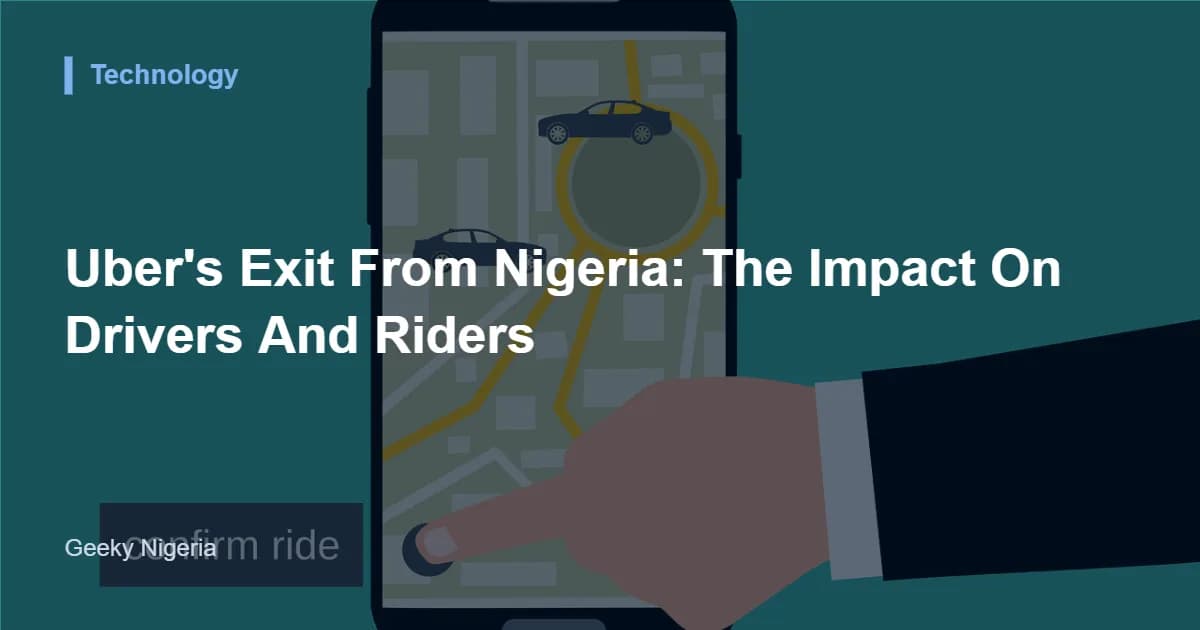
On the morning of 2 September 2026, Uber drivers across Nigeria opened the app to find no ride requests waiting. The company had told customers that, after a thorough review of its business, it had decided to wind down its Nigerian operations with effect from that day (Reuters via CNBC Africa). The move ended a 12-year presence that began with a Lagos launch in 2014, and Uganda was shut down at the same time (Bloomberg).
Uber has not published a country-by-country explanation, nor has it said the Nigerian business was loss-making (Al Jazeera). Yet company statements, independent trip data, union records and regulatory disputes together paint a fairly clear picture of why Africa's most populous country stopped making sense for the world's largest ride-hailing firm.
What Uber said
The official line was strategic rather than local. Uber said it was concentrating investment on markets where it could offer drivers earning opportunities at scale (Techpoint Africa). A spokesperson told Bloomberg the decision was confined to Nigeria and Uganda and that Uber remained committed to sub-Saharan Africa (Bloomberg). The company also said the exit was unrelated to the recent row over e-hailing at Nigerian airports (BusinessDay). Drivers were offered a one-off goodwill payment to ease the transition (TechCabal).
Read Also: Truecaller Rolls Out Scam Checker Tool For Suspicious Users
The trips did not pay
The most detailed evidence comes from Obi, a California-based ride-hailing data aggregator, which analysed 20,298 trips by 308 Nigerian drivers between January and July 2026 (WeeTracker; Obi report). Its findings are stark. On journeys shorter than about 20 kilometres, Uber paid drivers more than riders paid Uber; on 5–9 km trips, driver pay exceeded the fare by 23%.
Volume could not rescue those losses. A Nigerian Uber driver averaged about 130 rides over the seven months, roughly 3.9 a day, against 1,142 rides, about 9.9 a day, for a South African counterpart, an 8.8-fold gap. Uber raised its per-kilometre fare by 71%, from ₦574 to ₦983, over the period and still could not close the shortfall on short trips. Nor could it lift its commission much, as drivers were already keeping 80–90% of each fare (WeeTracker). These are third-party figures that Uber has not confirmed, but they are the most granular numbers in the public domain.
Read Also: Nigeria vs China: What Two Population Giants Reveal About the Future of Technology
A macroeconomic squeeze
Behind those numbers sits Nigeria's economic reset. The removal of the petrol subsidy and the depreciation of the Naira pushed up the cost of fuel, imported spare parts and vehicle maintenance (The Africa Report). In Lagos, petrol rose from around ₦800 a litre in late February 2026 to about ₦1,300 by mid-April (WeeTracker). Reuters noted that fuel costs, inflation, and currency volatility had driven up operating expenses and squeezed drivers and platforms alike (CNBC Africa).
For a company reporting in US dollars, a weakening Naira also shrinks the value of every fare. Uber joins a line of multinationals that have left since inflation spiked in 2023; when Procter & Gamble departed, it said Nigeria was “very difficult for a US dollar-denominated company to create value” (Semafor).
Caught between riders and drivers
Ride-hailing platforms must keep passengers, drivers and themselves satisfied at once. In Nigeria, that balance kept breaking. The drivers' union has staged repeated strikes since at least 2016, demanding higher fares, lower commissions and an end to arbitrary deactivations (SBM Intelligence). By March 2026, drivers in Lagos were protesting again over fares and commissions they said were unsustainable (BusinessDay).
Raising fares is no simple fix. Nigeria is a highly price-sensitive market, and dearer rides push commuters towards buses and taxis, what industry participants describe as a profitability trap (BusinessDay).
Read Also: OpenAI Enters the Courtroom: Inside Astra for Law
Tougher, cheaper competition
Uber pioneered app-based transport in Nigeria but never held the market alone. Bolt, which arrived in 2016, grew rapidly, while inDrive introduced fare negotiation between passengers and drivers (BusinessDay). Uber positioned itself at the premium end with stricter vehicle rules, whereas Bolt accepted cars Uber considered too old (Semafor). inDrive's global service fee has generally been about 10% (Al Jazeera). Bolt reportedly had more than six times as many Nigerian users as Uber (WeeTracker), and local players such as the Lagos State-backed LagRide added further pressure (Semafor).
Still, competition may not have been decisive. When Obi surveyed 93 Uber drivers after the announcement, 57% blamed currency and inflation pressure, 51% cited regulation and 44% said fares and commissions were too low; only 25% pointed to rivals (WeeTracker).
Regulatory friction
Operating in Lagos carries costs of its own, including a ₦25 million annual licence fee and a ₦20 levy on every trip (Techpoint Africa). In 2024 the state demanded real-time access to trip data through API integration; Uber pushed back on privacy grounds, vehicles on its platform were impounded, and the dispute was settled only after a month-long standoff (Techpoint Africa). SBM Intelligence has observed that such rules sit awkwardly alongside the state government's own stake in LagRide (SBM Intelligence).
Federal friction followed. A Federal Airports Authority of Nigeria memo dated 30 July 2026 ordered Uber and Bolt to stop commercial operations at all its airports pending licence agreements (Vanguard). Uber denies this triggered its exit, but it shows how unpredictable the operating environment had become.
Uber's global priorities
Crucially, the exit does not reflect a company in trouble. Uber recorded 3.9 billion trips in the second quarter, up 18% year-on-year, with free cash flow of $2.8 billion (The Africa Report). The same week, it announced about 3,300 job cuts, a tenth of its global workforce, to free money for growth and autonomous vehicles (Fortune), alongside commitments of more than $10 billion to robotaxi partnerships (Yahoo Finance).
Nigeria is also part of a pattern. Uber left Côte d'Ivoire in 2025 and Tanzania in January 2026 (Al Jazeera), keeping South Africa, Kenya, Ghana, Egypt and Morocco, markets where it has more scale and greater control over the economics of each ride (The Africa Report).
The verdict
Uber did not leave Nigeria for one reason. Thin and sometimes negative margins on short trips, low trip volumes, a currency and fuel shock, restive drivers, cheaper rivals and shifting regulation combined to make Nigeria a poor use of capital for a company pivoting towards automation. Demand has not gone away: Nigeria's ride-hailing market is valued at around $450 million and is projected to reach $879 million by 2031 (WeeTracker). The open question is whether Bolt, inDrive and local players can build a model that pays drivers fairly while staying affordable, the equation Uber could not solve.