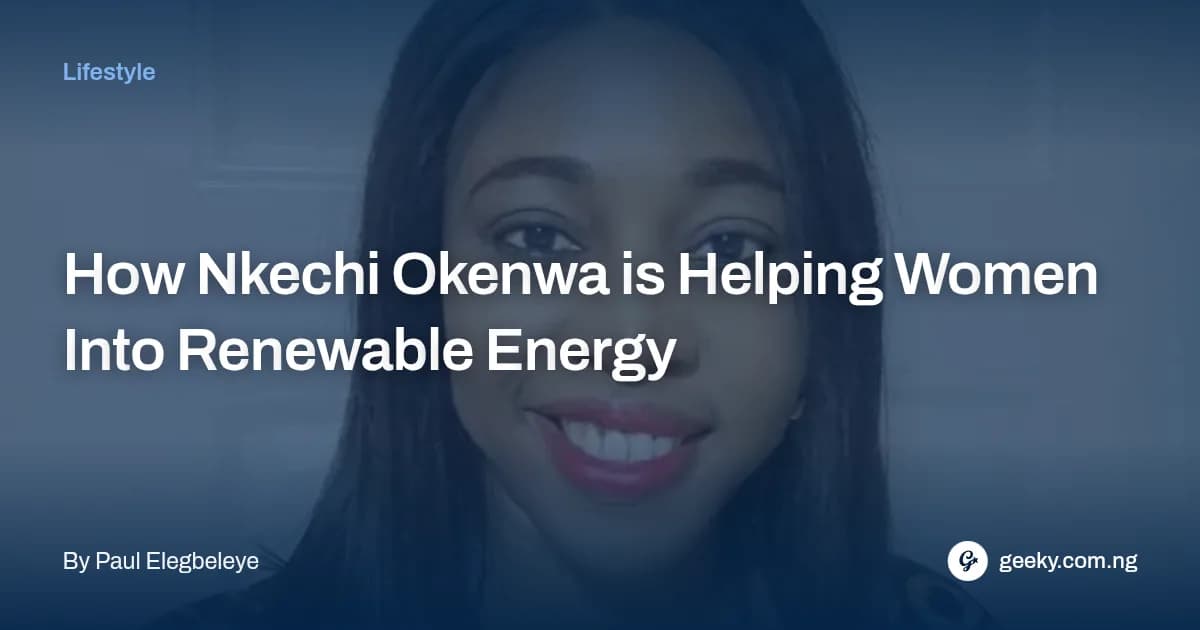
Nkechi Okenwa stepped into her office and almost out of habit, she headed for the window and drew the blinds back. Down below, the city had already got going: vehicles snaking through the traffic, traders setting out their wares, and the faint drone of generators somewhere far off.
She stopped briefly, a quiet smile on her face. To her, energy had always meant more than electricity; it stood for motion, opportunity and the ability to change lives.
Nkechi Okenwa's Journey Into Engineering
Nkechi said her fascination began long before she ever attended lectures at a university. As a child in Nigeria, she was struck by how a single flick of a switch could change the mood inside a house. She saw light flood darkened rooms, and saw how access to electricity kept communities and businesses running.
“As a teenager choosing the course of study, I had to take on electrical electronics engineering as a course,” she recalls. “Though I knew it was a male-dominated field, because I never saw any female studying that course… that’s actually how this whole journey started.”
Once she got to university, she could no longer overlook that gender gap. Her engineering lecture hall held over 220 students, yet just 12 of them were women, scarcely five per cent of the class. It was a daunting imbalance, but it also sowed the seed of a larger purpose.
“I said there has to be a way to, you know, get women included.”
Building a career in a sector dominated by men is no easy feat, and Nkechi Okenwa understands that better than most women. Reflecting on the obstacles she overcame, and the determination that carried her through, she came to believe that many other women with hopes of changing their communities could achieve the same.
She was convinced that other women could succeed too, and that conviction led her to found the organisation.
The Foundation of Her Initiatives
In the years that followed, that determination grew into two major undertakings. She is now chief executive of Energy Excell Systems and Solutions, and she has also founded the Women in Energy and Economic Sustainability Initiative (WEESI), which aims to create openings for more women across every tier of the clean and renewable power sector.
Entrepreneurship was not where her career began. After completing her studies, she took a position as a member of the technical staff at a company working in IT, handling power systems and software such as AutoCAD.
Workshops, conferences and other industry events gradually drew her closer to renewable energy, just as Nigeria was slowly starting to warm to alternative sources of power.
Afterwards, she moved into a role as a sales executive, and in time went on to found a solar installation firm of her own.
Since 2013, Energy Excell Systems and Solutions Limited has been in business. The company, a homegrown Nigerian social enterprise working in clean power, also doubles as an Engineering, Procurement, and Construction (EPC) firm. Nkechi, though, is firm that its true aim was never simply to put up solar panels, but to deliver what she describes as "productive use" energy.
The firm supplied energy-efficient equipment to households, farming communities and small businesses, among them solar-powered machines for milling rice, grating cassava and grinding grain. Such machines can raise incomes and give local economies a direct boost.
Another Discovering that Led to Another Milestone
While the business grew, Nkechi Okenwa spotted a further problem reaching well past the question of access to electricity. Women were mostly missing from discussions about energy solutions, even though they number among those hit hardest by energy poverty in their communities.
“I looked at women, and I found that most challenges in the community that we face, we face them as men and women, but I find that women sometimes are not really included in solving these challenges, so I told myself I have to find a way to get women across all levels.”
That insight led her to found WEESI in 2020. The scheme was built to open up routes for girls and women throughout the entire chain of the energy sector, from villagers at the lowest rung of the pyramid of energy access to senior leadership roles.
WEESI deliberately shaped its programmes to suit different age groups. Girls and women aged 12 to 26 could enter STEM essay-writing contests and take up scholarships and mentoring schemes, all intended to spark an early interest in engineering and renewable energy.
The programme's community work focused heavily on helping people make a living. Rural women, small-scale business owners from the community and people forced from their homes (IDPs) were taught how to install and maintain solar photovoltaic systems, and were also shown sustainable ways of cooking with clean energy.
"We have run programmes and training sessions for rural women, showing them how the waste around their communities can be converted into energy, for instance by producing charcoal briquettes from that waste.
Take a woman who threshes rice and is left with a pile of husks: she often has no idea what to do with it. So, can this rice husk be carbonised into charcoal, shaped into briquettes, and sold for a good profit?
WEESI changed the course of life for a good number of the women it reached.
Anita Manuel Came into the Scene
Among the participants was Anita Manuel, who runs her own business and also works as a contractor for a company in the petroleum and natural gas sector. She encountered WEESI when it was launched, and its aims struck a chord with her immediately.
“What drew me to the initiative is that their objectives aligned with my values and goals too, and I just wanted to expand my business,” Manuel said.
The training gave Manuel practical skills in installing solar panels, auditing energy consumption and diagnosing technical faults. More valuable still, it made her realise that her background in managing projects and in civil engineering works was relevant to the clean power industry.
Yet there was one moment she could never forget.
Manuel describes the moment a solar system she helped fit ran a whole building, freezer included, as a turning point. It showed her that what she had learnt was no mere theory but something capable of changing lives.
A Battle to Conquer for Nkechi Okenwa
Nkechi's growing prominence in renewable energy brought a quieter battle that numerous female professionals in science and technology will recognise: self-doubt and bias from the institutions surrounding them.
Despite holding an engineering degree, she regularly wondered whether anyone would really have faith in her skills in a field so dominated by men.
“My fears were: Are you sure that I’m going to do it right? Are you sure people are going to listen to me because I’m a woman?”
Again and again, the thing she had feared happened as she worked. Customers often came into her office asking for a man to oversee the engineering side, assuming that she did not have the technical knowledge.
“So many times, a man will walk into my office and want to make inquiries about our products and services, and ask me, ‘Where is the technician here? Where’s the engineer here?’”
“And I said, ‘Sir, talk to me; I am the engineer.’ Even the way he approaches me and talks to me shows that he’s still not confident.”
Rather than pulling back, Nkechi Okenwa threw herself further into her work and let the quality of her engineering answer the assumptions people made.
“With time, as I kept confronting my fears, as I kept going head-on with it, I, at least, have overcome those fears to a reasonable extent,” she says.
Conclusion: What We Can Learn From This
Even though stories like hers show how far things have come, Nigeria's clean power industry still struggles with deep structural weaknesses.
High installation costs limit how many people take up solar, while inconsistent policy and shoddy work by technicians without proper training have bred scepticism about the technology.
The International Energy Agency (IEA) reports that close to 600 million Africans still have no electricity supply, and that sub-Saharan Africa makes up the biggest portion of the world's access shortfall.
The agency adds that closing this gap on the continent will demand swift spending on mini-grids, solar installations and other decentralised renewable options, particularly for rural communities where extending the national grid is still difficult.
Also Read: Workers and parents can earn a degree online, says Olowolafe
According to Eng. Oluwafeyisayo Joy Ale, an engineer whose speciality is electrical systems and renewable energy, Nigeria is still behind both Kenya and South Africa when it comes to taking up renewable energy.
“In Nigeria, I would say that we’re not yet in full adoption,” Joy assesses. “And that’s due to a couple of factors, as compared to countries like Kenya and South Africa that have been able to get it right in certain structural development, fast-running policies, and also clear pathways and finances.”
She nonetheless holds that renewable energy is bound to shape Nigeria's future.
“Solar is not an option; it’s actually a necessity. I believe it being that way means that in the nearest future, in the coming months and years from now, it will be something that we get very competitive in the market expansion.”
To Nkechi, though, that future means far more than a growing market or the spread of technology. What matters to her is a change in who takes part in building it.
She wants girls who walk into engineering classrooms tomorrow to feel they belong from the start, and she wants a sector in which women are heard without first having to prove their place.
Each morning in her office, as she looks out of the window at the day beginning, Nkechi goes on building a future of exactly this sort, one powered by more than energy: by being inclusive, by perseverance and by what might be achieved.
Also Read: InternPulse Scholarship Offers Up to ₦475,000 in Tuition Support