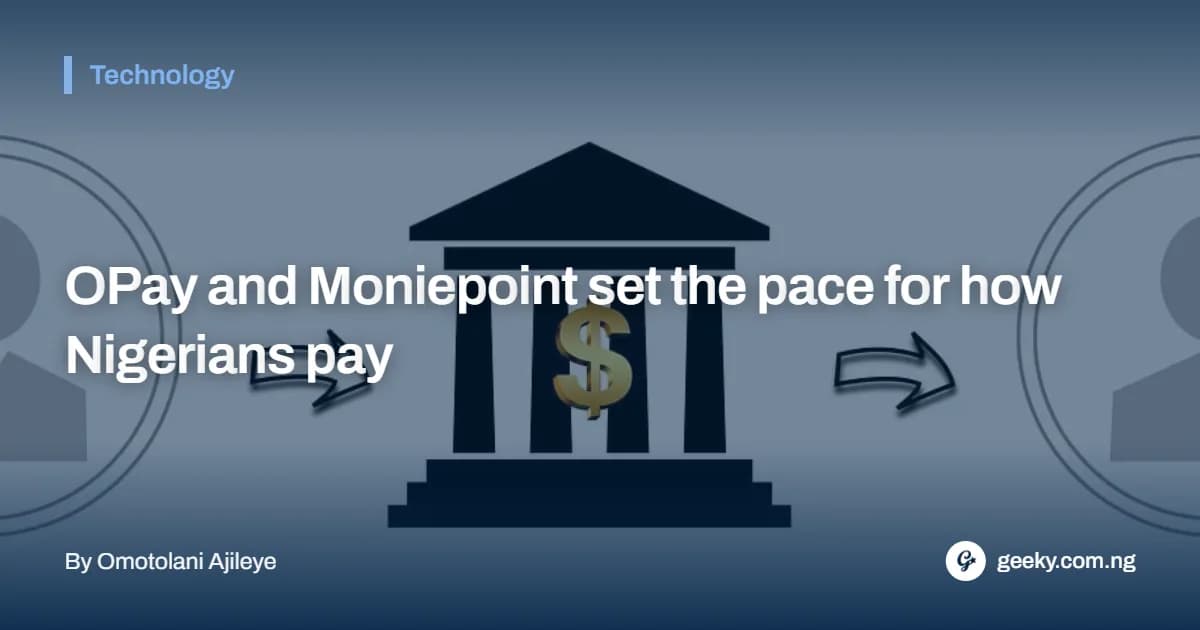
Nigeria's electronic payment channels carried transactions worth ₦1.2 thousand trillion ($880.51 billion) during 2025, with OPay and Moniepoint jointly responsible for $644.85 billion of that sum. Going by what each company has published, the two operate very different kinds of business. Riders in a Bolt vehicle can find themselves prompted to settle the fare through OPay once they arrive, while plenty of small neighbourhood shops have a Moniepoint card machine sitting next to the cash register. Each holds a microfinance bank licence, and each now stands as a byword for scale in Nigerian payments. OPay is ahead when it comes to retail transfers, and Moniepoint is ahead in merchant processing.
How OPay and Moniepoint compare on payment volumes
Throughout 2025, Nigerians sent more than ₦1.2 thousand trillion ($880.51 billion) through electronic payments. Of that, $644.85 billion was handled by Moniepoint and OPay combined, a sizeable share of the whole.
From its own disclosures, Moniepoint put through 14 billion payments over 2025, valued at ₦412 trillion ($286.85 billion, converted at ₦1,436.31/$ as of December 31, 2025). OPay put through 62.3 billion payments amounting to $358 billion. Measured by count, OPay's total was 4.45 times Moniepoint's, yet the average Moniepoint payment, at $20.49, was about 3.56 times bigger than the average OPay one of $5.75.
Moniepoint reports more than 20 million customers, a mix of businesses and individuals, whereas OPay says 50.1 million people use it actively every month.
Figures like these give a glimpse of how each company actually earns its living: which one shifts the larger sums, which one earns more from doing so, and which one holds on to a bigger share of its earnings.
A note of caution: Moniepoint operates chiefly in Nigeria, having only recently added Kenya. OPay, by contrast, also has businesses in Indonesia, Egypt and Pakistan, though most of its size still comes from Nigeria, the source of 88.1% of its 2025 income.
Reading the average transaction figures
At $20.49, the typical Moniepoint transaction is worth roughly 3.56 times the $5.75 recorded for OPay.
Moniepoint may process a larger proportion of payments to merchants, commercial transactions or other fairly big transfers, which would push its figure upwards. OPay's lower average may suggest that consumers make payments more frequently but in smaller amounts.
Neither of these is a confirmed reason; both are guesses. What the two firms have published about their transactions is too thin to pin down precisely what causes the gap.
Further measures hint at how often people turn to each platform. OPay reports that its average user launched its digital wallets around 209 times monthly, while Moniepoint reported 1.7 million swipes of its payment cards every day.
What OPay and Moniepoint actually earn
Even so, the total value of money moving through a payments platform should not be mistaken for what the company actually earns. Earnings depend on charges, commissions, loans, services for merchants and other streams of income.
In 2025, OPay disclosed that it had earned $536.25 million, whereas Moniepoint keeps its earnings figures private.
To get a sense of what Moniepoint might earn, consider how OPay's takings compare with the volume it handled: its $536.25 million in earnings amounted to roughly 0.15% of the $358 billion in transactions that passed through it.
Were Moniepoint to earn at that identical percentage, the $286.85 billion worth of payments it processed would generate something like $430.28 million in income.
Note that this is only a hypothetical exercise and not a projection of what Moniepoint truly earns, since the two firms differ in their mix of transactions, how they charge fees, and where their income comes from.
Moniepoint (Merchant Focus)
OPay handles 4.45 times the number of transactions that Moniepoint does, reflecting the rapid, frequent nature of ordinary consumer spending.
The Earnings Disclosure Gap
A look at how OPay's transaction volume of $358 billion turns into real revenue, set against Moniepoint, whose financial results have not been made public.
Handling large sums of money does not guarantee profit. For OPay, every unit of transaction value brings in 0.15% as income, and its lending business provides a heavy subsidy to that figure. For Moniepoint, the value of transactions on its own cannot tell us what income it earns.
The Rising Credit Risk at OPay
Provisions set aside for anticipated defaults on credit, measured against the revenue earned from loan financing.
Provision for Losses: $121.3M (46.6%)
The company lent out $938.3M to 4.6M distinct individuals who borrowed.
Business loans paid out have passed ₦1 trillion.
Where the CBN draws the line
The CBN set out fresh rules on market structure in June 2026, aimed at curbing dominance across an entire ecosystem.
Note: Provisions for anticipated credit losses are accounting projections of shortfalls that could emerge in future; they are not defaults that have actually occurred in cash terms. The 20.66% figure for OPay reflects its profit margin before tax rather than net profit. The CBN's thresholds mark regulatory limits and do not confirm that either company has breached them.
Lending is turning into one more source of income
Both OPay and Moniepoint expanded their lending during 2025, drawing on the transaction activity that flows through their platforms as the basis for extending loans.
Across Nigeria, OPay issued fresh loans worth $938.3 million, a jump of 284.71% over the space of a year.
Moniepoint, for its part, reported lending more than ₦1 trillion ($696.23 million) to micro and small enterprises in 2025. Back in 2023, the figure for its working capital loans stood at $71 million.
Moniepoint draws on its relationships with merchants when it offers credit to businesses. Through its terminals, it can see the volume a business handles, the regularity of the payments coming in, and the way that activity shifts as time passes.
That gives the lender another way to judge a business that might lack formal financial statements or enough collateral.
Moniepoint aims its loans at merchants such as wholesale distributors, restaurants, supermarkets, and provision stores. The company says that, after getting credit, the businesses that borrowed from it saw their transaction value rise by 36% on average.
OPay's lending business enjoys wider reach among consumers. Its wallet connects it to millions of people who are already making frequent transactions on the platform. During 2025, the number of unique borrowers it had in Nigeria each quarter climbed to 4.6 million, more than double the 2.1 million from the previous year.
OPay has aimed most of its lending at consumers, but it has also started moving into merchant lending, a service it only recently launched and now wants to grow. According to the company, loans for merchants usually come with bigger limits, cheaper rates and longer repayment periods that fit the cash flow cycles of a business.
In effect, each firm is converting payment records into insight about creditworthiness, though they point that insight at different groups of customers.
Credit risk at OPay and Moniepoint
Lending already makes a major contribution to OPay's revenue. Loan financing brought in $260.3 million in 2025, compared with $71.5 million in 2024, a rise of roughly 264.1%, and it made up 48.5% of the company's total revenue.
Lending is not without danger, however. OPay set aside $121.3 million in 2025 as a provision against anticipated loan losses, against $24.8 million in 2024, which is almost five times the earlier figure.
The amount set aside came to roughly 46.6% of the revenue earned from its loan financing. That is not equivalent to losses actually realised on loans, yet it points to the rising credit risk that comes with a bigger lending operation.
Moniepoint has not disclosed the financial workings of its lending arm, which makes it difficult to judge what income the credit unit generates or what it costs the firm to handle defaults. The company insists that its NPLs (non-performing loans), meaning facilities where the repayment of capital or interest has gone unpaid for 90 days or longer, are minimal.
The Central Bank of Nigeria (CBN) reports that NPLs climbed to 7% in 2025.
Profits
Processing billions of payments and bringing in hundreds of millions of dollars is one accomplishment. Turning all that business into earnings is another matter entirely.
Running at scale is expensive for payment firms, which have to pay for their tech systems, the handling of payments, winning new customers, salaries, fraud controls and regulatory compliance, as well as, more and more, the cost of lending.
In 2025, OPay earned $536.25 million in turnover and closed the year with $110.79 million in profit before tax. That works out at a net earnings margin of about 20.66%, meaning it kept roughly 21 cents of profit from every dollar of income.
Moniepoint keeps its revenue and profit undisclosed. Even so, if one takes OPay's ratio of income to the value of transactions, along with its net profit margin, and applies both to the transaction value Moniepoint handles, the result is a profit figure of $88.89 million. Readers should treat this as an indicative estimate rather than an official earnings disclosure, since it rests on the assumption that the two firms earn similar revenue yields and run similar cost structures.
The figures suggest OPay has developed a payments business that relies on customers transacting very frequently, while lending provides a growing share of what it earns. Lending products made up nearly 50 per cent of its 2025 income. Yet a growing number of users are complaining about steep interest charges, imposed to fund provisions against credit losses, which suggests this move into lending brings extra risk.
Moniepoint, by contrast, has put together a payments network aimed at merchants, which gives it a view of commercial transaction records and openings to offer working capital. Its larger typical value per transaction and expanding loan book signal a different way of making money: forging deeper financial ties with merchants instead of depending chiefly on how often consumers make everyday payments.
How a ₦1,000 payment moves between OPay and Moniepoint
Picture a shopper in a retail outlet who buys something. They launch their mobile money app to send the money across, then tap the button that starts the payment.
That instant transfer passed through a layered digital architecture. Select the points below to reveal its path.
2. Switch for Payments (NIBSS)
Customer’s Issuing Institution
A customer begins the payment from a banking app or from an e-wallet such as OPay. The issuing institution confirms there are enough funds, deducts the ₦1,000, and bundles the payment details for onward transmission across the broader network.
Worth noting: when a customer pays from an OPay wallet by scanning an OPay POS, the whole transaction may be settled within OPay's own internal ledger, never touching the national switch at all.
The Fight Over Each Transaction
Fintech firms vie for opposite sides of one and the same payment, and the boundary separating those who control the consumer from those who control the merchant is growing hazier.
Consumer & Merchant Play
OPay assembled a huge user base by concentrating on the consumer wallet at the paying end, yet it is also pushing hard to roll out POS terminals to win the receiving end too.
Cross-selling opportunities: merchant settlement, savings, and loans for consumers.
Merchant & Consumer Play
Moniepoint rose to prominence by concentrating on the merchant end of payments, working as an acquirer, and it is now promoting banking apps aimed at consumers to win individual customers too.
More products to sell on: loans to fund day-to-day operations, cards for business spending, and banking for individuals.
A ₦1,000 payment from a customer does not end up as revenue for any one payment firm; it gets divided into tiny fees.
For carrying out the transfer, the acquirer takes a fee, which is either capped or set at a flat rate.
That small fee is then split between the acquirer and the national routing switch.
A single ₦1,000 payment earns only a few kobo. Multiply that across millions of payments, though, and the result is a body of data large enough to underwrite huge loan portfolios.
- Purchase frequency
- Average basket size
- Cash flow consistency
Because money is constantly flowing into customers' accounts, fintechs can treat that activity as evidence of earnings and release loans on the spot.