Nigerian women in AI feature in report urging local data

A new report profiles Nigerian women in AI who are building health, education and farming tools around the country's own languages and needs. Techeconomy reports that the document, titled Make This Matter: AI, Equity & Nigeria's Choice, was published in October 2026 and covers work across healthcare, education, agriculture and policy.
It matters because the report argues that artificial intelligence trained mostly on foreign data serves Nigerians poorly, and it sets out what should change.
What the report says and who made it
The Nigeria edition was developed by the Goalkeepers community in partnership with Gatefield, according to Techeconomy. Premium Times reported on 7 November 2026 that the two groups launched it, calling for AI development in Nigeria to prioritise local needs, indigenous data and equitable access to technology.
The report is a Nigerian-focused synthesis of the global 2026 Goalkeepers Report and can be read online at makethismatter.ng. It was launched after an initial engagement with technology ecosystem leaders at the Moonshot event in Lagos, according to a republished Premium Times account.
It names three priorities for improving access to AI:
- investment in Nigerian language datasets;
- locally governed data;
- better access to skills, computing resources and connectivity.
The gaps behind the argument
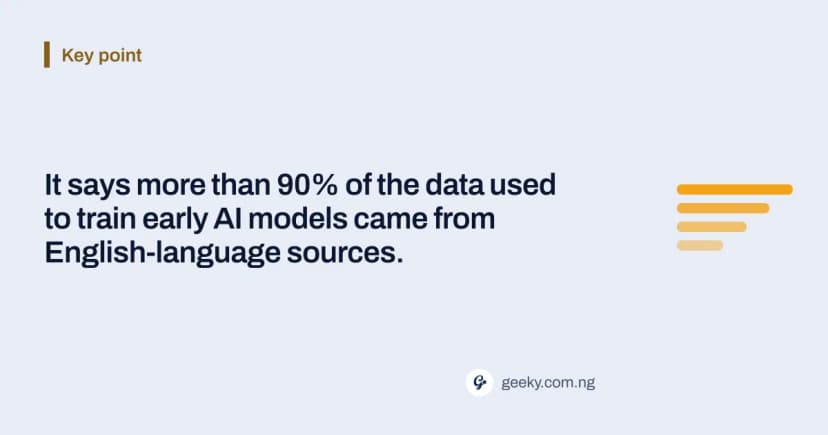
The numbers in the report explain the urgency. It says more than 90% of the data used to train early AI models came from English-language sources. It also shows error rates above 60% for Yoruba speech recognition, compared with below 6% for English.
The health figures are equally stark. Nigeria has about one doctor for every 2,500 people, compared with one for every 200 in high-income countries. The report presents AI built for local conditions as one way to ease that pressure, not a substitute for health workers.
The Nigerian women in AI behind the work
The women profiled are mostly working on practical tools. Dr Nneka Mobisson's company, mDoc, built Kem AI, a health assistant that gives guidance in English and Nigerian Pidgin. Jennie Nwokoye's Clafiya platform, which includes the ChiChi AI care assistant, has reported a 40% reduction in time-to-care.
Odunayo Sanya of MTN Nigeria Foundation leads a $25 million partnership with the Gates Foundation. It deploys AI-enabled ultrasound devices and digital tools across 500 healthcare facilities.
Kemisola Bolarinwa's Nextwear Technologies has developed a smart bra with portable ultrasound. The report says it can detect potential tumours within 30 minutes. That is the report's claim as relayed by Techeconomy, and the coverage does not say the device has been independently verified.
Education, data and funding
In education, Dr Success Ojo's GMind AI supports more than 15 languages. It is working with the Teachers Registration Council of Nigeria on a programme that, in the report's words, "targets 1.5 million licensed teachers with mobile-friendly, offline-first technology."
Tejumade Afonja has helped more than 1,000 learners through free AI training. She also helped develop two datasets: CHOWNET, which focuses on Nigerian food, and SautiDB, which covers Nigerian-accented speech. Datasets of this kind address the language gap the report describes.
The global report and Nigeria's thin presence in it
Capital FM Africa reported that it came with a Gates Foundation plan to spend at least US$1 billion over two years to expand access to AI.
Yet Nigeria barely features in that parent document. An analysis by The Digger found that, in the 72-page report, "the country is mentioned by name only twice—both times as data footnotes." Read against that, the Nigerian synthesis works partly as a correction, putting local people and local problems in front.
What happens next
The report is a call to act, not a funding announcement, and the sources do not describe any new government commitment tied to it. The three priorities give developers, funders and policymakers a checklist: build language datasets, keep data under local governance, and widen access to skills, computing and connectivity.
The initial engagement at the Moonshot event in Lagos suggests the authors intend to keep talking to the technology ecosystem. Whether that conversation produces investment in Nigerian language data will determine if the figures on Yoruba speech recognition start to fall.