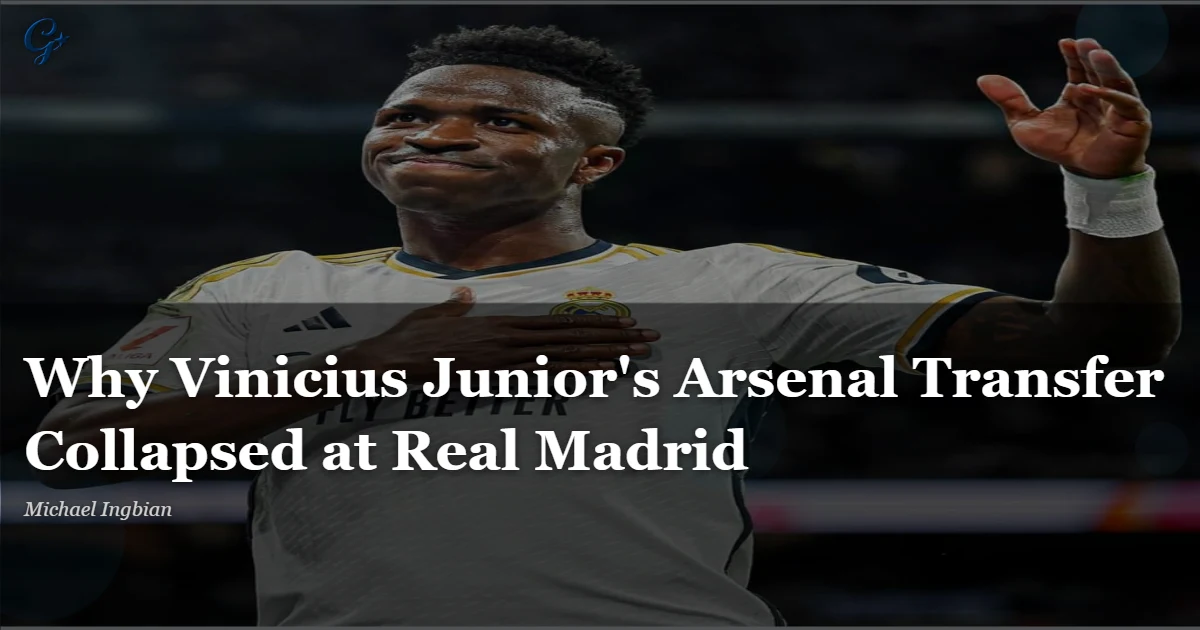
Photo: Herbert De Paz / Wikimedia Commons, CC BY-SA 4.0
Vinicius Junior has ended months of transfer speculation by signing a new six-year contract with Real Madrid.
This closed the door on what would have been Arsenal’s biggest signing in club history. Real Madrid confirmed the deal on Thursday evening, tying the Brazilian winger to the Santiago Bernabeu until 30 June 2032.
The breakthrough came just 24 hours after a decisive meeting between Vinicius’ representatives and Madrid’s hierarchy, ending a standoff that had dragged on for more than a year.
So how did Arsenal go from genuine contenders to watching from the sidelines? The answer lies almost entirely in money. Vinicius had been earning around €17.5 million a year and was reportedly seeking a new package worth close to €30 million annually.
Real Madrid initially offered far less, and that gap kept talks stuck for months. However, everything changed on Wednesday, when club director general Jose Angel Sanchez and chief scout Juni Calafat sat down with Vinicius’ agents at the Valdebebas training ground and tabled a significantly improved offer.
For Arsenal, the collapse stings because the opportunity looked real. The Premier League champions had reportedly secured approval from their owners to pursue Vinicius if his Madrid contract talks broke down, and they had already completed a £75 million deal for his Brazil teammate Bruno Guimaraes from Newcastle.
Consequently, the timing made a swoop for Vinicius feel like more than just transfer gossip. Instead, it evaporated within a single news cycle.
Table of Contents
What Changed the Deal at the Last Minute
Real Madrid’s turnaround was remarkably swift once talks resumed. Sources close to the negotiations described the mood shifting almost overnight, moving from resignation to genuine optimism inside a day.
- An improved financial package: Madrid moved off their previous offer of roughly €22 million a year to something much closer to Vinicius’ original demands.
- Jose Mourinho’s influence: The returning head coach reportedly pushed personally for the club to keep Vinicius, a factor several reports credited as decisive.
- Performance leverage: Vinicius returned from a strong World Cup with Brazil, where he scored four goals in five appearances, strengthening his negotiating hand.
- A clear statement of importance: Real Madrid’s official announcement called him “one of the most important players” in one of the club’s most successful eras, a public commitment that matched the financial one.
Vinicius wasted no time celebrating either. “Eight years at the Bernabeu are too few,” he wrote on Instagram. “Six more years, and forever!” That is not the language of a player who felt like an afterthought, and it explains why Arsenal’s chances collapsed so quickly once Madrid finally moved.
Also Read:Newcastle United: Rebuilding the Depleted Squad After Summer Exodus
The Numbers Behind Vinicius’ Real Madrid Legacy
Why did Real Madrid fight so hard to keep him? The statistics make the case clearly. Since joining from Flamengo in 2018, Vinicius has made 375 appearances, scored 128 goals and provided 100 assists, numbers that place him among the club’s most productive attackers of the modern era. He has also won 14 trophies at the Bernabeu, including two Champions League titles and three La Liga crowns.
Despite netting 22 goals in all competitions last season, Madrid still finished the campaign without a major trophy, ending runners-up in La Liga behind Barcelona. That trophy drought partly explains why some insiders had grown genuinely unsure whether Vinicius would stay. Nevertheless, his underlying numbers, including 21 goal involvements in league football alone, left little doubt about his continued value to the project.
What This Means for Arsenal Now
Arsenal must pivot quickly. Mikel Arteta’s side had identified Vinicius as their marquee attacking target, and no readily available alternative offers quite the same ceiling. Paris Saint-Germain’s Bradley Barcola remains on the market but would cost upwards of £145 million, while Athletic Club’s Nico Williams carries an injury history that gives suitors pause. Everton’s Iliman Ndiaye, fresh off a season that troubled even Manchester City’s defence, represents a cheaper route with real upside rather than the guaranteed superstar quality Vinicius would have brought.
For Nigerian football fans who followed Vinicius’ World Cup exploits closely, his decision confirms what many suspected all along: elite players rarely leave a project mid-peak unless the numbers genuinely fail to add up. Real Madrid made sure they never had to find out. As pre-season continues under Mourinho, all attention now turns to whether Vinicius can finally deliver Madrid’s first trophy since his new deal was signed and whether Arsenal can find a replacement plan good enough to sustain their title defence.
Catch up on: EPL Matchweek 37: Arsenal And Manchester City Title Race