
NOUN Matriculates Over Two Myriads of Students, Declares ODL the Future of Higher Education
The National Open University of Nigeria (NOUN) has matriculated 23,885 newly admitted students, reinforcing the growing importance of Open and Distance Learning (ODL) in Nigeria’s higher education system.
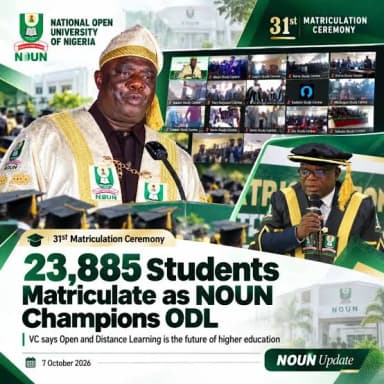
The students were formally inducted into various academic programmes during the university’s 31st Matriculation Ceremony held virtually across NOUN study centres nationwide on October 7, 2026. The ceremony was led by the Vice-Chancellor, Prof. Uduma Oji Uduma, who described ODL as the future of higher education.
The latest admission comprises students at different levels of academic study. Of the 23,885 matriculating students, 17,471 are undergraduates, while 1,967 are enrolled for Postgraduate Diplomas. Another 4,333 students are pursuing master's degrees, with 10 admitted into MPhil/PhD programmes and 104 into PhD programmes.
ODL Moves Beyond Being an Alternative
Speaking at the ceremony, Prof. Uduma argued that the growing adoption of ODL by conventional universities demonstrates a major shift in the way higher education is being delivered.
According to him, universities that traditionally relied on conventional classroom-based education are increasingly establishing distance-learning centres and adopting dual-mode systems that combine face-to-face and online learning. He said this development validates the vision behind NOUN's establishment and highlights the relevance of flexible education in the modern university system.
For decades, ODL has provided an avenue for people who might otherwise struggle to participate in traditional university education. Workers, parents, business owners and people living far from university campuses can pursue academic programmes without completely abandoning their existing responsibilities.
This flexibility is becoming increasingly important as students seek education that can fit around work and other commitments. Prof. Uduma noted that more young Nigerians are now deliberately choosing NOUN because of its flexible structure, technological orientation and ability to accommodate different lifestyles.
Technology Is Changing the University Experience
The growth of ODL also reflects the changing role of technology in education. Learning Management Systems, virtual classrooms, digital course materials, online assessments and electronic communication have made it possible for students to participate in university education without being physically present on campus every day.
NOUN's model is built around this flexibility. The Vice-Chancellor encouraged the new students to actively participate in facilitation classes, complete their Tutor-Marked Assignments (TMAs), use the university's Learning Management System (LMS) and seek support when they encounter difficulties.
However, the expansion of digital learning also places greater responsibility on students. Unlike traditional classroom environments where students may interact with lecturers and classmates every day, distance learning requires a high level of self-discipline, time management and independent study.
Prof. Uduma therefore urged the matriculating students to see university education as more than a pathway to obtaining certificates. He encouraged them to develop knowledge, competence, critical thinking, problem-solving abilities, character and integrity.
NOUN's Experience Could Become a Major Advantage
As more Nigerian universities enter the ODL space, NOUN faces greater competition. The Vice-Chancellor, however, said the development should not be viewed as a threat.
Instead, he described the increasing adoption of ODL by conventional universities as an affirmation of NOUN's pioneering role. With decades of experience in distance education, the university has developed systems for supporting learners across different geographical and social circumstances.
The challenge now is to ensure that expansion in access is matched by quality. More students participating in ODL will mean greater demand for reliable digital platforms, effective student support, responsive academic staff, quality course materials and dependable communication systems.
NOUN says it is already strengthening its learner-support structures through improved counselling, information and call-support services, as well as the Student Affairs Deanery, which focuses on student welfare and engagement.
What the 23,885 Students Represent
The matriculation of 23,885 students is more than a university admission statistic. It reflects a growing demand for higher education that can adapt to the realities of modern Nigerian life.
For many learners, the traditional model of relocating to a university town, attending lectures at fixed times and following a rigid academic schedule is increasingly difficult. ODL provides another pathway, one that allows students to combine education with employment, family responsibilities and other commitments.
The rise of ODL doesn't necessarily mean conventional universities will disappear. Rather, it suggests that the distinction between traditional and online education may continue to narrow. As more universities integrate digital learning into their programmes, flexibility could become a standard feature of higher education rather than a specialised offering.
Final Thoughts
For the 23,885 new NOUN students, therefore, their matriculation comes at a significant moment. They are entering a university system that is increasingly shaped by technology, flexibility and learner autonomy.
NOUN's message is clear: the future of higher education may not be defined by where students sit to learn, but by how effectively institutions can provide quality education regardless of where those students are.
Read more: FG Announces Plan To Establish National Cybersecurity Council